





Wabtec FLXdrive locomotive
(All images: Wabtec)
Redefining the railroads
Trains have long been associated with grease and grime, but could Wabtec’s battery-electric solution revolutionise the railroads? Will Gray reports
Railroads play a vital role in the transportation of both goods and people all around the world. They account for 7% of all global freight movements – rising to almost 40% for solely land-based movement – and provide essential routes of travel for billions of passengers every year. However, although they represent an exceptionally energy-efficient way of moving, the distances and weights involved also make them extremely difficult to electrify.
Diesel-electric trains have long been the major workhorses on the tracks and while electric trains powered by overhead cables have replaced them on some routes, the infrastructure costs involved make electrification over longer distances highly prohibitive. As a result, more than 60% of the rail network in the UK remains non-electrified; however, in China – where 51.75 billion tonnes of freight was transported by rail in 2024 – around 25% of the network is non-electrified. The US has even more reliance on such technology, with a massive fleet of 28,000 diesel-electric locomotives in operation and 124,000 miles of US Class I railroad in heavy use.
Traditional diesel-electric machines use their fossil-fuelled engines to generate electricity, which then powers direct-drive motors. They are a major contributor to the 250 million tonnes of CO2 emitted per year on the railroads, according to the International Energy Association. However, until now, there has been no other solution that can deliver the power and performance required to match them.
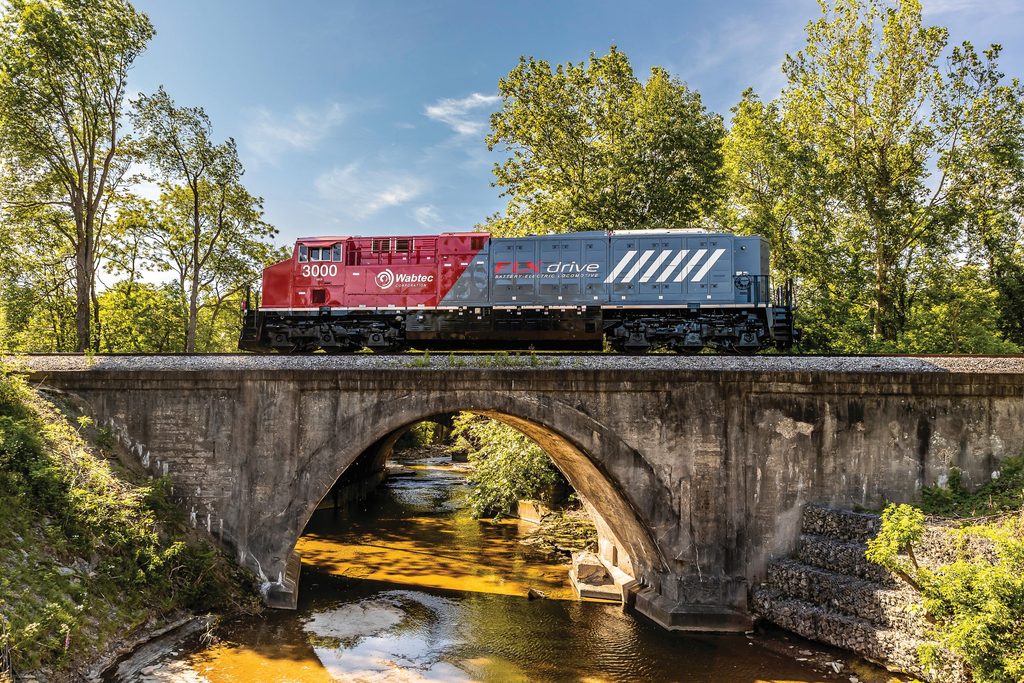
Wabtec (Westinghouse Air Brake Technologies Corporation) has long been a world leader in diesel-electric locomotive development, pioneering methods to make them more efficient. In 2001, they introduced regenerative braking to some of their locomotives – creating the first ever battery-diesel-electric hybrid machine – and over the following 25 years, they have evolved that initial concept into the world’s first ever fully 100% battery-electric heavy-haul locomotive, the FLXdrive.
If that sounds like a long time in development, that is because – as with most electrification challenges – it was only achievable once all the different pieces aligned. Jim Bunce spent seven years leading development of the battery packs and management system and is now systems engineering technology lead. He explains: “The goal was to design a battery-electric vehicle in such a way that it would provide the same power capability as a traditional diesel-electric locomotive – and we have now achieved that.
“The traction and propulsion systems are nearly identical in the diesel-electric and the FLXdrive, so it essentially provides the same 4500 bhp of capability. The battery-electric system can’t operate alone at the same ranges as a diesel-electric locomotive, but it can provide significant efficiency improvements over long distances when used in combination with other vehicles. The FLXdrive system is scalable and modular and can suit a variety of applications, including line haul, heavy haul, freight, yard movements and hybrid work operations.”
Scalability matters because the duty cycle matters but the battery-electric system is not currently capable of delivering a stand-alone system. The objective is not to eliminate the diesel engine in every circumstance, but to use battery power where it creates the greatest operational and environmental advantage. A locomotive working in a subway maintenance environment, for example, faces a very different problem from a line-haul freight locomotive travelling long distances – so different versions have been developed for different use-cases.
The Switcher is ideal for yard use, building up trains to carry freight from location to location, and those vehicles can typically contain fewer battery packs because they stay close to a charging system. The hybrid version, designed for maintenance work in larger city subway systems, retains a diesel engine but can switch to full battery operation inside tunnels. It is scaled to allow enough capacity for the engine to be shut down where fumes and emissions would otherwise affect the working environment.
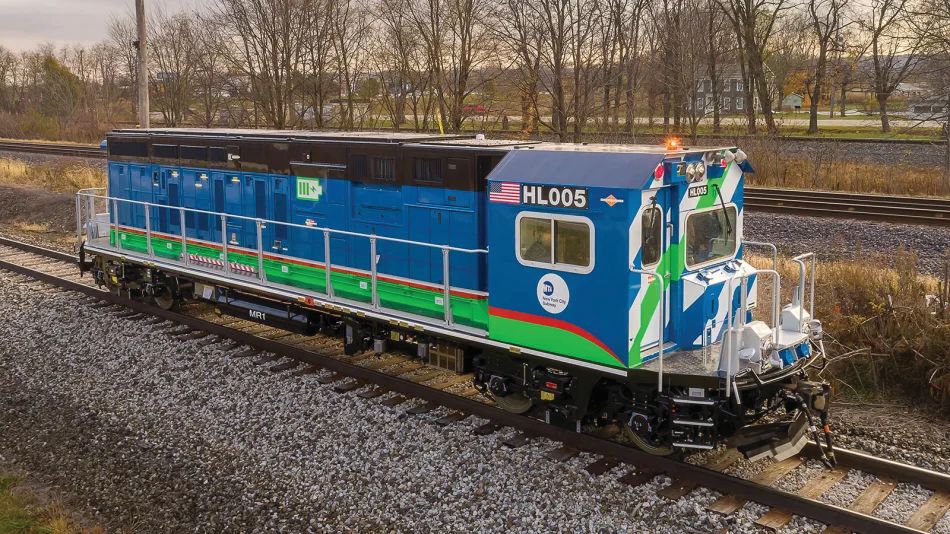
In the case of long-haul freight locomotives, the FLXdrive is fitted with the maximum number of battery packs and designed to work as part of a fleet, complimenting the existing diesel-electric locomotives by operating alongside them to effectively create a hybrid solution. “A long-distance freight train in the US is typically about one and a half miles long and it has three or four locomotives in lead operation,” explains Bunce. “We replace one of those diesel-electrics with a FLXdrive, so the locomotives work in concert together as part of a hybrid consist. The long ranges are still supported by the diesel-electric fleet with fuel efficiencies improved by the battery-electric.”
Proving the concept
The first prototype of the FLXdrive design was released for testing in 2021. It was fitted with 18,000 air-cooled lithium-ion battery cells providing a total of 2.4 MWh of battery storage and it weighed in at 430,000 pounds. The focus was on longer-range transportation and, rather than running around loops on a test track, the locomotive was trialled in real-life roadway service with BNSF Railway, the largest railroad in the US.
Over the three-month trial period in California’s San Joaquin Valley – a territory surrounded by mountains with hilly terrain that maximised the use of regenerative braking – it completed 13,320 miles working as part of a rail consist alongside other diesel-electric locomotives. Achieving an 11% reduction in fuel use (equivalent to more than 6200 gallons of diesel) and a reduction in CO2 emissions of approximately 69 tons, it proved the initial concept but also highlighted one major potential for improvement.
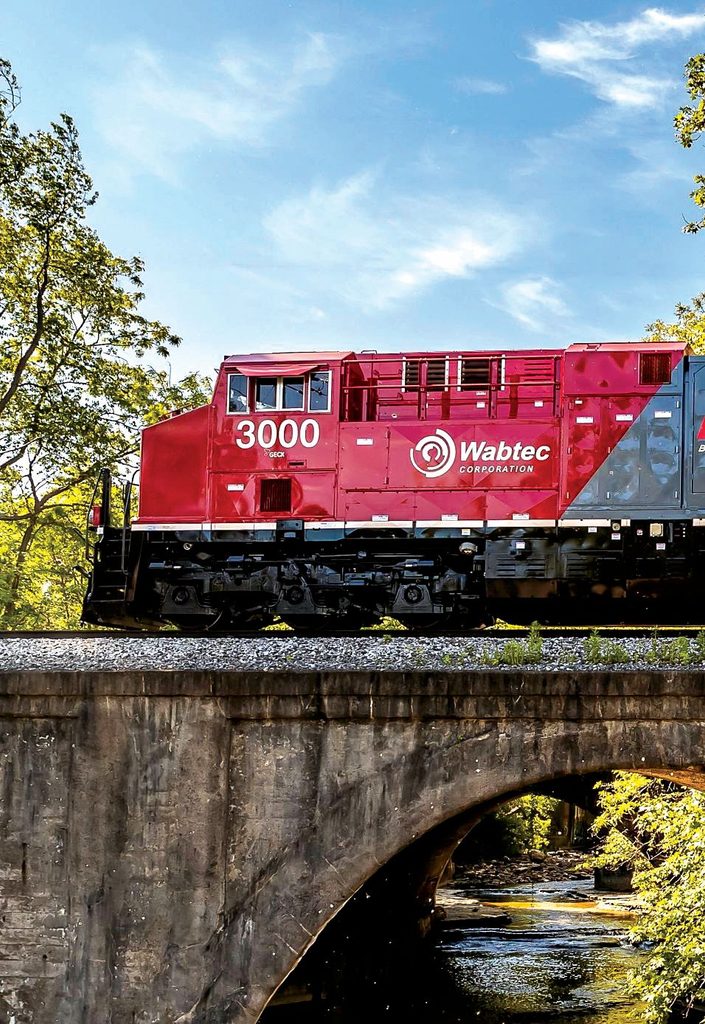
The second iteration, released for customer demonstration service in Australia a couple of years ago, had a significant upgrade, with the original air-cooled battery system replaced by a water-cooled design. The improved efficiency of water cooling enabled a significant increase in battery density, meaning the battery capacity of the vehicle could be tripled, increasing it to a total of 7 MWh. The company estimates that, depending on the route and customer operations, this has the potential to reduce fuel consumption and emissions by up to 30%.
“In an air-cooled system, you actually need a significant amount of space to move the air required to cool the batteries,” says Bunce. “By going to a liquid-cooled system, we can use up every inch of available space on the locomotive. Alongside this development, the field trials have been significant in enabling our customers to evaluate new technology in their applications – understanding what servicing requirements and infrastructure needs they may have – as well as enabling us to demonstrate a safe and serviceable system that maintains performance capability with significant fuel saving and emissions advantages.”
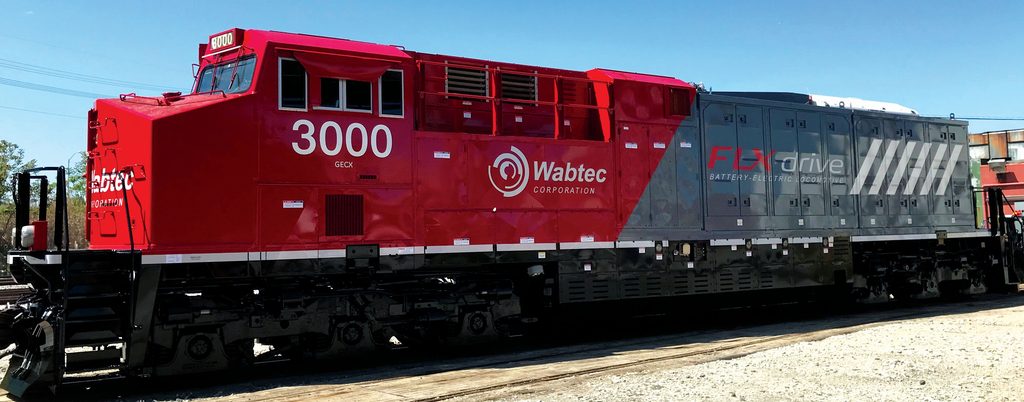
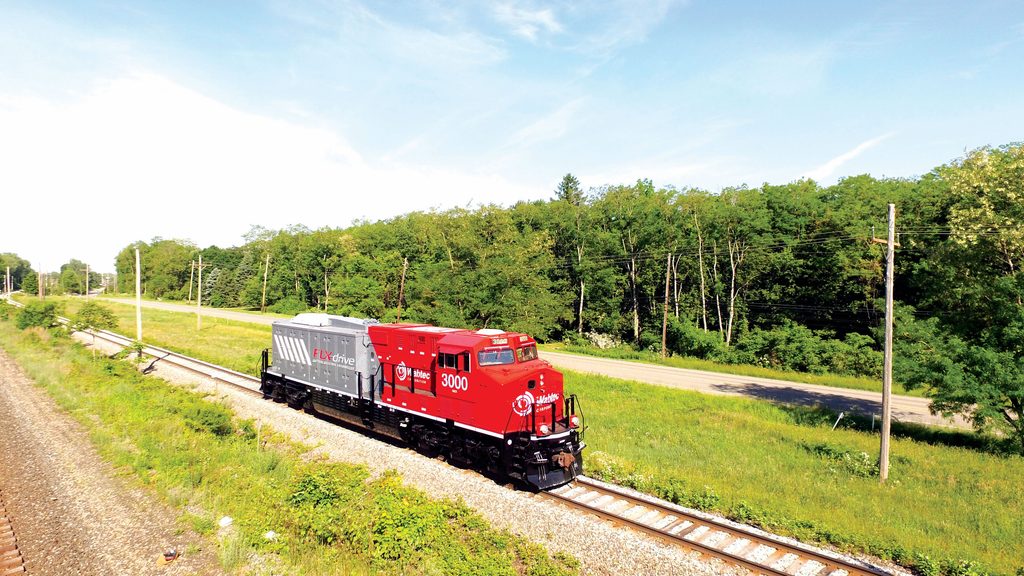
The FLXdrive locomotive bears a strong resemblance to the traditional diesel-electric engine, with the same external shell and cab layout – albeit with a significantly different information feed coming in to the driver. The contrast becomes more obvious beyond the cab, where the diesel engine, the alternator that would normally convert mechanical engine output into electrical power and the large cooling system associated with the diesel installation are all absent. In their place are battery packs, together with a thermal management system designed to keep the packs within their intended operating temperature range.
The difference is also felt in the driving experience, with the reduction in engine-generated vibration dramatically improving the ride quality onboard the vehicle. “If you were to walk into the operator’s cab where the crew works today on a diesel-electric locomotive versus a FLXdrive locomotive, they’re essentially identical – but the lack of the diesel engine actually has a significant impact on the amount of noise and vibration of the vehicle,” says Bunce.
“One of the largest vibration sources on the locomotive is that diesel engine, and although our diesel-electric locomotives have a soft mounting system so that operators don’t feel that vibration, it is still significant. The weight of the locomotive is probably the largest contributor to the rail wear, and the overall weight doesn’t change much, but there is a significant impact on operator ride quality. It’s much nicer to drive!”
Electricifation at scale
At the wheels, the FLXdrive relies on familiar AC traction technology. Most versions use six individual General Electric GEB13 AC high-torque traction motors mounted on the trucks (bogeys), each of which delivers roughly 1000 horsepower. One motor drives each axle, and each axle is controlled individually through its own advanced variable-frequency liquid-cooled inverter. This creates a degree of resilience because a problem affecting one motor or inverter does not necessarily prevent power being directed to the remaining motors.
The electrical architecture centres on a high-voltage DC bus and the system operates nominally at 1350 V DC, with the inverter systems converting that electrical supply into AC power for the induction motors. This high-voltage environment – most typical modern automotive platforms are around 800 V – meant that developing the battery-electric locomotive involved more than simply adding automotive-style batteries to an existing locomotive platform. Instead, the company had to develop bespoke battery packs, configured to operate within the heavy freight propulsion system.
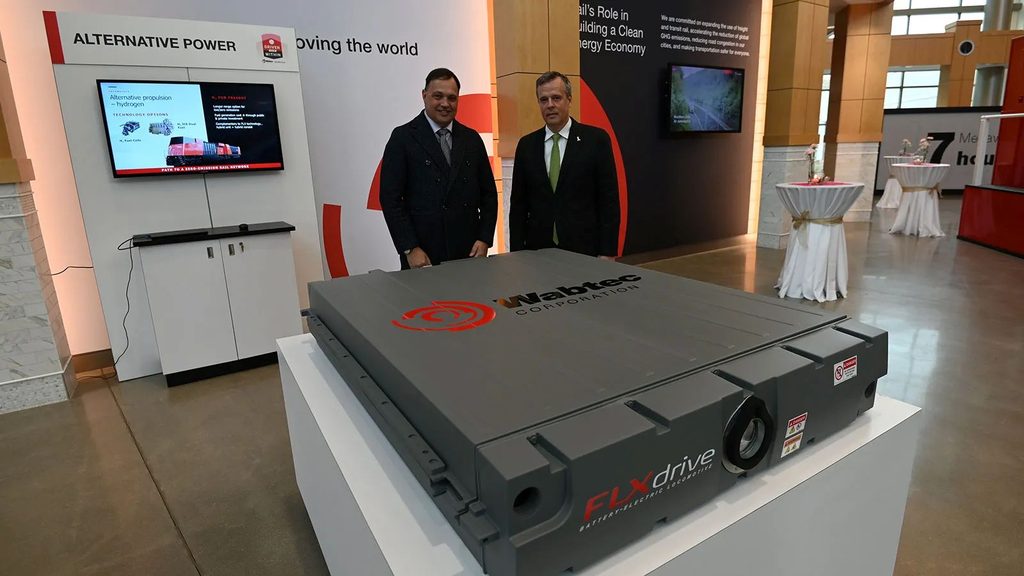
This is electrification on a different scale. Each battery pack is roughly the size of a queen-size mattress – about 64 in long, 48 in wide and 10 in tall – and with the removal of the original components, there is space for these giant components to fill up to two-thirds of the locomotive. “We currently have up to 72 battery packs onboard,” says Bunce. “That’s 72 Teslas-worth of battery packs on one vehicle!”
Wabtec designs and manufactures the battery packs completely in-house at its US-based facility in Erie, Pennsylvania. It uses battery cells from a third-party supplier, with capability of accommodating a variety of cell chemistries including NMC (Nickel Manganese Cobalt), LFP (Lithium Iron Phosphate) and LTO (Lithium Titanate Oxide). Each battery pack has 504 individual battery cells, designed for 350 V per pack at top of charge, and these are arranged such that four together can nominally operate at 1400 V, just above the required 1350 V.
“The battery cells we use are designed for automotive applications because they are the highest consumers of individual battery cells and so they are the most readily available,” says Bunce. “The form factor we have selected is available at multiple suppliers, in multiple chemistries and in various capacities, and they all have multi-generational product plans. So, as capacities and chemistries improve, we should feel the advantages of those changes.
“All our batteries are built up electrically in strings and banks, so we can isolate individual battery banks as needed. We feed all of that power into a common DC bus, then individual inverter stacks take energy and power from that DC bus to individually control each axle. We size and scale the batteries based on the application – our larger heavy-haul freight system has as many as 72 battery packs, while our smaller Switcher set-up has 28 – and in some cases, we leave space to allow us to modify those units in the future if there is demand for greater range.”
Individual axle control gives in-built resilience to any individual motor or inverter system having a failure, with power simply moved to other motors without any performance impact on the locomotive. It also allows the system to manage slip between motors, and each traction motor also has its own independent gearing – built into the axle motor assembly, as opposed to having gearing in the overall drive train – to maximise traction.
The hefty battery system adds significant weight to the locomotive, but in this case – unlike many other electric vehicles where battery weight is an unavoidable penalty that engineers work constantly to reduce – that added mass is a benefit because it contributes to traction between the wheels and rails. Diesel-electrics actually add ballast to build up the weight, but the battery system means less of that is needed to put power effectively into the rail, and the vehicle weight is maximised within the limits imposed by the rail bed and ground infrastructure.
Battery safety and performance
Given the high voltages involved, operational safety is a priority, and the ability to isolate parts of the electrical system before working to replace battery packs or interact with inverter equipment was a vital part of the design criteria. The FLXdrive incorporates a LOTO (‘Lock Out – Tag Out’) approach – an established practice for the rail industry – which ensures that the system can be isolated and physically locked to prevent any other person restoring power when work is being done. Additional security is provided by the use of a trapped-key system, which requires maintenance teams to perform a sequence of actions to progressively isolate and decouple the equipment.
“Safety was a driving focus in the design of the locomotive,” explains Bunce. “We spent a considerable amount of time and effort evaluating various use-cases from different service operations and understanding not only how the vehicle could be utilised to perform as a locomotive, but also how maintainers will service the equipment, how they will replace a pack and how they will interact with other parts of the vehicle.”
The safety case also extends into the requirement for physical protection from the tough conditions typically experienced by heavy rail vehicles, which operate at speed and have the potential to be involved in serious accidents. Wabtec has worked directly with individual customers to evaluate emergency-response scenarios, combining their knowledge of the battery technology with the operators’ understanding of their specific railway environment, and Bunce adds: “We’ve designed the pack to be robust, with validation through a significant amount of drop, shock and vibration testing.”
Maintaining the battery at a suitable operating temperature is also a vital part of the safety case, as well as being a major factor in achieving the best performance. To optimise performance in both cases, Wabtec has spent significant time developing its own bespoke cooling system. “The current technology batteries like an environment with a nominal operating temperature of around 25 degrees Celsius,” says Bunce. “We designed our battery thermal management system to heat or cool the batteries to keep them around that temperature using a 50–50 mix of ethylene glycol and water to provide that capability.”
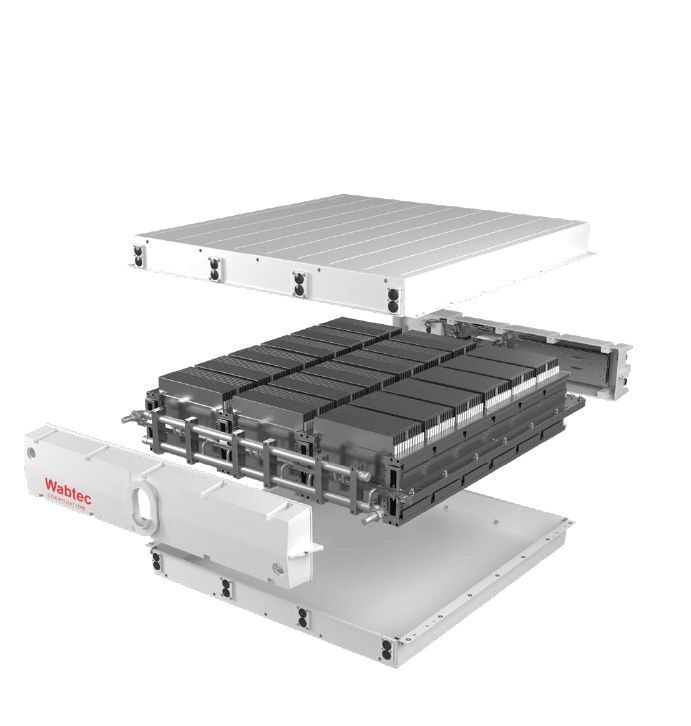
The system, which is developed by Wabtec’s sister company and is an existing technology used in other transit applications, has been adapted for integration into a freight locomotive system. The battery packs are mounted directly to an integral chill plate, enabling cooling to be independently provided to every individual pack. The cooling tubes and channels never come into contact with any of the battery cells or the electrical system, ensuring they are fully isolated, and the cooling plate feeds that cooling into all the cells.
The system typically employs one circuit per column, and every individual battery pack has a dry break connection that enables individual packs to be separated without having to drain the entire locomotive cooling system. This allows maintenance engineers to simply isolate an individual pack from the coolant system, remove and replace it, then reconnect the coolant lines to get the system back up and running.
To prevent thermal runaway – which is one of the most closely scrutinised risks in any large battery system – the team has developed a passive solution at the pack level. Bunce explains: “Locomotives spend a significant amount of time in a standby or shutdown mode and, in many cases, we ship these locomotives around the world. In those situations, they’re not powered at all and the battery management system isn’t operational.
“For those reasons, we designed our system in a way that it was not dependent on the battery management system for thermal runaway mitigation. Gases are directed through a burst disk and then flow from the battery pack in a controlled fashion through a chimney to exit the vehicle. There’s no propagation from pack to pack because everything is contained within an individual battery pack, and although the battery management system adds value when in operation and can reduce the event inside that battery pack, it is not a safety-critical element of our thermal runaway mitigation strategy.”
Managing energy
The key to the battery-electric locomotive’s operation is its ability to capture energy on the move. This is why it works so well as a complement to diesel-electric locomotives in a consist on a long-distance journey. The company’s conventional diesel-electric locomotives already use AC traction, whereby dynamic braking causes the traction motors to generate electrical power. However, the traditional system simply dissipates that braking energy as heat through electrical resistive grids and cooling blowers, whereas the battery-electric system harnesses that energy, storing it for reuse on the journey.
The amount of benefit this offers, of course, depends on the specific operation the FLXdrive locomotive is performing, and Bunce explains: “Every route and application is different. The shunting yard work gets a lot of regen benefits due to the stop–start operation, but even in the freight line haul applications it can provide significant advantages. The weight and speed of the train, and the size of the hill it’s going down, all affect how much power is generated to be stored – and it can be a significant amount.”
The key is not merely to recover energy; it is to understand and manage how and when it should be stored or used. That makes regenerative braking part of a wider energy strategy – and the benefit of a railroad is that it always follows a fixed line along known topography. Recognising this, Wabtec is able to optimise operation along the route and has developed an intelligent energy management system for the FLXdrive that can plan charging and discharge behaviour against what lies ahead, seeking to make use of regeneration while avoiding unnecessarily aggressive charging.
Known as the FLXoptimizer, this advanced energy management and automation software system has been specifically designed to operate the FLXdrive. Acting as an overlay system across all locomotives in the consist, it builds upon Wabtec’s heavily proven Trip Optimizer technology that is used for the company’s diesel trains, building on standard functions such as the smart, AI-driven cruise control and expanding this logic to intelligently manage the hybrid mix of diesel and battery locomotives.
“It was around 2010 when the energy management system development started and it’s been building and growing ever since,” says Bunce. “The operation of a FLXdrive locomotive is essentially identical to any other diesel electric locomotive – the individual operators don’t make the decisions on how best to optimise for fuel or velocity, it’s all done in the background through the energy management system – and we are also now using AI in a number of different ways to optimise even further what we have already achieved.
“We work with our customers to understand the different operating environments and any different modes that they’d like, but it’s all handled through the energy management system. We actually map every single individual route as we are implementing the energy management system for the train’s specific use-case – so at the start of a trip, we know exactly what we’re hauling, what locomotives we have, what power we’re using and where we are going.
“We use the system on normal diesel-electric set-ups, but when we have the battery-electric locomotive as part of the consist and we can operate in a hybrid mode, we create an entire charging and discharging plan before the train even leaves the yard. The energy management solution understands what that route is, so it’s planned to ensure that the battery doesn’t ever get to a full empty and that there is capability to get as much out of that battery as you can.”
In addition to regenerative charging, the battery-electric locomotive contains an integrated solution to enable static plug-in charging. The standard system has been adapted from technology that is typically used in the automotive industry and Bunce continues: “The charging requirements vary depending on the application, the operating profile and the customer’s infrastructure, and we work with each customer to bespoke these for their use.
“Typically, for a freight line haul operation, most charging is done through the regenerative braking system where the terrain allows, but the stationary plug-in charging is useful for operations like the hybrid or Switcher locomotives where, at the end of a shift, when the locomotive is not in use, it can be plugged in and charged on an off shift. It’s very similar to an EV system and, in some cases, we utilise an EV charging supplier to support that.”
As well as this, the company has also developed a train-specific DC fast-charging option using a stationary pantograph linkage to take power from overhead lines. It does not yet have the capacity to be used for charging on the move, but Bunce says Wabtec “absolutely expects to have that capability” in the future. “We would pull power and energy off the pantograph system as we pass under it and use that to charge the batteries as we’re moving, as well as simultaneously powering the propulsion system,” He explains: “When we’re no longer under the overhead line, we would then use the batteries to continue to propel forward.”
Performance matching
The philosophy of the FLXdrive was to match the performance of existing diesel-electric machinery as closely as possible – but it was not as simple as replacing the diesel engine with the equivalent amount of battery storage. Unlike a diesel-electric locomotive, where the engine must build speed before delivering its full response, early development showed that the battery-electric locomotive could respond too quickly, giving the operator an unexpected challenge compared to a conventional product.
Performance and range figures vary depending on the route, of course, but the concept was always to develop a range of solutions that work for a variety of applications and Bunce explains: “The FLXdrive Switcher is designed to operate a full eight-hour shift, which is based on the typical shunting requirements our customers have. The FLXdrive heavy-haul, meanwhile, can be carrying one-and-a-half miles of cars or more behind it, so its range capability is very specific to the route, terrain and operation.
“Generally, on a hilly route, the locomotive will use the power to go up the hill, then the system will recharge when it is going down the hill. A typical mining application from mine to port will haul uphill one direction and downhill the other direction – so they’re getting the full capability of that terrain in that application.”
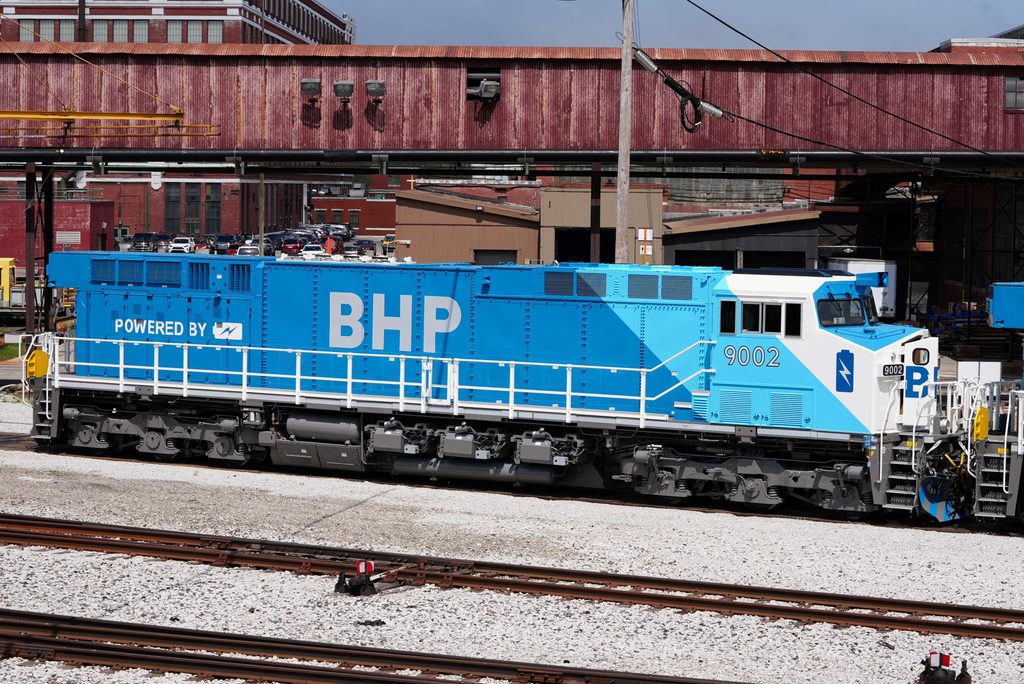
Wabtec has orders for all types of operations, all around the world. Union Pacific will soon take delivery of four FLXdrive Switcher units for yard operations in California and Canadian National will take delivery of a Switcher. In Australia, BHP have put to use several heavy-haul units in the Pilbara mining region, running them fully loaded downhill from inland mines to coastal ports to self-charge along the descent.
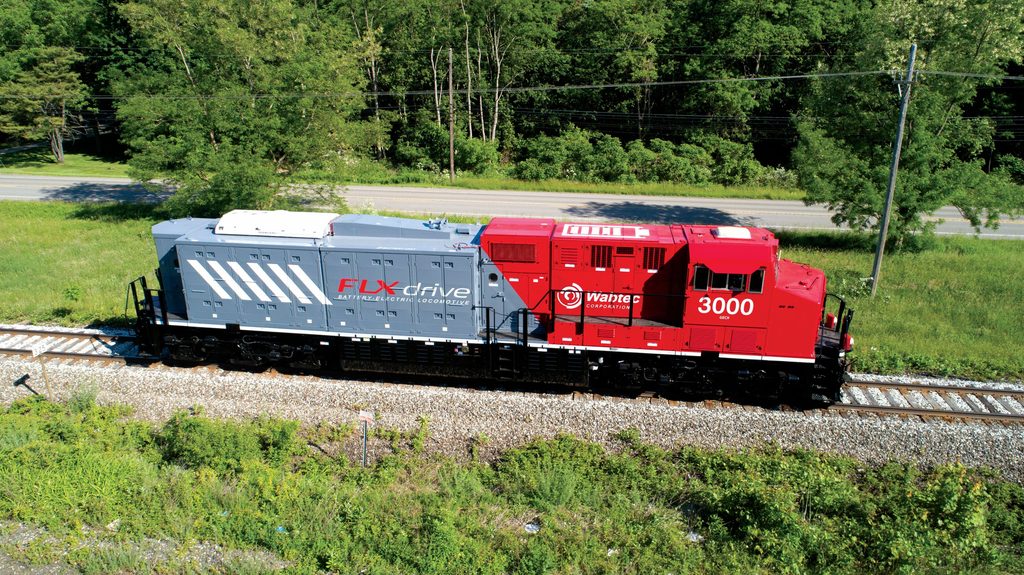
The question is no longer simply whether a battery-electric locomotive can work; it is how the technology should be specified, supported and integrated for each specific application. FLXdrive 2.0 continues to progress the concept, allowing the technology, the customer and the infrastructure around it to learn together. The technology is still at an early stage of development and improvements in battery capacity and energy density will continue to expand the range of viable applications into the future.
Ultimately, however, full electrification of the rail networks is still a long way off, and while battery-electric is highly suitable for some applications – particularly shunting and yard work – the range limitations still mean that hybrid systems will make sense long into the future. In a world where sustainability is a priority, therefore, Bunce believes alternative fuels will also have a role alongside the FLXdrive, with a portfolio of solutions rather than a single replacement technology imposed across every network.
To that end, as well as the development of its battery-electric system, Wabtec is already exploring alternative fuel and propulsion technologies such as biodiesel, renewable diesel and natural gas, with ethanol and hydrogen currently under evaluation.
“Battery-electric is still very much an emerging technology and, ultimately, there will need to be a range of products to support our customers, including alternate fuels, hybrid and battery applications, all of which are going to come into play in the future,” says Bunce. “Every application is going to have its own requirements but there are certainly some customer applications that absolutely lend themselves to a full battery-electric future.”
The current FLXdrive locomotive is a platform for development, rather than a final answer. The battery packs are based on cell formats that can benefit from improvements being made by the wider battery industry – with higher capacity, better charging chemistries and better energy density all capable of bringing improvements to future locomotives. The control system will also continue to improve how existing energy is used, benefiting from the inevitable advances of AI.
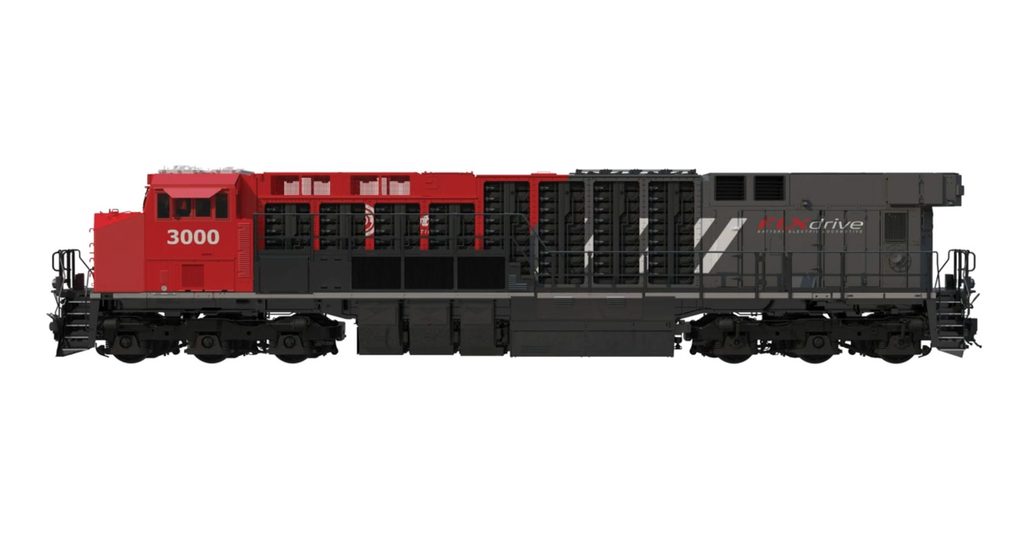
What is already clear is that the technology has moved beyond the early question of whether batteries can power a locomotive. The engineering challenge is now one of scale, integration, energy management and the development of the infrastructure required to run this type of machinery. FLXdrive represents multiple answers to that challenge: a locomotive designed to look and operate with the familiarity of conventional rail equipment, but with a fundamentally different approach to energy for different operations.
The progress from early hybrid lessons to customer demonstrations indicate how the system will continue to evolve. Cooling has already created more capacity; high-voltage architecture has enabled the use of proven traction motors; regeneration is now able to convert braking energy into stored energy; predictive software has turned a fixed railroad into an energy map; and the entire system has been built to ensure safety of operation and maintenance.
The future of lower-emission freight rail is unlikely to arrive as one dramatic technological switch; it is more likely to emerge route by route and application by application as batteries, software, charging and alternative fuels improve together – and Bunce concludes: “Every route and every application has its own specific needs, and we are evaluating each one of those to determine what the long-term expectation could be.
“Battery-electric technology is still in the early stages of development and adoption. So, as battery capacity improvements come along and our energy management system continues to evolve, I think we’ll have increasing levels of capability on range. We are continually looking at the design and new technologies to evaluate ways we can enhance the overall density of our system – and I think we’re just at the start.”
An adaptable workhorse
Wabtec works with individual customers in North and South America and Australia to develop battery-electric locomotives for a variety of specific needs, from local transportation to long-distance mining haulage. No job is the same on the global railroads, so Wabtec has developed four different baseline versions of its FLXdrive system for different needs.
The baseline models are all designed to operate on a track gauge of 1435 mm, but are each fitted out to optimise performance for different key railroad work modes – including yard work, local transport, underground operation and long-distance heavy-haul.
These baseline models are built on the standard Heavy-Haul 32 t/Axle platform, with power delivered through individual motors to up to six powered axles. Regenerative braking effort can provide crucial energy reuse capability, while there is also in-built 480 V AC charging, with optional DC fast charging using charging rails on top of the locomotive.
Heavy haul
This is the highest-capacity specification, designed for mainline service. It is typically used alongside other diesel-electric engines in a consist.
Power (maximum): 3200 kW / 4360 hp
Battery capacity: 7 MWh
Axles: 6, Co-Co format
Weight: 461 klbs / 209 t
Size: L – 76 ft / 23.2 m; W – 10 ft / 3 m; H – 15 5 ft / 4.7 m
Max speed: 76 mph / 123 kph
Tractive effort
– Starting mode: up to 200 klbf / 890 kN
– Continuous: up to 155 klbf / 690 kN
– Regen braking: up to 98 klbf / 436 kN
Switcher
This lower-capacity version is designed for yard work and for shorter local and regional transportation services.
Power (maximum): 1700 kW / 2280 hp
Battery capacity: 2.7 MWh, full charge time 4–7 hours
Axles: 6, Co-Co format
Weight: 417 klbs / 189 t
Size: L – 68 ft / 20.7 m; W – 10 ft / 3 m; H – 15.5 ft / 4.7 m
Max speed: 70 mph / 112 kph
Tractive effort
– Starting mode: up to 200 klbf / 890 kN
– Continuous: up to 155 klbf / 690 kN
– Regen braking: up to 98 klbf / 436 kN
Shunter
This is the lowest-capacity version developed so far, designed with a different running platform suitable for work on the railroads of central Asia.
Power (maximum): 700 kW / 940 hp
Battery capacity: 1.2 MWh
Axles: 4, Bo-Bo format
Weight: 212 klbs / 96 t
Max speed: 70 mph / 112 kph
Tractive effort
– Starting mode: up to 83 klbf / 370 kN
Dual mode
This was developed specifically for operation on underground railways in Europe, with an onboard hybrid combination of electric and battery-electric.
Power (maximum): 800–1500 kW / 1072–2010 hp (battery only); 3800–5500 kW / 5095–7375 hp (electric + battery)
Battery capacity: 1.5 or 2 MWh
Axles: 6, Co-Co format
Weight: 278 klbs / 126 t
Max speed: 70 mph / 112 kph
Tractive effort
– Starting mode: up to 117 klbf / 520 kN
Click here to read the latest issue of E-Mobility Engineering.
ONLINE PARTNERS