







Volvo Construction Equipment
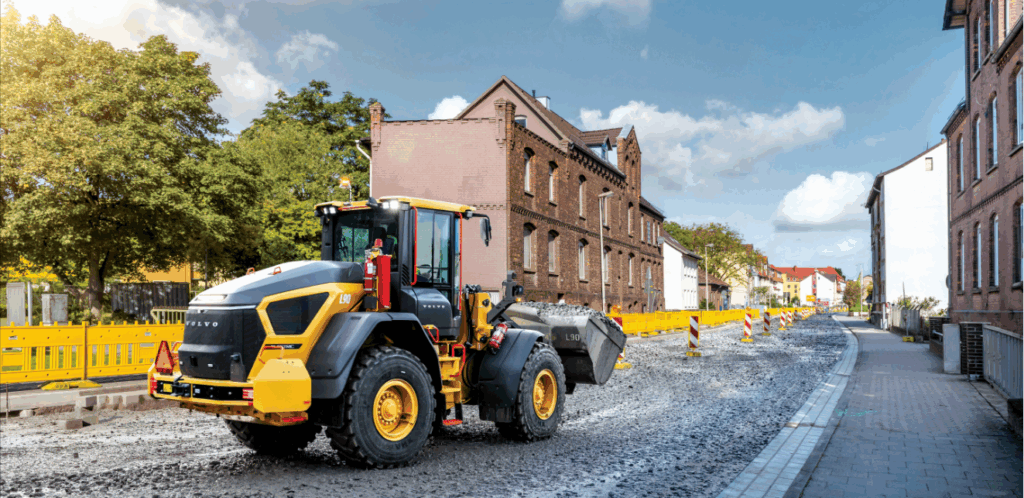
(All images courtesy of Volvo CE)
Rough, tough and electric
Volvo CE is taking on the task of electrification of heavy-duty off-highway vehicles. Peter Donaldson has unearthed all the details
Clean air and quiet are not associated with construction sites in the public mind; rather, the imagined scene is characterised by the roar of diesel engines powering excavators, dump trucks, pile drivers, cement mixers and generators. The picture is similar in agriculture and forestry, where diesel-engined tractors, telehandlers, harvesters, forwarders and others dominate. Although modern diesels are far cleaner and quieter than their predecessors, the writing is on the wall and this sector is being transformed through electrification.
Heavy-duty off-highway applications present their own set of challenges for engineers tasked with electrifying existing vehicles and developing BEVs, hybrids and FCEVs from scratch. Many such vehicles need both high peak power for digging, lifting, pushing etc and long operational run times in applications where shifts of 8 or 12 hours or more are common. They also have to operate in environments where they are exposed to vibration, shock, extremes of heat and/or cold and contamination by dust, water and aggressive chemicals – far in excess of automotive requirements.
Volvo Construction Equipment (Volvo CE) has invested heavily in electrification in this space, developing grid-connected and off-grid charging systems, remote vehicle- and fleet-management systems and electromechanical actuation in addition to the vehicles themselves. The company is also part of the Emission-free Network Infrastructure initiative, an industry collaboration established to create a coordinated, emission-free energy charging infrastructure in Europe to support the growing fleet of electric machinery. Ahcène Nedjimi, expert in global e-mobility and system architect at Volvo CE, explains the company’s nuanced approach.
Diverse platforms
Vehicles in this space are highly diverse, and don’t lend themselves easily to a uniform style of chassis architecture, such as a skateboard for example, while a bespoke architecture for each model or category is neither efficient, nor scalable for a manufacturer that builds in a wide range of categories. Furthermore, the diversity of key powertrain components such as the energy storage system, electric drive units, power electronics and their integration requirements make a single solution unviable, he emphasises.
The solution, he adds, is to take a platform-based approach to strike a balance between technical flexibility and business efficiency. “By developing a scalable architecture with defined variants such as mini, medium and large performance segments, we can accommodate different power and range needs while leveraging common subsystems,” he says. “This approach reduces development cost, shortens engineering cycles, and enables economies of scale in procurement and manufacturing.”
The company’s electrified vehicle range encompasses articulated haulers, excavators (both tracked and wheeled), material handlers and wheel loaders, ranging from the EC18 Electric compact excavator with its 1955 kg operating weight to the A40 articulated hauler with its 39,000 kg payload.
Because the path to decarbonisation differs between markets and customers, the company is investing in multiple propulsion technologies and common platforms that can accommodate them. “Our main focus today remains on battery-electric solutions because they are more mature and supported by a growing charging infrastructure. That said, we continue to explore hydrogen fuel cells and hydrogen combustion engines as longer-term options, depending on how market demand and infrastructure evolve.”
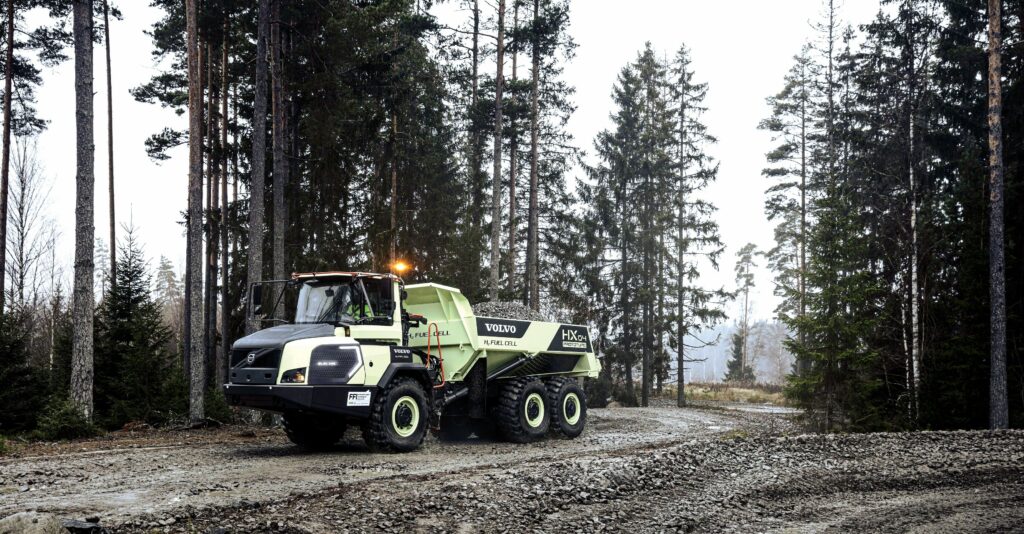
In the summer of 2022, for example, Volvo CE began testing the HX04 fuel-cell-powered articulated hauler. The 35 tonne, six-wheeled machine draws power from a fuel cell system from PowerCell Sweden that is designed for both the vehicle and the application. The fuel tank can be filled with 12 kg of hydrogen in 7.5 minutes, enough for around 4.5 hours of operation. It was refuelled at a hydrogen filling station supplied by Shell and installed at Volvo CE’s test track in Braås, where the vehicle was put through its paces. The two companies are founding members of H2Accelerate, which is a collaboration of companies working to foster conditions for the mass market roll-out of hydrogen trucks in Europe.
HX04 resulted from a strategic sustainable vehicle r&d and innovation project, which ran from 2018 to 2022 with funding from FFI, a national collaboration between the Swedish Innovation Agency VINNOVA, the Swedish Energy Agency, and the Swedish Transport Administration. Besides Volvo CE, partners included RISE – the Research Institutes of Sweden, who provided specialist competence on driveline development and safety – and PowerCell Sweden.
Pack architecture agnostic
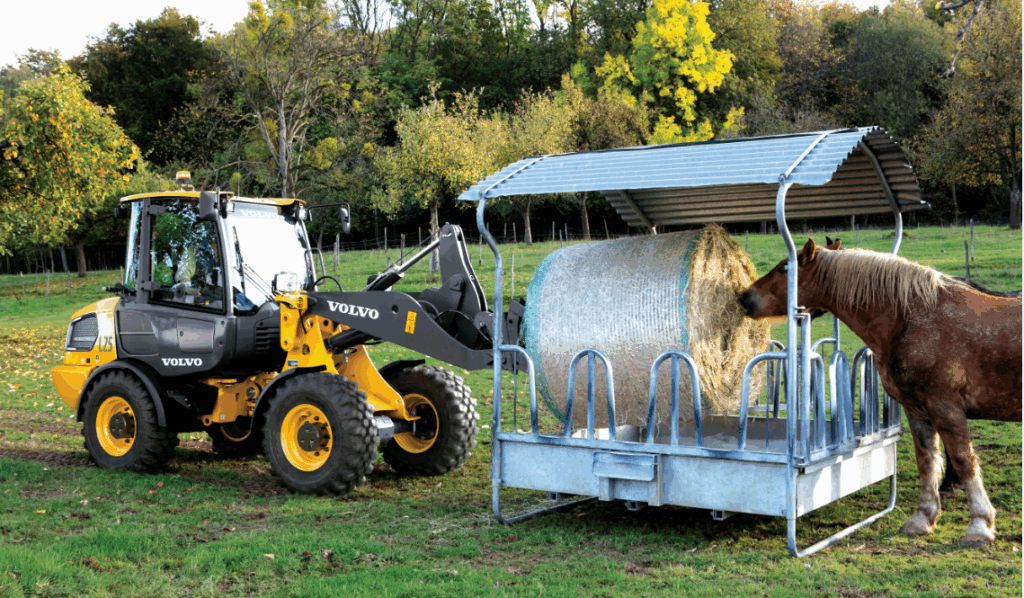
In battery design, Volvo CE supports multiple architectural approaches, depending on the vehicle class and application. In some cases, a single integrated battery pack is optimal, but in others, such as the compact ECR25 excavator and L25 wheel loader, a modular set-up with multiple packs is much more flexible, easier to service and allows module-level replacement where appropriate, Nedjimi explains.
For example, with an operating weight of 2670 kg, the four-wheeled L25 operates on 48 V and features as standard a five-pack lithium-ion battery system with capacity of 40 kWh. As an option, customers can specify an alternative seven-pack system with 56 kWh capacity. The battery system is embedded in the machine’s structure for physical protection – both from damage and from theft – and is designed to be maintenance free.
The pack supplies power to two motors. The first is a 22 kW induction motor for the driveline that includes a pair of rigid planetary axles with mechanical differential locks front and rear. The second motor is a 14 kW permanent magnet synchronous machine that runs the hydraulic pump. Both are maintenance free and shut off automatically when not needed to minimise wear. The fully electric driveline halves the requirement for hydraulic oil, and the design provides ground level access for lubrication points.
Onboard charging is via a Type 2 automotive standard inlet into the standard 4.6 kW charger, with chargers of 9.2 or 13.6 kW capacity available as options.
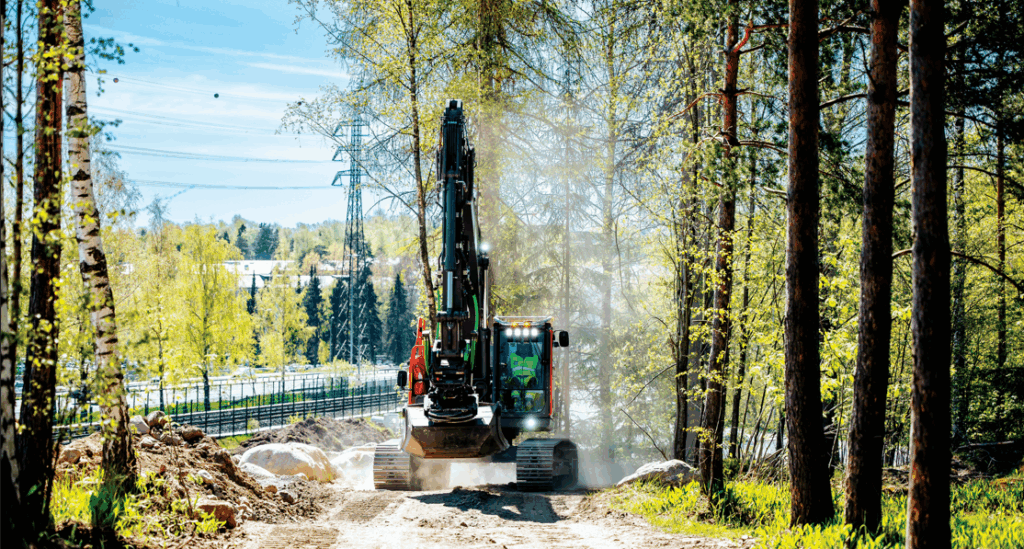
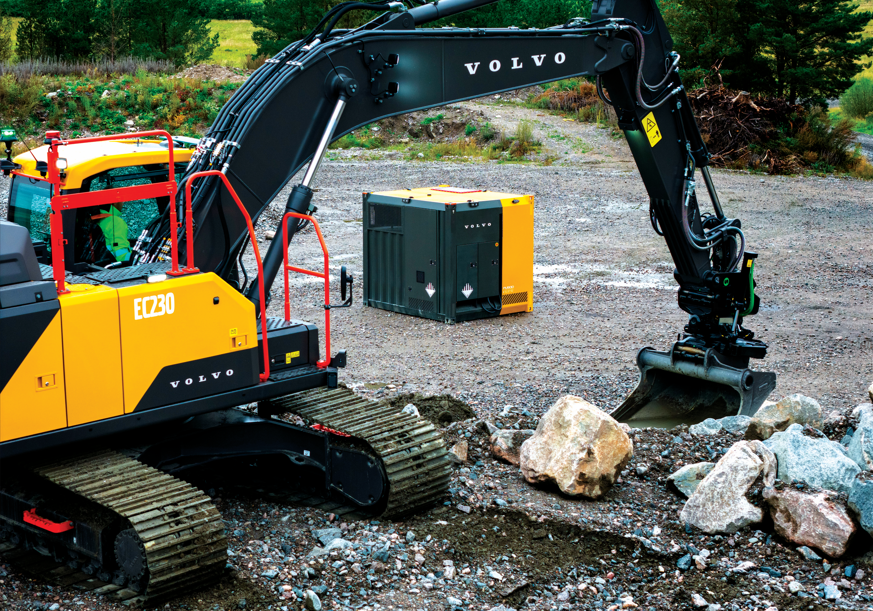
In contrast, the high-battery-capacity version of the EC230 general-purpose tracked excavator has a high-voltage driveline powered by a 650 V battery pack with NCA chemistry. With capacity of 450 kWh, the pack is based on Volvo CE Penta’s Cube battery architecture. A single Cube battery measures 768 x 684 x 668 mm and has capacity of 90 kWh. The cubic shape, which allows the units to be easily stacked together, is designed for increased energy density and greater flexibility in installation in vehicles that don’t easily accept Volvo CE’s flat-pack batteries. This pack supports maximum operating times between 7 and 9 hours, depending on the application. For charging, it is compatible with Combo2-Plug (CCS2) connectors and EU regulated chargers of up to 250 kW capacity. Each track is driven by its own automatic two-speed shift travel motor, while a dedicated third motor drives the hydraulic pumps.
Volvo CE is also agnostic towards cell chemistry, basing the choice on the required performance, energy density, cycle life and charging needs. “We work with several technologies, LTO, LFP, NMC, and NCA depending on the required performance, energy density, cycle life and charging needs. LTO is well suited for intensive duty cycles, while LFP offers strong safety and cost advantages; NMC and NCA are options when higher energy density is needed.”
Duty cycle significance
The duty cycle and power profile are related concepts that apply to all machinery, and it is critical to pay attention to them in the design of vehicles with smaller energy budgets than those running on hydrocarbon fuels. The duty cycle describes what happens and when, while the power profile quantifies how much power is needed to make it happen. Both also differ significantly between classes of off-highway vehicle.
From an engineering perspective, the power profile provides invaluable information for specifying the motor and the battery (or fuel cell stack), for design of the cooling system and for evaluating the viability of electrifying the task. The motor of a wheel loader, for example, must be sized to deliver the torque and power to meet the high peak power demanded by the pile ramming and digging phases without overheating. That peak power demand also determines the C-rate required of the battery, while the total energy consumed for a complete duty cycle is calculated by finding the area under the power profile curve. The two major heat-generating events (digging and lifting) are also identified from the power profile, while the duty cycle reveals their duration and frequency and provides the information needed to gauge the capacity requirement for the thermal management system. While the repetitive high peaks in power demand are challenging for both battery and motors, the consistent cycle with regular periods of lower demand provides opportunities for them to cool down.
Equally important as the selection of cell chemistry are ruggedisation and serviceability, both of which play major roles in how the battery pack is designed or selected, he says. Shock, vibration, ingress protection and structural robustness are critical, and to address these issues, the company combines multiple layers of validation.
“Balancing ruggedisation with serviceability is a key design trade-off. The pack must be robust enough to withstand harsh operating conditions while still allowing safe and efficient maintenance by aftermarket personnel,” Nedjimi emphasises. “We place importance not only on accessibility of service points but also on ensuring that commissioning and decommissioning procedures can be executed safely, with minimal downtime.”
With charging, the direction of travel is from slow AC systems to high-power DC fast charging on fixed sites, including depots, farmsteads, sawmills and log yards with established grid infrastructure. While AC is well suited to overnight charging of machines with relatively small batteries, such as compact excavators, high-power DC systems are essential for large excavators and haul trucks that must be recharged over a lunch break, for example, so the industry is standardising on chargers rated from 150 kW to more than 1 MW.
Charging ecosystem
Volvo CE sees charging as an integral part of the e-mobility ecosystem rather than as a separate element, according to Nedjimi, and stresses the need to support vehicles that cannot return to a central depot. This involves compatibility with existing infrastructure, offering its own chargers and providing solutions for locations without grid access, and compatibility is critical. “Because charging protocols and connector standards vary across regions, our priority is to ensure that all machines can interface with the appropriate inlet types used in each market.”
Most of its chargers rely on standard protocols, but the segment below 60 V that Volvo CE’s ECR25 and L25 inhabit is not served by a universal standard. So, it developed a proprietary communication protocol, publishing it to help drive alignment across the industry and to help create a more unified ecosystem.
The company also continues to consider alternative charging strategies such as battery swapping, he notes, adding that this requires careful consideration around standardisation, safety and operational logistics. “We are actively evaluating modular and swappable energy solutions for applications where uptime and operational flexibility are critical. This includes the possibility of standardised mobile battery packs, but our strategy extends beyond simply swapping batteries on the machine.
“We are already developing mobile power units and battery containers that effectively decouple the machine from the fixed energy infrastructure. These units can be deployed on-site to provide DC charging for our vehicles, but they also offer AC outputs through standard inlets, enabling them to power other site equipment when needed. This creates a more versatile energy ecosystem, particularly in environments where grid access is limited or intermittent.”
In this space, Volvo CE now offers the PU500 mobile charging unit. As well as enabling off-grid charging, it supports fast charging of machines and vehicles where grid infrastructure is present but inadequate, while the PU500 can recharge itself using cheaper off-peak power at up to 86 kW. A containerised system, the PU500 includes a 540 kWh battery pack made up of 6 x 90 kWh Cube batteries, a 240 kW CCS2 DC charger and a 63 A socket to support equipment with higher power demands. Measuring 3 m x 2.5 m x 2.6 m and weighing 7600 kg, it features holes for forklift tines on two sides, making it easier to move around a worksite.
Basic monitoring and control can be effected through the My Equipment app (see below), with fleet management functionality provided through the CareTrack telematics system.
Fast charging is the operation that puts most thermal stress on batteries, so thermal management systems (TMSs) have to handle that effectively, while not being over-designed and potentially inefficient when they are not working so hard. Volvo CE takes an integrated approach to TMSs, providing the right heating and cooling to all key components in the machine, including the operator’s cabin. In BEVs, the TMS is designed to recover and reuse waste heat wherever possible. “Our approach focuses on keeping energy consumption low, reducing packaging space and managing costs. By designing cooling and heating loops that work together across different subsystems, we avoid the need for multiple standalone circuits. This results in a more compact, efficient and cost-effective solution. Ultimately, this gives customers improved comfort, better machine reliability, and a system that supports energy efficient and sustainable operation.”
Software and telematics
Software plays a central role in how Volvo CE manages the balance between performance, energy consumption and runtime. For the machine operator, this is presented as working modes such as Eco, Standard and Boost, which adjust parameters including the availability of peak power, acceleration response, hydraulic performance and the power drawn by auxiliaries. These modes allow operators to prioritise runtime when they need to, or access higher performance for demanding tasks.
“Beyond user selectable modes, our control software also dynamically manages power based on battery state of charge, temperature, duty cycle and predicted energy requirements. This is to ensure that the machine maintains consistent performance while maximising runtime and protecting battery health.”
Electrified machines are prolific generators of operational information that allow OEMs and customers to develop a deep understanding of how they perform and endure in the real world. Volvo CE collects machine and battery data through its own telematic system, Nedjimi explains. “With e-mobility, we naturally gain access to far more detailed information than with traditional machines, like energy use, charging behavior, temperature patterns and operating loads,” he says. “We use these data to better understand real-world operating costs and guide future design decisions. And this same data foundation is what allows us to support our customers more effectively.”
Building on this, the company launched a web-based app called My Equipment to put productivity and energy efficiency in operators’ hands, which should enhance their experience and, more broadly, strengthen the electric transformation. The app provides vital information on machine hours, status, location and power consumption. “Launched primarily for electric machines, it provides real peace of mind for operators, or indeed anyone on site, needing to monitor battery charging status remotely – thanks also to notifications alerting them if there is a disruption to charging. It has been designed to ensure that they get the most out of their electric construction equipment.”
Tooling up
Heavy-duty off-highway vehicles usually need large amounts of power to operate essential tools that are predominantly hydraulically operated today. There is a wide variety of such vehicles characterised by different power profiles, force densities (for example, the requirement to apply immense, concentrated force) and duty cycles. They also present different levels of complexity when it comes to integrating them with the vehicle’s power source. These differences fundamentally affect the ease or otherwise of converting or re-engineering them for electric power. In the early stages of electrification, the solution to this problem has been to electrify hydraulic pumps so that existing tools can be used unmodified, although direct electric actuation is gradually making its way into this space.
When it comes to phasing out hydraulics for tools and accessories, the company is keeping its options open. “Our roadmap does not commit to a single path; instead, we are pursuing both electrified hydraulic solutions and full electromechanical actuation in parallel because each approach has distinct advantages and constraints.”
In 2017, Volvo CE demonstrated a fully electric excavator concept, EX02, with a complete electromechanical actuation chain. “That concept clearly showed the efficiency gains, noise reduction and environmental benefits of removing hydraulic oil entirely. Electromechanical actuators offer superior energy utilisation, improved controllability and the potential for significant maintenance reduction,” he notes.
He cautions, however, that there are still significant hurdles to clear, including the maturing of an entire ecosystem of electric tools in areas such as availability, cost and validation of long-term durability. Furthermore, hydraulic systems powered by electric pumps remain an attractive mid-term solution. “Hydraulics remain a proven, robust and cost-effective technology with excellent force density and smooth operation,” he says. “When combined with high-efficiency electric pumps and smart control strategies, E-pump architectures can deliver significant gains in overall system efficiency without requiring a complete shift to electromechanical actuation.”
In this light, the company’s decision on whether to use electric or hydraulic tools on a particular vehicle model depends on application requirements, cost targets, supply chain readiness and expected performance. “We anticipate coexistence of both solutions for the foreseeable future, with the optimal choice depending on machine class, duty cycle and customer priorities.”
Autonomous focus
As with data gathering and operational software, electrification is also a good fit for automation and autonomy. Volvo CE has long been a pioneer in autonomous machinery, starting with early concept projects like the autonomous, battery-electric load carriers (HX1 and the later HX2) showcased in Gothenburg, he notes. “These innovations demonstrated how automation could transform off-road productivity, safety and sustainability.”
To bring the technology to commercial scale, the Volvo Group established Volvo Autonomous Solutions (VAS), a dedicated business area focused on developing and industrialising autonomous transport and worksite systems.
“The creation of VAS has significantly influenced the electrical and network architecture of Volvo CE machines. Autonomy demands exceptionally reliable power and communication, driving the adoption of redundant electrical domains, backup energy systems and parallel compute paths to ensure that safety critical functions such as steering and braking remain fully operational, even in the event of a failure.”
The future of the construction industry, therefore, will be one in which it is served by a variety of electrified machines including BEVs and FCEVs, each dominating in specific application niches based on a matrix of power, energy and infrastructure needs, and characterised by increasing levels of automation and autonomy.
Click here to read the latest issue of E-Mobility Engineering.

ONLINE PARTNERS