






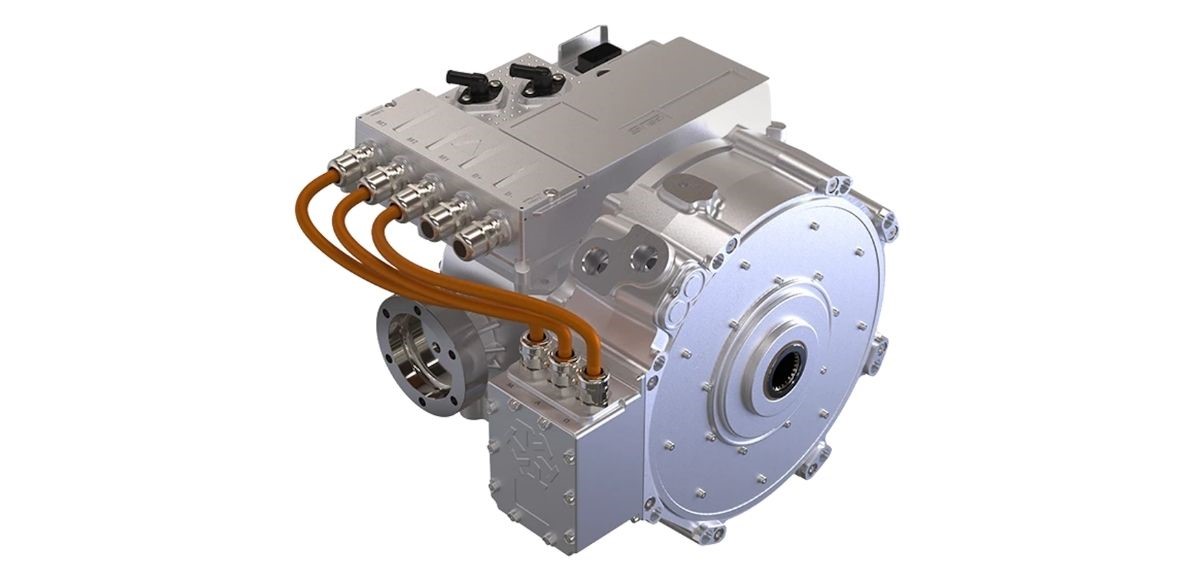
Turntide’s semi‑integrated electric drive powers off‑highway electrification
(Image: Turntide)
Increasingly close powertrain integration is well established in the passenger car sector, but for off-highway, construction, and commercial vehicles, the path to electrification presents a unique set of challenges, writes Peter Donaldson.
Space is often at a premium, duty cycles are extremely demanding, and serviceability is essential. Matrishvan Raval, head of product at Turntide, details how the company’s new “semi-integrated” Electric Drive Unit (EDU) exploits the inherent advantages of axial flux (AF) motor technology to address these specific market demands.
AF motors are famous for their axial length and ‘pancake’ shape. This form factor is a critical enabler for applications where space along the driveline axis is the primary constraint, such as in hybrid vehicle integration where the electrical components must fit into the internal combustion powertrain, Raval notes. “Axial flux motors tend to just slot very neatly into the bell housing.”
This compactness translates directly into a significant power density advantage over conventional radial flux machines, he says. “Most of the time, we see about two to four times more power and torque delivery for a given volumetric footprint,” Raval states.
(Image: Turntide)
Thermal and mechanical robustness
However, under sustained heavy loads, thermal saturation becomes the limiting factor. For off-highway applications, continuous performance is non-negotiable. Raval emphasises that thermal management and ruggedisation were primary design requirements from the outset.
“We made sure that the operating temperature range of the motor goes up to 85 degrees Celsius in terms of ambient temperatures,” Raval says. “The thermal fluidic channel that we’ve designed for cooling the stators has been specified with high-temperature operations and significant vibration in mind. The result is a design that extensive dyno and field testing have proved capable of withstanding the thermal shock and vibration profiles typical of non-highway applications.”
The pursuit of robustness was balanced with a pragmatic approach to commercial viability. The design team focused on three main axes of development: thermal-fluid optimisation using conjugate heat transfer analysis, electromagnetic (E-mag) design to maximise torque while minimising magnetic material mass, and design for manufacture. “Historically axial flux motors have had the reputation of delivering high performance, but being extremely difficult to manufacture,” Raval acknowledged. “So one of the key requirements for our latest development efforts was to make them mass-producible.” Another was reliability, with a guaranteed Mean Time Between Failures (MTBF) of 50,000 operational hours.
Semi-integrated architecture
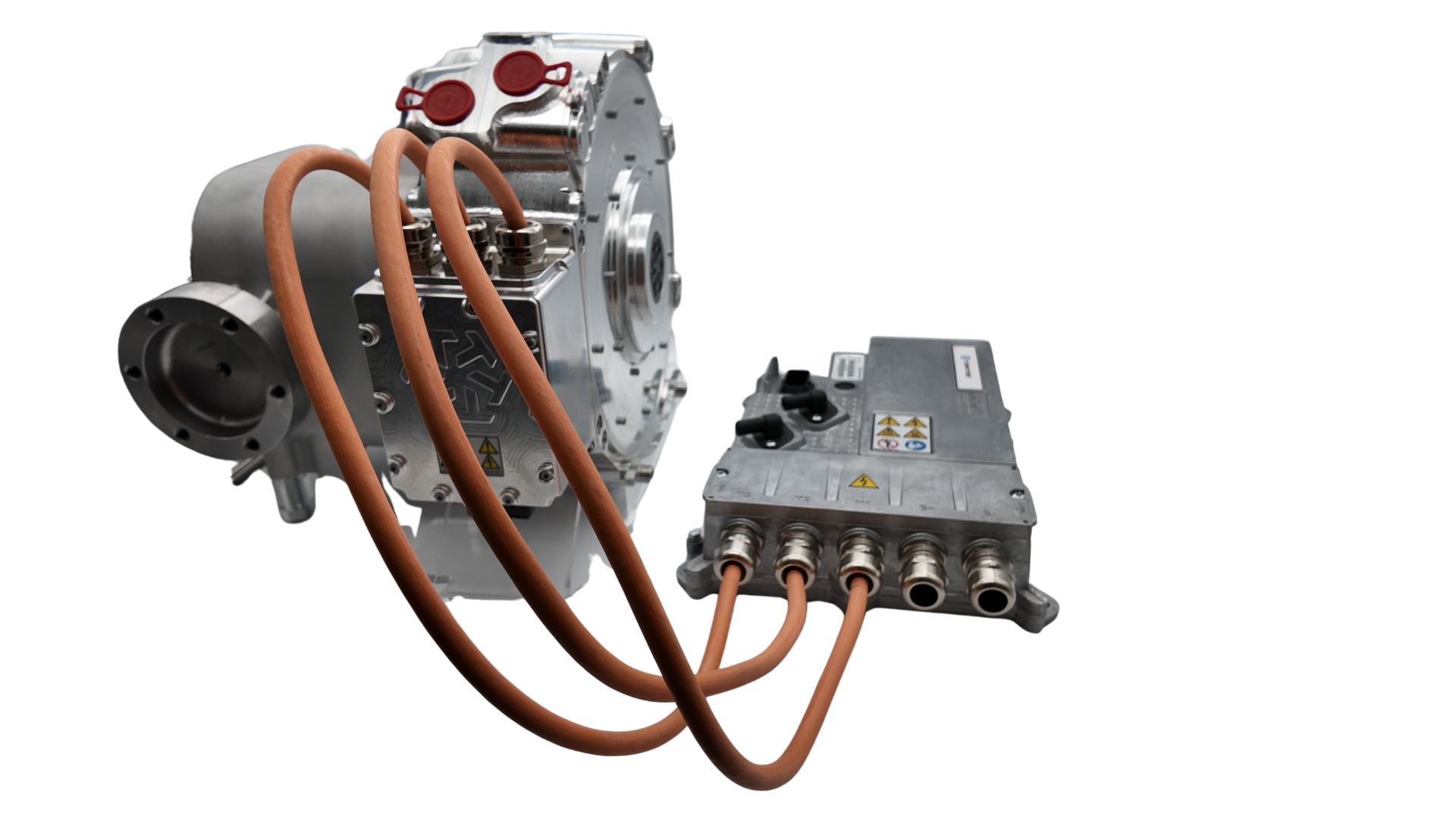
The EDU itself is conceived as a three-component system comprising the axial flux motor, a gearbox, and the inverter in a “semi-integrated” arrangement, while the motor and gearbox are fully integrated into a single unit, the inverter location is kept flexible. This allows OEMs to adapt the package to a wider variety of vehicle architectures and space claims.
The cooling architecture is similarly flexible. Depending on the application’s thermal load, the system can be configured for either series or parallel cooling of the motor and inverter. “Where there is heavy demand in terms of thermal load cycles, we recommend parallel cooling — where the pressure drops are still able to sustain the required flow rate,” Raval says. “Otherwise, we recommend series cooling to simplify the overall cooling circuit.” This decision is left to the OEM during the integration phase.
Simplification and scalability
One of the most significant system-level benefits of the axial flux motor’s high continuous torque at low speeds is that it enables driveline simplification. By delivering higher wheel torque directly, the required gear ratio can be substantially reduced. This enables the use of a simpler, lighter, and more efficient gearbox. According to Raval, this can push gearbox efficiency from the typical 90-92% range toward 97-98%, contributing to increased vehicle range.
To cover a broad spectrum of applications—from powersports to heavy construction—the EDU is scalable. The motor family is built around three diameters (300mm, 400mm, and 430mm), each available in single or double-stack configurations. This creates six distinct motor variants spanning a continuous power range of 60 kW to 200 kW, with peak power ratings typically 2 to 2.5 times higher.
Adapting this hardware to different vehicle dynamics is managed through the inverter software, which features numerous tunable parameters. Rather than placing the calibration burden entirely on the OEM, Turntide provides direct application engineering support, both at the customer site and remotely. “The team can very quickly complete drivetrain tuning with a few vehicle runs,” Raval says.
Finally, acknowledging the realities of life in the field, the design philosophy prioritises serviceability for the most likely point of failure: the gearbox. While the motor and inverter are designed for lifetime reliability without service, the gearing is intentionally selected from widely available, off-the-shelf components. This ensures that parts are accessible through a large network of service centres, reducing mean time to repair from weeks to just a few hours.
Click here to read the latest issue of E-Mobility Engineering.
ONLINE PARTNERS