



Thin film motor boost
(Image: Syensqo)
A new generation of thermoplastic is replacing aramid papers and enamel coatings in motors, writes Nick Flaherty.
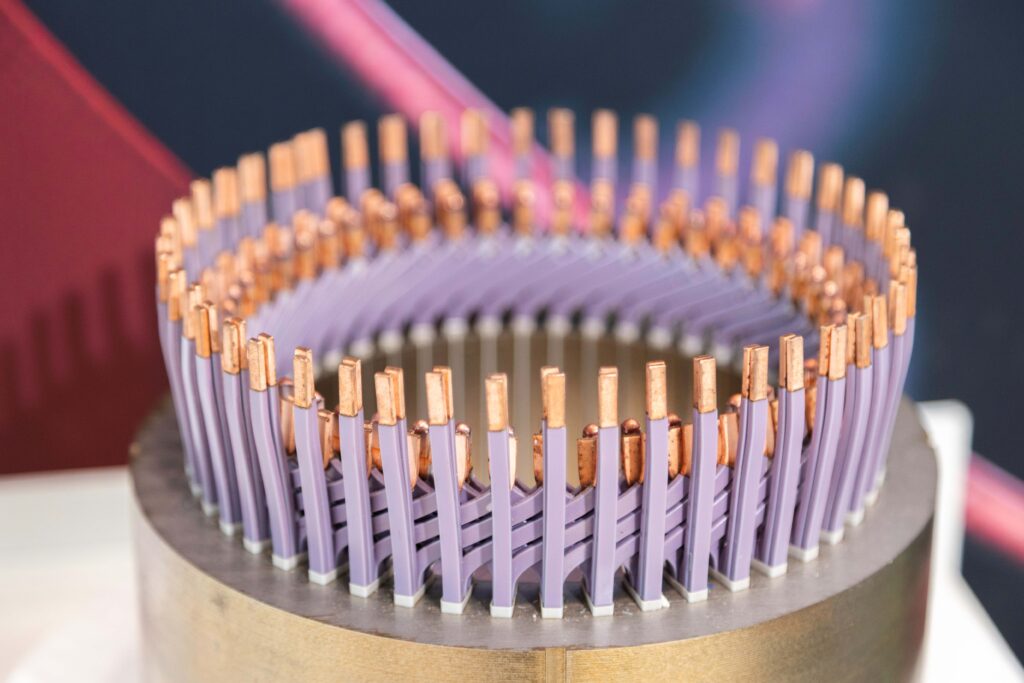
The advanced thermoplastic, now being adopted using existing production equipment in a new generation of motors, is showing a reduction in weight and an increase in efficiency through improved thermal management.
“Among the solutions we have brought to the market are thermoplastics – PEEK [polyether ether ketone] and PPSU [polyphenylsulfone] polymers – that can be used as a film for stators and as a coating with various grades to substitute for enamels,” said Luigi Marino, global marketing manager for e-motors at materials developer Syensqo.
“Our materials allow the motor designer to have thinner insulation. Aramid papers would be 200 to 250 μm thick while ours is 100 to 150 μm. As a coating for wires, we are able to decrease the thickness by 20% while still retaining the insulation properties. This opens up new design spaces. The thinner the material, the better it is for the designers as it removes a thermal barrier to the cooling. So, the thinner it is, the better it is for cooling, which increases efficiency. Even saving microns means you can fit more copper in the stator.”
Studies show efficiency can increase by 1–2 percentage points, downsizing motors in weight and cost by 8–10% while retaining the same performance. This is achieved using fewer laminations and smaller magnets.
“There is a portion of the efficiency gain coming from the thermal insulation with the slot liner. We double the thermal conductivity and, in simulation, the greatest benefit comes from the thickness reduction.
“What allows the lower thickness is the combination of mechanical and electrical properties. Our R&D has been working on making sure that the mechanical properties are appropriate for the lower thicknesses, so we do not use standard PEEK. We have been developing specific grades for slot liners and wire coating with different specifications for the balance between elongation and insulation,” he said.
“The other aspect is that our slot liners and coating can be processed with existing equipment. We have run a study with a company that produces manufacturing equipment and exactly the same equipment was used successfully. What was needed was fine-tuning the setting of the machine,” he said.
The aim is to maintain production speed with a maximum scrap rate and production rates that are similar if not better. “I haven’t seen an e-motor where aramid paper works and our films don’t work in principle,” he said.
The production process of the thermoplastic for the wire coating in a motor is substantially different to that used for producing insulation.
(Image: Syensqo)
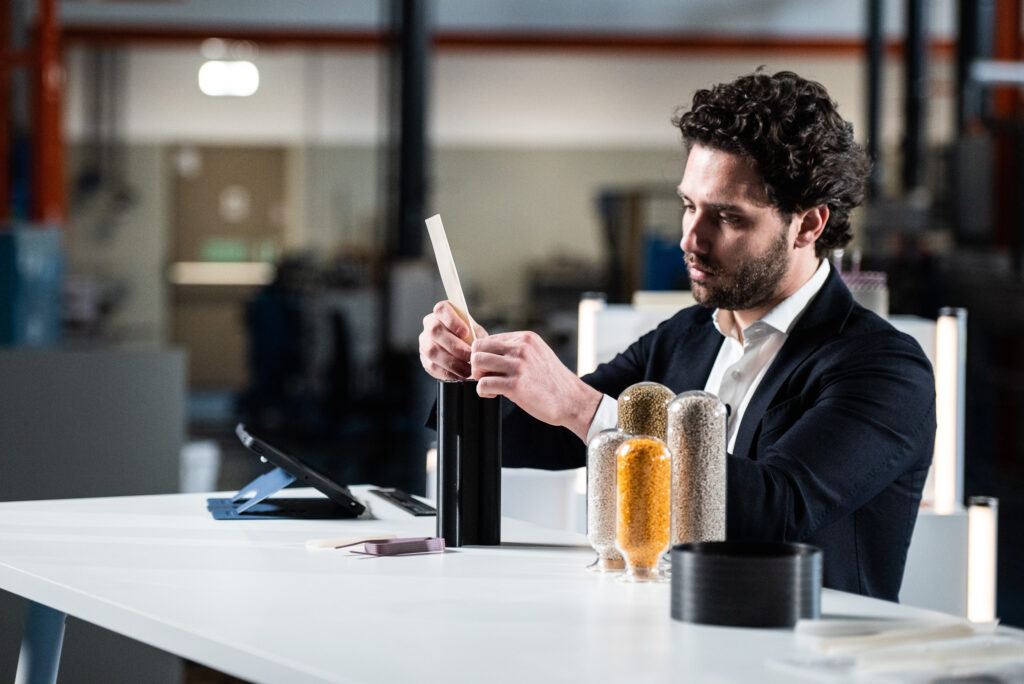
“For the wire coating, we sell pellets to the magnet wire manufacturers and they sell the coated wires to the OEMS,” he said. “Internally, we have two extrusion lines for R&D, and one of these is the same as the ones that magnet wire manufacturers use.
“When thermoplastics are applied through extrusion no solvents are required, making the process more sustainable and energy efficient. The equipment is different and much simpler compared to enamelling and there are several suppliers, some of which are traditional enamelling companies that are moving into extrusion.
“The main barrier to adoption is that the designer needs to consider them from the beginning of the design process to extract the full value, but we have seen several cases where it was simple to introduce these solutions into existing designs.
“What we have seen is that 50 μm can be enough for the insulation in some designs, but below 100 μm it gets more difficult for building the stator. While 100 μm materials can be processed practically anywhere, below that threshold the limit is dictated by the e-motor design, the production equipment and the rate, as well as the volume the machines need to achieve. In several cases you could probably go down to 50 μm but it is not proven yet. It is more an exploratory area for each design. For us there is no problem in producing films that are 50 μm thick or less because we go way below that for other applications.”
Luigi Marino began his career as an e-motor design engineer at Magneti Marelli. Over the past decade, he has held various positions across the e-motor value chain, from OEM to material supplier. In 2022, Luigi joined Solvay as the global leader for the E-Motor Application Development team, where he directed the global technology strategy and application development efforts within Syensqo. In this role, he managed a team of engineers focused on driving the innovation pipeline for new materials, managing the IP portfolio, and developing advanced testing and prototyping capabilities to support development and market opportunities in transportation, aerospace and energy sectors.
ONLINE PARTNERS