








Thermal lab cuts development time
AVL List has developed a platform for testing the thermal management of electric and hybrid electric vehicles long before a protype is built, writes Nick Flaherty.
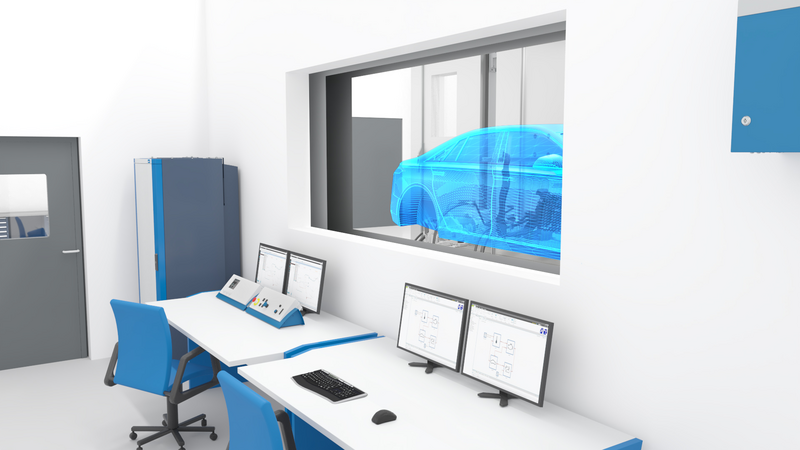
The AVL ThermalLab is used to optimise the thermal performance of the complete vehicle thermal management system and of components such as batteries, e-motors and power electronics as part of a larger virtual system design, saving significant time in an EV development.
The lab consists of a thermal chamber where components and even a chassis can be tested in operation at temperatures from -40 to +60 C and humidity from 10% to 90%.
“We are not limiting ourselves to a certain size. We are designing the lab for customer wishes,” said Peter Priesching, senior system line manager for ThermalLabs in Graz, Austria.
“We are using mounting rigs for the unit under test (UUT) for example the refrigerant circuits of the platform. Depending on the application, the mounting rig will be approximately the size of the vehicle or smaller. We have a few specific standard sizes that are easier and cheaper for the customer but we can also make bigger or smaller versions.”
A chamber of 100m3 will fit a small delivery truck, while the chamber for a passenger vehicle is are smaller at around 65m3. “The room needs to be as small as possible to be efficient but as large as necessary to work inside,” said Priesching.
“With regard to the temperature we try not to overspecify the cooling side as a higher margin would be more expensive. Humidity is definitely a test point as you want to be able to represent the external environment. The air conditioning and heating of the passenger compartment uses an increasing number of heat pumps and these can have an issue with radiators that can face freezing conditions from the humidity so that needs to be controllable to impose specific test conditions for the icing of the radiator.”
Air pressure is not a factor that is usually included in the chamber. “We have a separate altitude chamber but this is more relevant for ICE cars not so much for EVs,” he said.
“Usually there are a large number of sensors used in the tests as customers are focussing on the energy efficiency improvement so for each of the components as well as for the overall system you would like to know the energy it is consuming and the heat it is producing. The evaluation is done based on the data from temperature sensors, flow sensors for liquids and airflow in different parts of the system,” he said.
There can easily be over 200 temperature and flow sensors at 10Hz so there is a large amount of data produced that needs to be managed in real time. “Basically we use our own data acquisition system. We have our own AVL PUMA automation system which can handle all the necessary tasks. For this kind of thermal testbeds the capabilities of PUMA fit very well and can even do much more since its original versions have been developed to fit to the needs of very fast rotating combustion engines, which require a high data acquisition frequency of the sensors .”
The data from the hardware tests is combined with simulation models in a hardware-in-the-loop (HIL) system to evaluate the whole platform.
“The tests are done in a way so that you can operate the components on the rig build up like in a vehicle on the road. We operate the testbed in real time mode with the simulation models in a closed hardware-in-the-loop approach.”
For the testbed you need capable models as you want to run a WLTC cycle for example so you need models that are able to handle the effects in real time. they are usually derived from more accurate pre-calibrated models. The level of accuracy is not the same for each component submodel. The key is to reach a total level of accuracy which is sufficient to compare the results to a real level of operation,” he said.
In a specific project for example, the accuracy of the total energy consumption of the UUT has been +-5% compared to a vehicle on the road. As the many tests are comparisons of variants and a large part of the development work is the control function development for the ECU this accuracy level was sufficient. .
“This is front loading the development where you try to take out risks in the later development phases and discover any problems in the earlier phases to ensure that the protype vehicle for on road testing is more mature,” he said.
The HIL approach allows to reduce the number of prototype vehicles and reduces iterations in the development cycle of the complete vehicle as well as of components. In an average case it should be possible to save one generation of thermal prototypes.
For more information about AVL ThermalLab visit: https://www.avl.com
ONLINE PARTNERS