









Stellantis eliminates the EV inverter
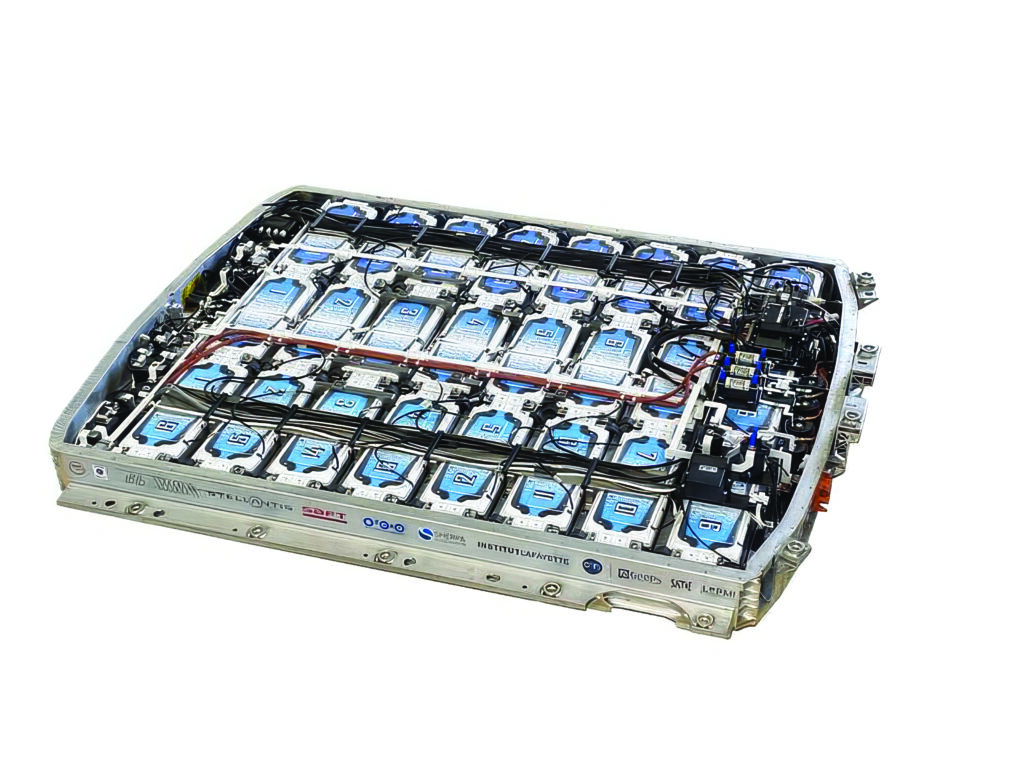
(Image: Stellantis)
Stellantis has designed a battery pack that can supply power directly to a motor, eliminating the need for a charger or inverter, writes Nick Flaherty.
The Intelligent Battery Integrated System (IBIS) has been in development at car maker Stellantis for the past six years as a drop-in replacement in existing electric vehicle platforms.
The design allows AC power direct to the battery and DC power to the motor by scheduling the output of each cell to create an AC signal.
“Eliminating the charger and inverter allows 17 L of additional space and cuts 40 kg in weight from the vehicle,” says Anne Laliron, senior vice president of technology research at Stellantis.
“Two years ago, we were demonstrating this technology with a stationary prototype. The next step was to integrate the powertrain into an existing vehicle.”
The resulting physical prototype, shown in September 2025, boosts the performance of an existing platform. “We have integrated the technology in a Peugeot e3008 on the STLA 230 hp medium platform. This increased power by 15% compared to the standard e2008. Now we are very close to TRL6 with a vehicle in real-life situations, and we are driving the car on the open road.
“IBIS simplifies the powertrain architecture. We have removed the charger and inverter, and integrated the components in the battery pack to produce directly the three-phase current,” says Laliron. “We are validating the technology with mature modules rather than changing everything at the same time. With this not completely optimised integration into the demo car, we are already able to demonstrate huge benefits in charging and efficiency, so there is room for improvement when it goes into development.”
The 65 kWh IBIS battery pack was developed with Sherpa Engineering and has 288 cells in 24 modules configured in three current lines, and the modules are switched by low-voltage silicon MOSFETs. A supervisory board manages the control of the current, with a redundant fault-tolerant architecture to guard against board failures. The terminals are laser welded with ribbon cables.
“By the control of the modules, we are able to generate the voltages and the current has no harmonic content. As you don’t have the harmonic content, you improve the efficiency at the electric machine, the motor,” says Francis Roy, project leader over the past six years.
“We have two principal boards,” he adds: “The supervision board is similar to the BMS for diagnosis, and we are adding specific features to make the control of the power boards where we have an H switch with four MOSFETs with low voltage below 40 V with low resistance. You can pass through a current that is higher than 500 A, even though it’s a very small component.”
The design shows 10% savings in AC charging, with the pack showing 96.5% efficiency with a 22 kW charger and 95.5% with an 11 kW charger because there is no intermediate conversion stage.
“We don’t use all the modules at the same time, and we are not limited by the weakest modules, so we extend the lifetime of the battery.
The voltage is 0 V, so there is no high-voltage risk and it is not necessary to repair the batteries in dedicated centres. You can also replace the modules with different chemistries,” says Laliron.
Stellantis is looking at having the technology in production by the end of the decade.
Click here to read the latest issue of E-Mobility Engineering.
ONLINE PARTNERS