










A sodium fuel cell for electric aircraft
(Image: MIT)
Researchers in the US have developed a sodium/air fuel cell that can be used for electric aircraft, writes Nick Flaherty.
The cell uses liquid sodium with a layer of solid ceramic material that serves as the electrolyte, allowing sodium ions to pass freely through, and a porous air-facing electrode that helps the sodium to chemically react with the oxygen.
In a series of experiments with a prototype device, the researchers at MIT demonstrated that this cell could carry more than three times as much energy per unit weight as lithium-ion batteries. “We expect people to think that this is a totally crazy idea,” said Yet-Ming Chiang, professor of ceramics who led the team. “If they didn’t, I’d be a bit disappointed because if people don’t think something is totally crazy at first, it probably isn’t going to be that revolutionary.”
The improvement in energy density could be a breakthrough for electrically powered flight practical at significant scale for domestic and regional flights, he said.
“The threshold that you really need for realistic electric aviation is about 1000 Wh/kg,” he said, pointing out that today’s lithium-ion batteries top out at about 300 Wh/kg. “People have been aware of the energy density you could get with metal-air batteries for a very long time, and it’s been hugely attractive, but it’s just never been realised in practice,” he said.
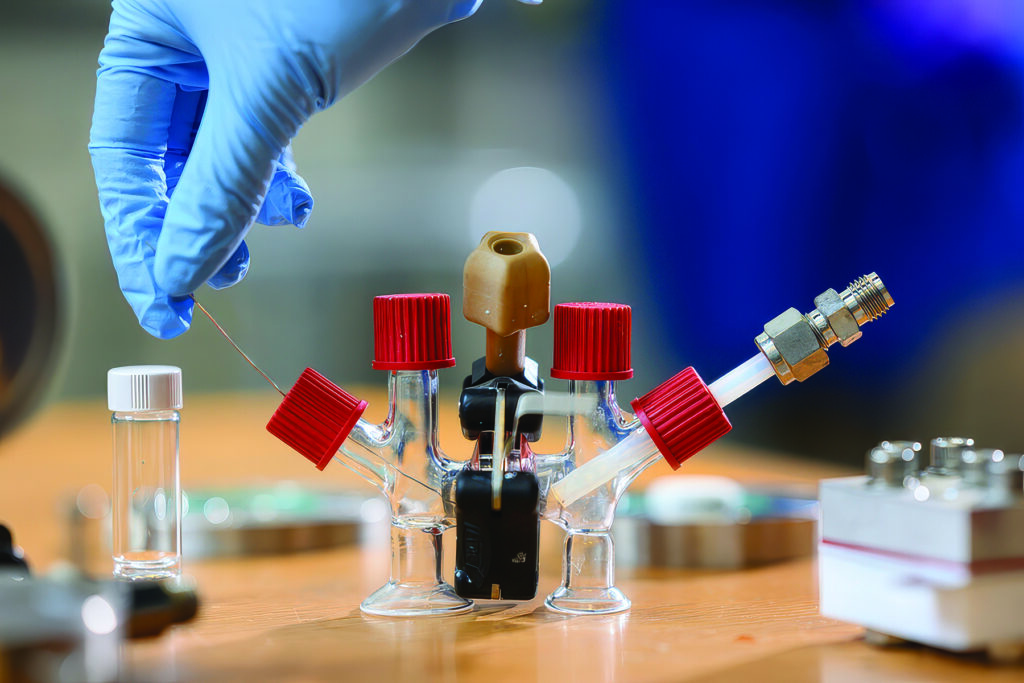
Using a fuel cell enabled the higher energy density in a practical form. The team produced two different versions of a lab-scale prototype of the system. In one, called an H cell, two vertical glass tubes are connected by a tube across the middle, which contains a solid ceramic electrolyte material and a porous air electrode.
Liquid sodium metal fills the tube on one side, and air flows through the other, providing the oxygen for the electrochemical reaction at the centre, which ends up gradually consuming the sodium fuel. The other prototype uses a horizontal design, with a tray of the electrolyte material holding the liquid sodium fuel. The porous air electrode, which facilitates the reaction, is affixed to the bottom of the tray.
Tests using an air stream with a carefully controlled humidity level produced a level of more than 1500 Wh/kg at the level of an individual stack, which would translate to over 1000 Wh/kg at the full system level, said Chiang.
To use this system in an aircraft, fuel packs containing stacks of cells would be inserted into the fuel cells and the sodium metal in the packs melts at 98 C. The sodium oxide exhaust would actually soak up carbon dioxide from the atmosphere and combine with moisture in the air to make sodium hydroxide and then sodium bicarbonate.
Chiang says the system should be quite straightforward to scale up to practical sizes for commercialisation and members of the research team have already formed a company, Propel Aero, to develop the technology.
Initially, the plan is to produce a brick-sized fuel cell within the next year that can deliver about 1000 Wh of energy (which is enough to power a large UAV) to prove the concept.
The amount of humidity in the air is crucial to making the electrochemical reaction efficient. The humid air resulted in the sodium producing its discharge products in liquid rather than solid form, making it much easier for these to be removed by the flow of air through the system. “The key was that we can form this liquid discharge product and remove it easily, as opposed to the solid discharge that would form in dry conditions,” said researcher Karen Sugano.
Click here to read the latest issue of E-Mobility Engineering.
ONLINE PARTNERS