








Thermoplastic intrusion plate boosts EV battery safety and sustainability for major European platform
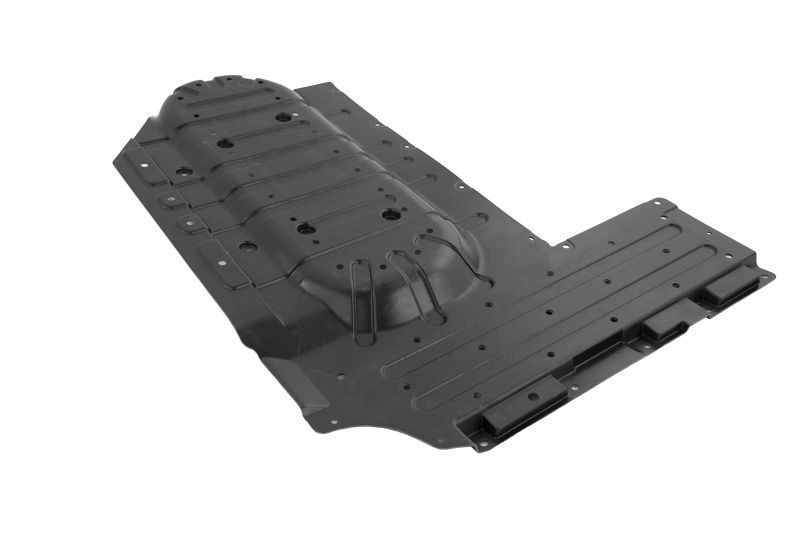
(Image courtesy of Röchling Automotive)
Röchling Automotive has strengthened its position in electric vehicle safety technology with a new contract to supply Intrusion Protection Plates for an entire vehicle platform developed by a major European OEM. From 2027, the lightweight structural components will be integrated across several battery-electric models built on the same architecture.
Developed to shield drive batteries against physical damage, the Intrusion Protection Plate serves as a key safety barrier in the underbody. It prevents foreign objects or debris from breaching the battery housing during road impacts or crashes – an essential line of defence as vehicle designers continue to push for lighter, more efficient structures.
The component is manufactured using a sandwich construction of thermoplastic composites reinforced with continuous glass fibres, known as unidirectional (UD) tapes. This design delivers high stiffness and impact resistance while keeping weight to a minimum. Röchling’s engineers note that the material retains its structural integrity even under severe mechanical loads, offering protection against both minor road debris and high-energy impacts.
An additional benefit of the thermoplastic composite lies in its intrinsic thermal insulation. By limiting heat transfer, the protection plate helps maintain stable battery temperatures and mitigates the risk of thermal runaway in the event of damage – an aspect increasingly valued as energy densities rise in next-generation cells.
Röchling Automotive’s CEO, Martin Schüler, highlights that the fully recyclable nature of the fibre-reinforced plastic supports the industry’s wider shift toward circular production systems. Manufacturing the plates also requires significantly less energy than comparable metal solutions, reducing emissions both during fabrication and over the vehicle’s lifetime through mass savings.
The company expects thermoplastic composites to become the preferred choice for underbody battery protection as OEMs seek to balance safety, performance, and environmental targets. With this new collaboration, Röchling is set to bring its material technology into large-scale series production for several of Europe’s leading electric vehicle models.
Click here to read the latest issue of E-Mobility Engineering.
ONLINE PARTNERS