















Microgrid design for shipping
(Image: University of Vaasa)
A researcher in Finland has developed a power management strategy that prevents blackouts in the electrical grid of a ship, writes Nick Flaherty.
The scheme, developed by researcher Timo Alho at the University of Vaasa, separates a vessel’s electrical equipment into independent units supporting the ship’s grid without centralised commands. This makes the vessel’s power systems significantly more fault-tolerant than previously, which is key for electric vessels.
The maritime industry is moving towards modern DC networks, but development of the control strategies they require is lagging behind. Traditionally, shipboard power management has relied on a centralised automation system that continuously calculates the available power.
The problem is that the centralised system is slow and rigid. If a ship’s generator fails suddenly, the central control cannot react in time. The remaining generators are easily overloaded, resulting in a blackout, said Alho.
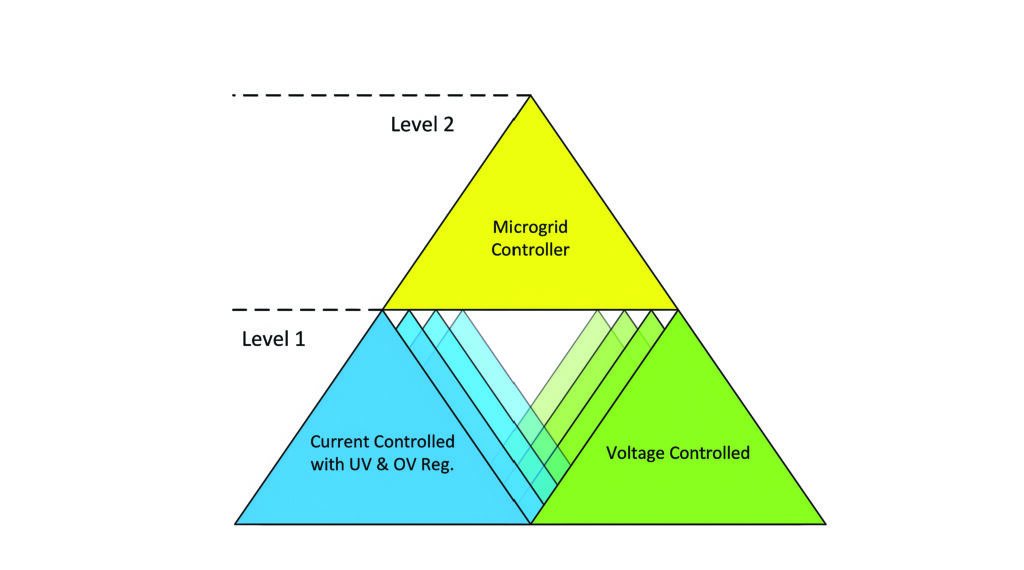
Instead of one central control system micromanaging all the equipment, the intelligence and control is distributed. The central control provides only the operational boundaries as a sandbox within which the devices can operate independently.
Devices, such as the main propulsion or battery inverters, directly monitor the grid’s DC voltage, which is directly proportional to the generator load.
If a generator drops off the grid, the voltage collapses. This is an immediate signal to all devices to reduce power, or for the batteries to support the grid. This all happens autonomously in milliseconds, without an active command, said Alho.
Key contributions of the research include the development of a mathematical modelling paradigm that accurately represents the behaviour of DC microgrids, including load inverter voltage regulators, and also new algorithms for a load inverter for under- and overvoltage regulation that enable smooth parallel operation with other voltage-maintaining equipment. It also includes new energy storage state-of-charge balancing algorithms compatible with the control strategy, ensuring stable voltage levels, and also detailed performance evaluation of the strategy in shipboard scenarios, including case studies on power supply prioritisation and blackout prevention using real-world data.
Within the variable voltage-based power management strategy, the disconnection of non-critical loads operates in a manner analogous to the automatic starting of standby generators and battery systems. Inverters supplying non-critical loads are programmed to shut down when the DC-link voltage falls below a defined threshold. This reduces the demand on the voltage sources and causes the DC- link voltage to rise proportionally. For this reason, non-critical loads must not be restarted automatically based solely on the DC-link voltage, unless a sufficient hysteresis margin between the stop and start thresholds is implemented. Otherwise, the system risks entering an oscillatory cycle of repeated load connection and disconnection.
The resulting management scheme allows a more flexible system that is easier to expand because new equipment does not need to be complexly programmed into the central system. The method is based on existing standard technology, so its adoption depends mainly on a change in design philosophy.
The management strategy is especially suited to environments where unforeseen situations can surprise a centralised system and cause problems such as in space. When the system is inherently fault-tolerant, it doesn’t need a human or a complex state machine monitoring it, said Alho.
Click here to read the latest issue of E-Mobility Engineering.
ONLINE PARTNERS