







MG’s SolidCore battery: why semi-solid state is the smarter path to production
(Image: MG)
As EVs migrate to higher voltages and more aggressive operating environments, the demand for protective coatings has shifted from passive defence to active engineering. For the past decade, the solid-state battery has occupied a familiar space in automotive R&D roadmaps: perpetually two years away, perpetually hindered by interface instability, manufacturing scale-up, and the fundamental challenge of managing volumetric expansion without a compliant liquid electrolyte. MG’s upcoming launch of its SolidCore semi-solid-state battery, claimed to be the first such technology to reach mass production, marks a change of approach, writes Peter Donaldson.
Rather than risking the leap to a fully solid electrolyte, the engineering strategy behind SolidCore, which was developed in partnership with QingTao Energy, represents a pragmatic intermediate architecture – one that accesses the stability of solid-state materials while retaining a minimal liquid fraction to preserve manufacturability and interfacial integrity.
Advanced LMO chemistry
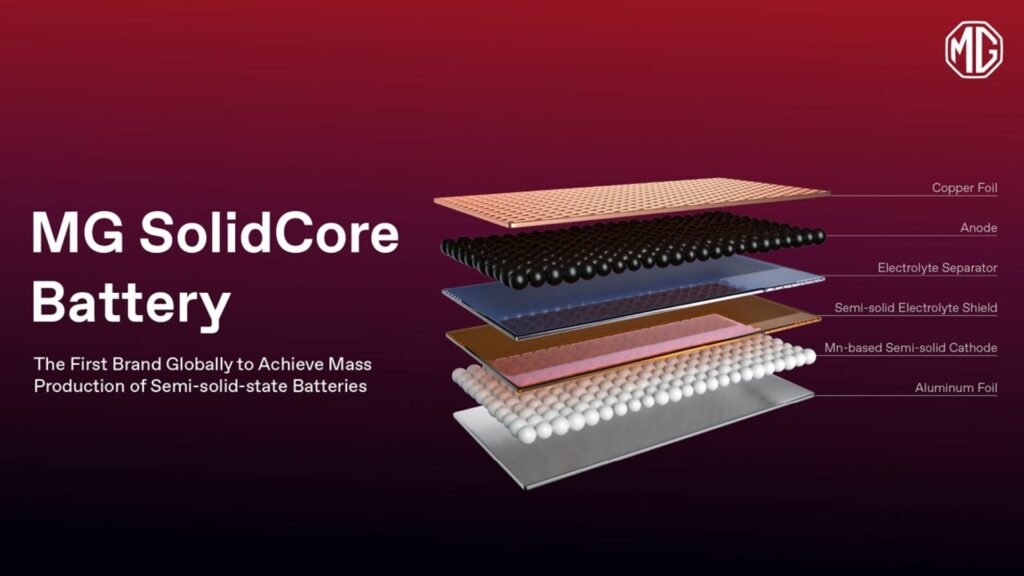
From the cathode side, the laminated components that make up one lithium-manganese oxide (LMO) cell in the SolidCore battery consist of aluminium foil, the manganese-based semi-solid cathode, a semi-solid electrolyte shield, the separator, the silicon-carbon (Si-C) composite anode, and the copper foil. The electrolyte shield protects the electrodes from degradation and acts as a thermal barrier.
The first generation of this technology boasts a specific energy of around 180 Wh/kg, which is similar to that of LFP, but QingTao has outlined a roadmap that includes a second generation with 368 Wh/kg and a third exceeding 500 Wh/kg, with different manganese-based chemistries.
From a cell chemistry perspective, the choice of LMO is significant. LMO’s spinel structure offers inherent advantages in rate capability and thermal stability, but its historical limitation has been cycle life degradation driven by manganese dissolution and the molecule-distorting Jahn-Teller effect. Its semi-solid nature helps overcome these limitations.
In conventional lithium-ion cells, the liquid electrolyte acts as both the transport medium and the aggressor, accelerating cathode degradation through surface corrosion and by carrying dissolved manganese to the anode. SolidCore’s architecture mitigates this by reducing the liquid electrolyte content to approximately 5% by weight — a substantial decrease from the 10 to 15% typical of conventional lithium-ion cells. The semi-solid electrolyte phase effectively limits the mobility of dissolved species, suppressing the crossover effect that drives capacity fade. For engineers working on cell degradation mechanisms, this represents a fundamental change: the cathode-electrolyte interface becomes more static, shifting the dominant failure modes from chemical dissolution to mechanical fatigue.
The Jahn-Teller effect is a lithium-trapping, capacity-reducing physical distortion of the LMO’s 3D crystal structure caused by a change in the electronic structure of manganese ions from Mn4+ to Mn3+ and back during charge-discharge cycles. Chemical engineers typically combat the distortion by doping the LMO crystal with supportive “scaffolding” in the form of ions of scandium, aluminium, or tungsten, and by limiting the allowable depth of discharge with the BMS to minimise the effect. SolidCore may benefit from both measures, while its semi-solid nature with minimal liquid electrolyte makes it inherently more stable physically.
The thermal management implications are equally noteworthy. Solid-state and semi-solid electrolytes typically exhibit lower ionic conductivity at room temperature compared to liquid electrolytes, necessitating careful thermal system integration. However, MG emphasises that SolidCore enables immediate vehicle start-up without preheating, even in low-temperature conditions. This suggests that the semi-solid electrolyte has been engineered to maintain adequate bulk ionic conductivity below 0°C, potentially through a combination of optimised electrolyte composition and internal cell architecture. This could simplify thermal management architectures, reducing or eliminating the need for active battery heating during preconditioning cycles.
(Image: MG)
Pragmatic scaling path
From a manufacturing perspective, the semi-solid approach offers a pragmatic path to scaling. Unlike full solid-state cells, which require expensive dry-room processing and are highly sensitive to interfacial voids, semi-solid electrolytes can be processed using adaptations of existing slurry-coating and winding equipment. This reduces the capital expenditure barrier and accelerates time to market. MG’s claim of mass production readiness implies that the technology has passed critical validation milestones for cycle life, safety, and manufacturing consistency.
Safety engineering is another domain where SolidCore introduces meaningful advantages. MG notes enhanced safety performance, and semi-solid electrolytes are inherently less flammable than their liquid counterparts. This translates to potential simplifications in thermal propagation mitigation strategies, such as reduced dependence on inter-cell barriers and active cooling redundancy.
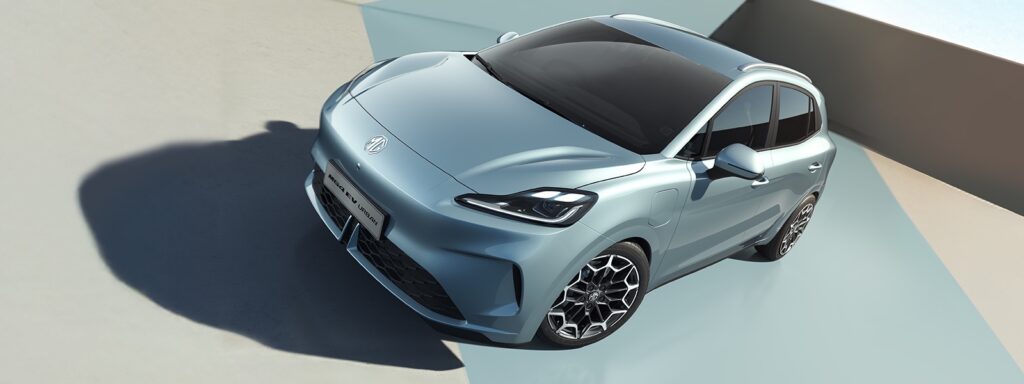
Perhaps the most significant implication is positioning. By bringing a semi-solid-state battery to market in 2026 – in the MG4 EV Urban city car – MG establishes a production platform that can evolve incrementally toward full solid-state architectures.
ONLINE PARTNERS