














Lighter, more efficient motor for aviation propulsion
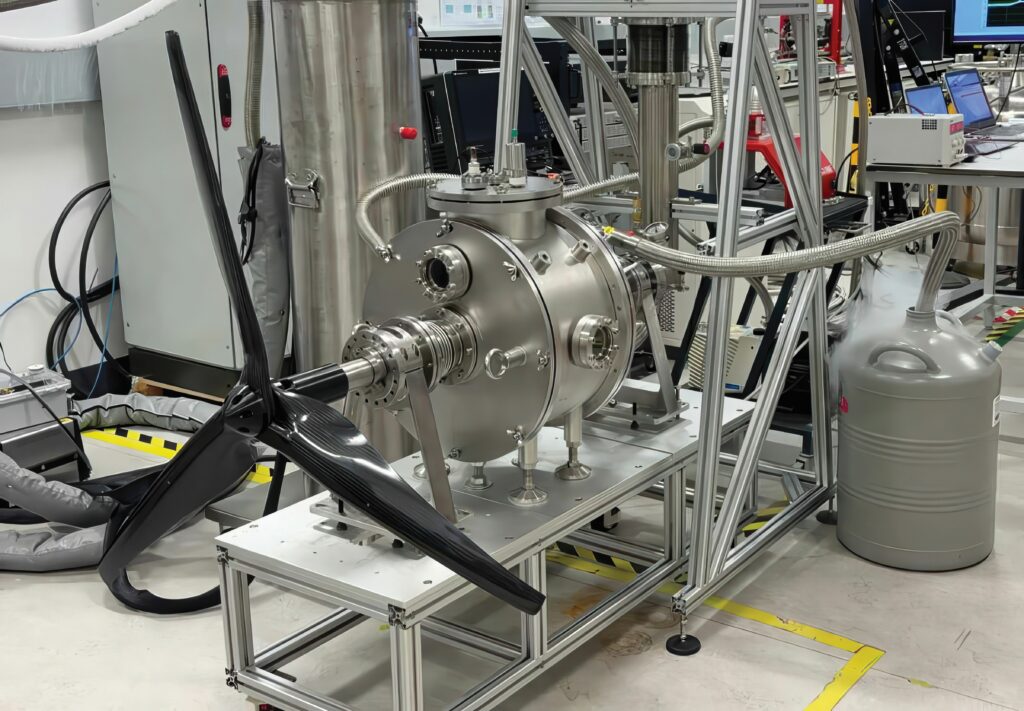
(Image: University of Strathclyde)
Researchers in Scotland have demonstrated a 100 kW fully superconducting axial flux motor for aviation, writes Nick Flaherty.
The prototype system was created by the Applied Superconductivity Laboratory (ASL) at the University of Strathclyde in Glasgow and operates at 20 K (-253 C).
“Superconducting technology offers a route to much lighter and more efficient propulsion systems, but it also brings major engineering challenges in cryogenic cooling, protection and system integration,” said Prof Min Zhang, who leads the ASL.
The Strathclyde team developed the motor from fundamental research through to technological demonstrator with low AC loss superconducting windings, new brushless excitation and rotational cryogenic operation in a single integrated platform.
“This demonstrator shows that fully superconducting aviation motors are no longer just a theoretical concept. By integrating superconducting windings, brushless excitation and cryogenic operation, we have created a platform that can help inform the next generation of megawatt-class propulsion systems,” said Zhang.
The motor is part of the UpNext demonstrator by Airbus.
Click here to read the latest issue of E-Mobility Engineering.
ONLINE PARTNERS