











Closing the compliance gap: validating EV chargers ahead of ISO 15118-20
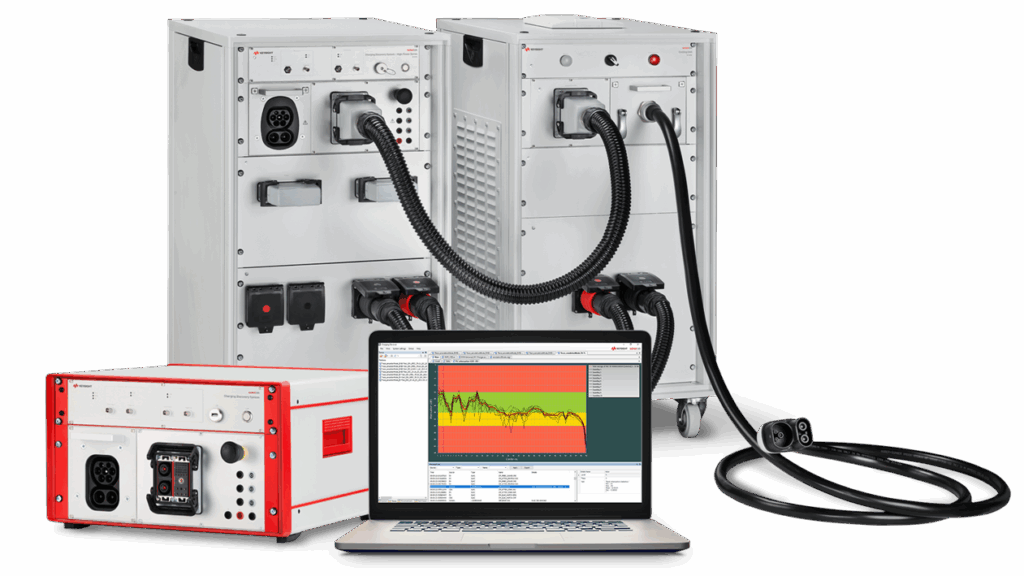
(Image: Keysight Technologies)
For engineers developing EV chargers and the broader infrastructure – from connectors and cables to software, collectively known as EV supply equipment (EVSE) – the European Union’s Alternative Fuels Infrastructure Regulation (AFIR) has fundamentally redefined the validation timeline. With a hard deadline of January 2027, every new or upgraded AC and DC charging station must support the ISO 15118-20 standard, which mandates TLS 1.3 mutual authentication, advanced Plug and Charge (PnC), and bidirectional power transfer (BPT) readiness.
The challenge lies not in the complexity of the standard alone, but in a critical mismatch between regulation and standardisation. While the legal framework is already in force, the official conformance test plans lag behind, according to Alexey Telegin, solutions engineering manager for power and e-mobility test solutions at Keysight Technologies. “Formal ISO 15118-20 AC conformance test cases are not expected before late 2027,” he says. For AC Mode 3 charging – encompassing both unidirectional and emerging bidirectional flows – this creates a compliance gap in which manufacturers must implement and validate functionality nearly a year before the official test methodology exists.
Traditional test-at-the-end strategies are no longer viable. Missing a single timing violation, certificate error, or response code can halt charging entirely. The solution requires shifting validation left, integrating it into the CI/CD pipeline early in the development cycle, enabling continuous verification of communication and system behaviour as the product evolves.
Keysight’s approach addresses this gap by decoupling validation from the standardisation timeline. “We already enable practical validation by emulating both EV and EVSE behaviour with full support of the ISO 15118-20 AC message set, including TLS 1.3, manual timing control, and error injection,” Telegin explains. “This allows validation of real implementation behaviour today, rather than waiting for the standardisation process to complete.” For formal conformance, testing is already available based on ISO 15118-21, providing a standardised baseline for communication validation for both AC and DC use cases.
A key differentiator is the integration of communication testing with power hardware-in-the-loop. “The platform links protocol-level commands with measurement of actual electrical response when combined with power emulation,” Telegin says. “Users gain synchronised visibility of communication messages, PLC or Automotive Ethernet communication, and power measurements within a single environment across the full charging process.”
Security validation is equally critical. Keysight’s environment supports Plug and Charge workflows with TLS 1.3 mutual authentication, including certificate installation, validation, and update handling across multiple public key infrastructure implementations. This covers scenarios such as successful and failed TLS handshakes, expired or invalid certificates, mismatched certificate chains, incorrect contract certificates, and signature validation failures.
For interoperability across vehicle brands, the solution is designed to reflect real-world variability across OEM implementations, validating behaviour under non-ideal conditions including timing variations, non-strict implementations, and stress scenarios.
On bidirectional readiness, the platform supports simulation of reverse power flow requests and validation of ISO 15118-20 BPT communication, safety logic, and system behaviour under realistic conditions for both AC and DC scenarios. By adding an AC emulator ahead of the EVSE, users can validate how digital BPT commands translate into real bidirectional power flow on the AC mains. The entire setup can be wrapped into an automated end-to-end test framework, enabling repeatable validation from communication and control logic down to physical power response.
Ultimately, the shift to ISO 15118-20 demands a test architecture that mirrors the complexity of the standard itself: automated, integrated, and capable of validating both communication conformance and physical-layer power behaviour from the earliest firmware builds through to final certification.
Click here to read the latest issue of E-Mobility Engineering.
ONLINE PARTNERS