







Keeping cool on the move
(Image: Nivalis)
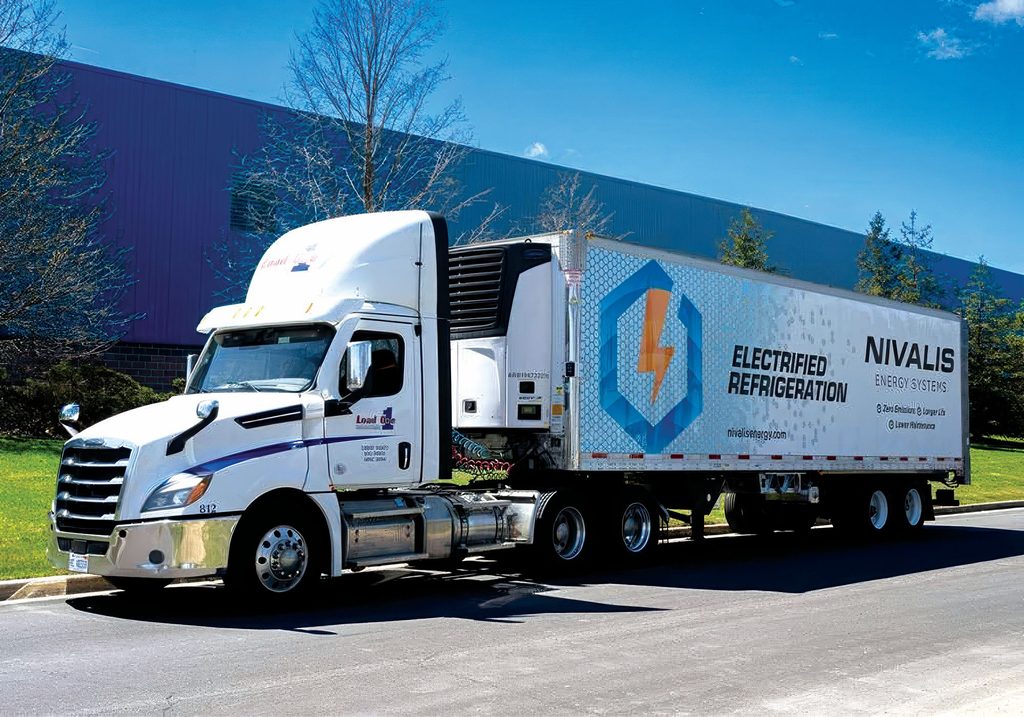
Nivalis Energy Europe has developed a solar-powered system and an e-axle system for refrigerated trucks to keep produce cool, writes Nick Flaherty.
“We have developed a battery system with an optional e-axle that is harvesting the power and an optional photovoltaic [PV] solar system on the roof,” said Pavel Gilman, vice president of project management in Europe for the company, which earlier this year acquired SolarEdge e-Mobility as its European operation.
The difference is the load. The PV provides energy for the refrigeration unit while for the e-axle, the load is also propulsion. As of writing, 70% of the trailers have both e-axle and solar, while 30% have solar only.
The 400 V battery pack includes the BMS, power distribution unit (PDU), vehicle control unit and inverter with 15 kWh of cells. “The sweet spot is 30 to 60 kWh, that’s two to four battery packs, but it can be more up to 180 kWh with 12 packs,” said Gilman. “30 kWh is for distribution logistics, while hub-to-hub is closer to 60 kWh.
“We are producing the battery packs ourselves in Italy for the European market, buying the cells from a partner in Asia. Today, it is NMC cells at 400 V but we are going to switch in 2027 to the next generation of our technology with a fully integrated PDU to support LFP to 800 V for commercial and efficiency benefits, and the e-motor and inverter will go to 800 V.”
The e-axle provides the ability to move the trailer on its own, assisting with operations in the logistics yard. If the SoC is below 20%, the axle will automatically go into backup mode as a dynamo for the refrigeration unit, providing 2–4 kW to keep the unit powered.
“We started with the e-motor from a range of suppliers and interface to the gearbox/reducer so we don’t reinvent the wheel. In Europe we have three different suppliers,” he said.
“We designed the motor for light commercial vehicles to give the best efficiency for the torque of the trailer with up to 96% efficiency as opposed to 84% or 86% that you see from an industrial motor, and that helps the weight-to-power ratio. So, our 25 kW peak power motor weighs 25 kg,” he said. “The mileage is significant. The lifetime is 1 million km for the e-axle and that means you have to redesign the motor bearings and seals.”
The solar panels are 2.5 mm thick flexible panels to fit on the trailer roof, which is typically 13.6 m long.
“There is a limited number of suppliers and we selected two suppliers after validating the technology. This produces 3 to 4 kW depending on the roof. What we are doing is using an optimiser from SolarEdge with microcontrollers for each panel. This gives us two big advantages to harvest the maximum amount, for example if the trailer is parked half in shadow, and we also receive stable voltage levels.
“A significant part of the system is the telematics and we developed our own system that has three main functions. It has a customer interface that shows where the energy is coming from, as well as diagnostics for us. The third use is for remote maintenance to update over the air without disturbing the customer.”
Click here to read the latest issue of E-Mobility Engineering.
ONLINE PARTNERS