

Improving magnetic performance in EV motors
(Image: DGIST)
Researchers in South Korea have developed a process for creating permanent magnets that reduces the need for heavy rare earth elements, writes Nick Flaherty.
The process significantly advances the diffusion technology, which is essential for improving magnetic performance, and creates new possibilities for applying high-efficiency magnets in EV motors.
Neodymium (Nd-Fe-B) permanent magnets, widely used in EV motors, show decline in magnetic performance under extreme heat, and require the addition of heavy rare earth elements such as terbium and dysprosium to maintain field strength; however, these elements are rare and expensive.
The current grain boundary diffusion process is limited to the surface layer and does not penetrate the magnet’s interior, making it difficult to apply to thick magnets.
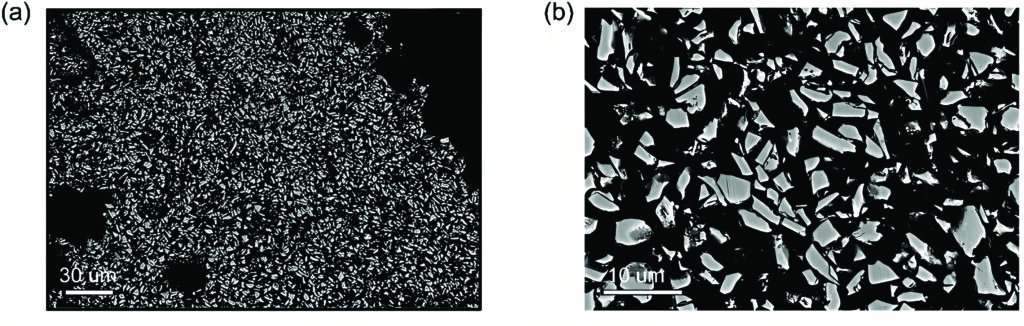
So, the team at the Nano Technology Research Division at DGIST in Korea, led by Dr Donghwan Kim and Dr Jungmin Kim, combined spark plasma sintering with the grain boundary diffusion process. Pre-mixing the diffusion material during the powder-based magnet fabrication stage achieved uniform diffusion throughout the magnet. This increased the diffusion depth, allowing the creation of structures such as a core–shell topology that has a higher, uniform performance.
A magnet created at 750 C and 50 MPa achieved near-theoretical density with minimal grain growth. A post-sintering heat treatment at 1000 C significantly enhances coercivity and refines the microstructure, even with the same amount of rare earth material as in conventional magnets, allowing fabrication of smaller and lighter magnets with the same magnetic strength.
“This study presents a method that overcomes the limitations of the conventional grain boundary diffusion technology, enabling uniform performance throughout the magnet. It will make a significant contribution to the development of high-performance permanent magnets,” said principal researcher Dr Donghwan Kim.
Click here to read the latest issue of E-Mobility Engineering.
ONLINE PARTNERS