












Improved cooling for high-power electric motors
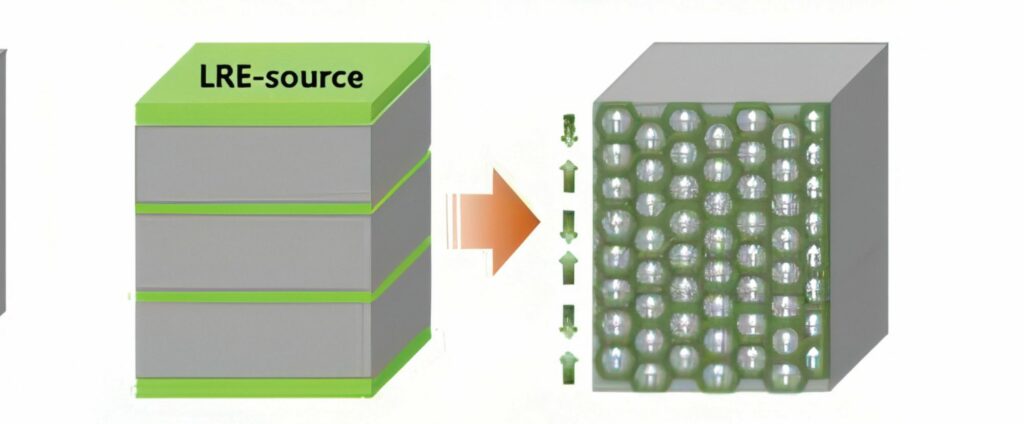
(Image: Korea Institute of Materials Science)
Researchers in Korea have developed a sandwiched magnet that improves the cooling for high-power motors in vehicles and electric shipping, writes Nick Flaherty.
The research team at the Korea Institute of Materials Science (KIMS) developed a sandwich-structured grain boundary diffusion and bonding process where multiple magnet layers are stacked and then integrated.
As the power output of motors based on Neodymium–iron–boron (Nd-Fe-B) magnets increases, it becomes increasingly difficult to maintain high coercivity throughout the entire magnet. In addition, high-speed operation induces eddy currents within the magnet, generating heat that leads to performance degradation and reduced motor efficiency.
Conventionally, heavy rare earth (HRE) elements have been added to maintain magnetic performance at elevated temperatures. In particular, grain boundary diffusion processes, which involve coating HRE elements on the magnet surface and allowing them to diffuse inward, have been widely used.
The HRE elements are coated or sprayed on the surface and the magnet is heated in a vacuum at temperatures of 900–1000 C. The molten elements travel rapidly along the liquid grain boundaries and penetrate the outer edges of the main magnetic grains. This forms an outer shell of HRE around the Nd-Fe-B core.
However, this approach is limited by the diffusion mechanism that is based on the surface of the grains. This makes it difficult to achieve sufficient performance improvement in the interior of thick magnets and can lead to overheating.
Typically, HRE elements such as neodymium, dysprosiuum and terbium are expensive and can be subject to supply chain constraints in sourcing from China. This poses significant supply chain challenges and this is driving magnet makers to reduce the use of these elements.
To eliminate the use of HRE elements, the process developed at KIMS is instead based around a light rare earth alloy with a low melting point using praseodymium not only on the surface but also at the interlayer interfaces. This enables diffusion to initiate from within the magnet as well. This achieves stable coercivity even in thick magnets while ensuring uniform performance throughout the entire structure. It also reduces the reliance on expensive HRE elements.
The technology also addresses heat generation by forming a high-resistivity structure within the magnet, which suppresses eddy current formation. Unlike conventional approaches that require separate processes for magnet segmentation, grain boundary diffusion, and insulating bonding, this method simultaneously enhances coercivity and electrical resistivity through a single grain boundary diffusion process. This integrated approach simplifies manufacturing while improving magnetic, electrical, and structural properties.
The resulting magnets can be used for electric vehicle traction motors where the lower heat generation and improved efficiency at the magnet level can enhance overall motor performance and energy efficiency.
“This study demonstrates a breakthrough in simultaneously achieving high coercivity and reduced heat generation in thick magnets,” said Su-Min Kim, senior researcher at KIMS.
“What differentiates this technology is that it integrates coercivity enhancement, resistivity improvement and structural bonding into a single process. This technology has strong potential not only for electric vehicle motors but also for applications requiring large, high-performance magnets, such as electric ships, and it is expected to evolve into a key materials technology for next-generation motors,” he added.
Click here to read the latest issue of E-Mobility Engineering.
ONLINE PARTNERS