








Battery debonding
(Image: Henkel)
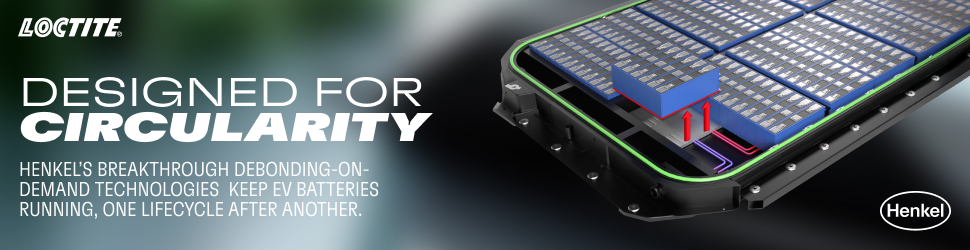
Henkel’s debonding-on-demand technology turns EV batteries from “single-use” assets into repairable, upgradeable and recyclable platforms, cutting costs across the full lifecycle while helping OEMs meet circularity and regulatory targets. The solution combines robust in-use bonding with controlled, precise separation on-demand, allowing valuable materials to remain in circulation across multiple lifecycles and supporting a more sustainable EV battery ecosystem.
“At the moment, for batteries, we see the debonding on demand particularly relevant for end of line and in-use repair, along with end-of-life applications and recycling,” says Dr. Tobias Knecht, head of e-mobility global strategy at Henkel. At the end of the production line, this creates a rework option for welding defects, assembly issues or electronics failures that would otherwise force OEMs to scrap high-value packs, directly impacting yield, cost per unit and CO₂ footprint.
“The industry is moving towards more integrated battery concepts such as cell-to-pack or cell-to chassis. In comparison to modular concepts, these designs allow for higher volume utilizations, lighter weights and reduced costs but also come with challenges with respect to repair and recycling. While modular concepts facilitate EV battery pack disassembly and recycling, in cell-to-pack designs where the battery cells are structurally bonded into the battery housings that is hardly possible,” he says. Henkel’s debonding-on-demand adhesives are designed specifically for these highly integrated packs, enabling targeted access to cells, modules and cooling components without destroying the surrounding structure, protecting the upfront investment in pack manufacturing.
“At the end of the vehicle life, we see the demand for debonding solutions coming from recycling. In structural battery pack designs with limited options for disassembly, recyclers are often required to shred the entire packs leading to low-quality waste stream. Our debonding-on-demand technologies enable the clean separation of the battery cells from the pack” says Knecht. This controlled disassembly supports higher recovery rates and cleaner material streams, which improves recycling economics, supports compliance with emerging battery legislation and strengthens OEMs’ sustainability credentials.
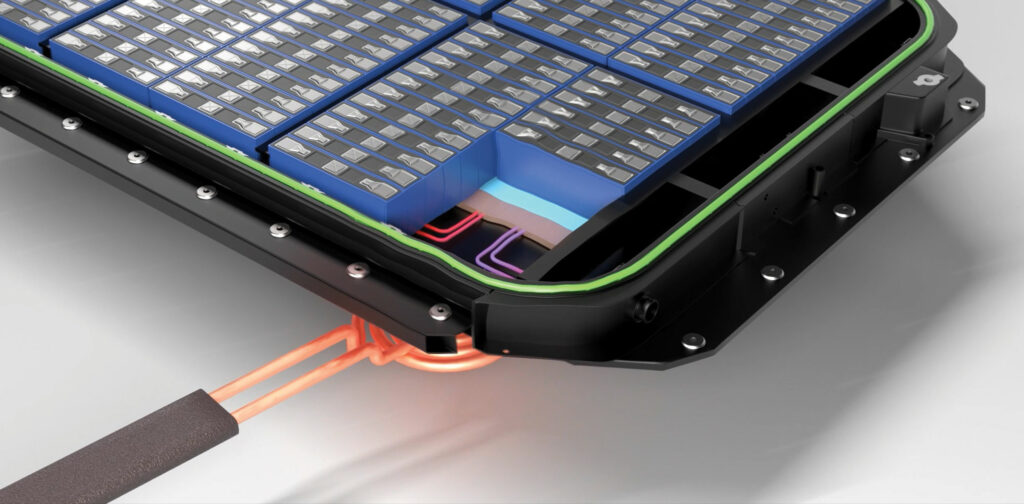
The debonding process can be triggered either thermally or electrically, each based on tailored adhesive chemistries that can be aligned with the OEM’s and battery manufacturer’s battery designs and operational strategies. Thermal debonding uses heat to activate a debonding layer at the bond line, allowing the adhesive to weaken and enabling clean separation of substrates such as cells and cooling plates. This can be done via induction, integrated heaters or through the cooling plate with a heated medium, and is suitable where pack or compartment-level heating fits the service concept.
Electrical debonding relies on an electric field between two conductive surfaces bonded with an engineered adhesive layer. When voltage is applied, a reaction at the interface reduces the adhesive forces to near zero, enabling precise and non-destructive separation under mild conditions. For battery makers, this opens up new commercial models around repair, upgrade and second life, as cells or modules can be selectively removed and replaced without compromising the rest of the pack.
“Many people approach us for a solution specifically tailored to their application. So, for the best results, you need to think about debonding on demand at the early design stage,” says Tom Fleck, (former) product development chemist at Henkel. “We see a lot of different approaches and a lot of different entry points depending on our customers design criteria.” Working with Henkel early helps OEMs build a business case around material selection, service strategies and total cost of ownership.
“There are two main triggers that cause the loss of adhesion: electrical and thermal,” says Dr. Fleck. “Thermal debonding can be introduced through a thin additional layer between the adhesive or sealant. If the bond line is heated up the debonding process is triggered and materials can be easily separated. For electrical debonding, the debonding functionality can be directly integrated into the adhesive which creates a lot of design flexibility, however, it requires two conducting surfaces to apply an electrical field to the adhesive.” These trade-offs allow OEMs to choose the concept that best supports their service model, cost targets and brand positioning.
“We further offer electrical film and tape debonding solutions,” says Fleck. These products allow of easy cutting and handling while maintaining favourable thermal paths and mechanical performance in the pack, helping engineering teams implement debonding with minimal impact on existing production processes.
Henkel backs its debonding-on-demand solutions with testing, ageing and validation to meet automotive requirements over the full battery lifetime. Combined with global application engineering support and a portfolio that spans structural adhesives, thermal interface materials, gasketings and functional coatings, this positions Henkel as a strategic partner for OEMs and battery manufacturers who want to turn sustainability, serviceability and circularity into tangible commercial advantages.
Click here to read the latest issue of E-Mobility Engineering.
ONLINE PARTNERS