







Fast-charger manufacturing
(Image: Kempower)
Charging ahead
As the fundamental electronics of EV fast chargers mature, Peter Donaldson considers the options available to manufacturers for upscaling production
EV charging has reached an inflection point as an industry. The fundamental power electronics of fast charging are largely mature. At the time of writing, the bottleneck is no longer topology or semiconductor physics, it is around manufacturing scalability, quality consistency and supply chain resilience.
Yet, there is no single blueprint for building chargers at scale. Four companies represent fundamentally different strategic approaches. ABB operates high-automation, capital-intensive factories. Tesla pursues vertical integration, embedding charger production within its vehicle ecosystem and standardising the North American market around the North American Charging Standard (NACS). Kempower champions modularity and local supply chains, building scalable 50 kW power blocks in Finland and North Carolina. ChargePoint owns no factories at all, relying solely on established partners for both hardware development and manufacturing while it focuses on software, network operations and AI-driven quality validation.
Each model has distinct trade-offs in terms of capital intensity, the ability to respond quickly and cost-effectively to regulatory changes (that is ‘regulatory agility’), quality control and supply chain risk. On the regulatory front in the US, for example, the National Electric Vehicle Infrastructure (NEVI) programme that provides government funding and the Buy America, Build America (BABA) act loom particularly large. Understanding these manufacturing strategies directly informs supplier selection, design-for-manufacturing decisions and long-term reliability expectations.
Four strategy archetypes
The four companies in this arms-length comparison represent fundamentally different approaches to manufacturing.
ABB represents the industrial giant’s approach: own the factory, automate everything and push for consistent output at volumes that smaller competitors cannot match. For example, the Valdarno facility produces one DC fast charger every 20 minutes. This model excels at repeatability but requires sustained capital investment and long lead times to retool.
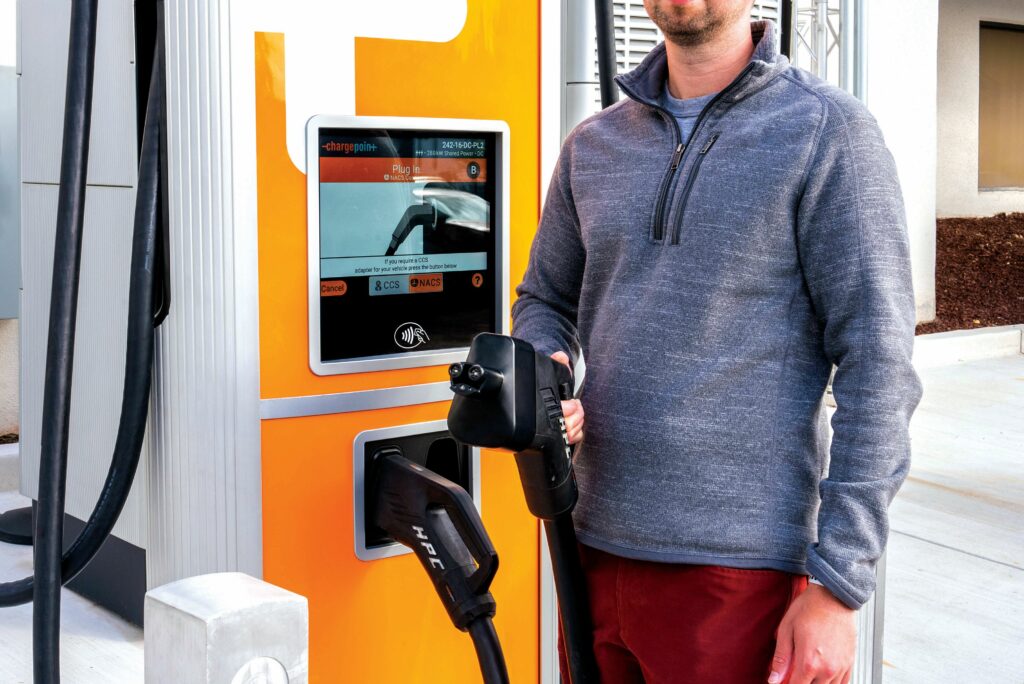
Tesla inverts the logic. Manufacturing serves the ecosystem, not the charger market. The Supercharger is a component of the Tesla ownership experience, optimised for vehicle integration rather than standalone sale. While this originally locked customers (and Tesla itself) into proprietary interfaces, this changed when the company opened the NACS design files to the public in November 2022, leading to a wave of vehicle manufacturers announcing their migration to NACS through 2023 (see below) and mass vehicle integration during 2025.
Kempower offers a third path characterised by modularity and localism. By standardising on 50 kW power blocks that stack to any desired capacity, Kempower avoids retooling its lines for different power ratings. By sourcing locally in Finland and building a US factory in North Carolina, it insulates itself from global supply chain shocks.
ChargePoint takes the most radical position of all. Instead of owning and operating factories, the company co-develops hardware with AcBel Polytech and manufactures through Kinpo – a global electronics giant with 24 production bases. ChargePoint’s core competence lies in software, network operations and AI-driven quality validation.
Each of these models has particular strengths and vulnerabilities.
High-automation global scale model
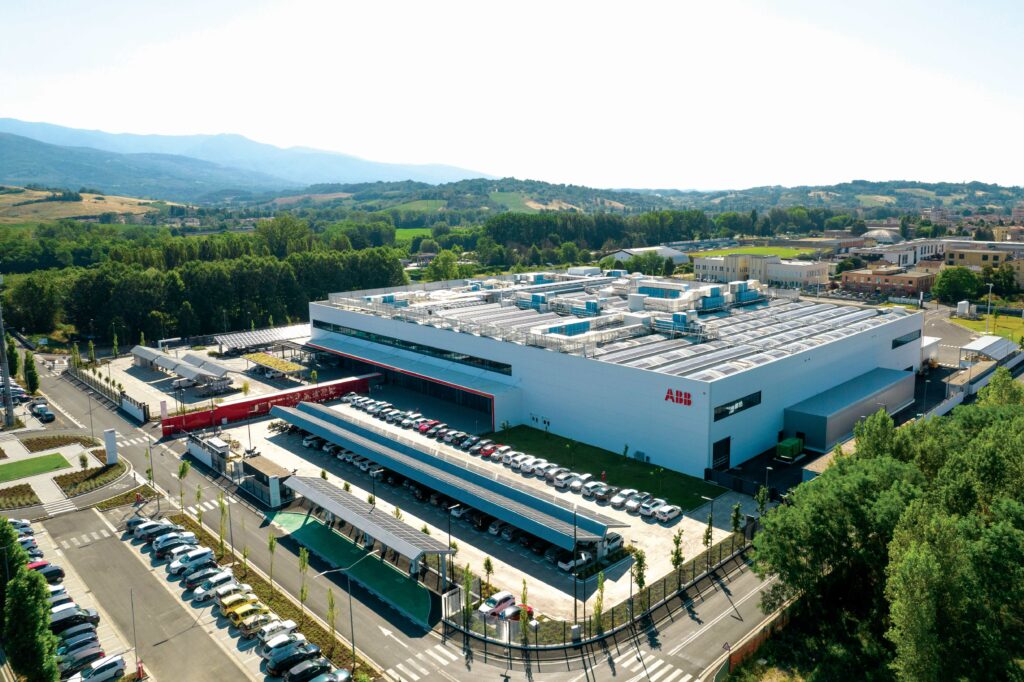
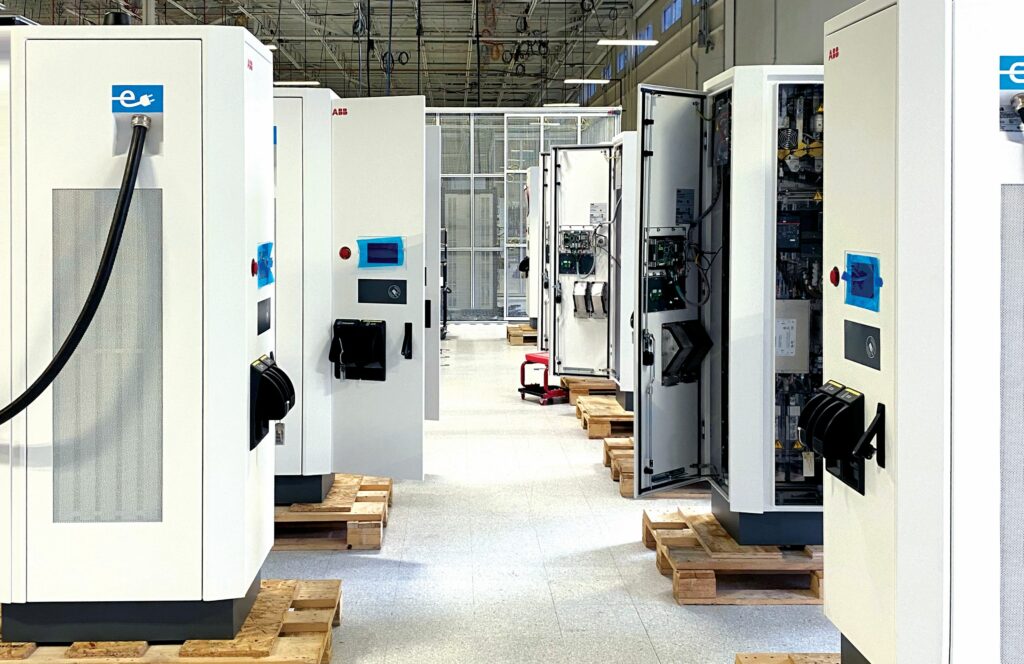
With more than a million EV chargers sold across 85 markets, including over 50,000 DC fast chargers, ABB has built a global production footprint designed for scale, regulatory compliance and continuous quality validation. Its flagship manufacturing facility, in San Giovanni Valdarno, Italy, is a 16,000 m² ‘centre of excellence’ representing an investment of US $30 million. Valdarno’s output comes from seven automated production lines, supported by 15 testing facilities capable of simulating over 400 charging sessions per day. Research and development are tightly integrated in a 3200 m² section of the facility dedicated to prototyping and product lifecycle management, with approximately 70 of the site’s 500 employees focused on R&D. This co-location of engineering and production allows ABB to rapidly deploy new software tools and manufacturing process improvements directly to the factory floor.
Embodying ABB’s broader industrial automation philosophy, the plant uses autonomous guided vehicles to connect production lines to an automatic warehouse, enabling 24/7 operations with optimised stock control and full traceability. Each DC charger passes through numerous sensors during assembly, with AI-powered optical inspection systems comparing boards to expected photos and using machine learning feedback loops to improve defect detection over time.
(Image: ABB E-Mobility)
Responding to the pressure to manufacture in the US, ABB established production capacity for 10,000 DC chargers annually in Columbia, South Carolina, starting operations in early 2023. The facility was developed in partnership with global manufacturing partner Flex to speed production ramp-up. The plant produces Terra 184 DC fast chargers (up to 180 kW) and Terra DC Wallbox units (up to 24 kW), both of which are NEVI-ready and compliant with Federal Highway Administration BABA requirements.
ABB’s manufacturing model delivers exceptional consistency, traceability, and regulatory agility – advantages that are difficult for smaller competitors to replicate. The company’s ability to produce NEVI-compliant chargers from a US facility positions it to benefit from federal infrastructure spending. However, this comes at the cost of high capital intensity and the inflexibility of large-scale automated lines when market requirements shift.
Tesla vertical integration
Tesla’s approach to charger manufacturing is inseparable from its broader strategy as a vertically integrated car manufacturer. Tesla manufactures Superchargers primarily to serve its own vehicles, although that is rapidly changing. The company controls roughly 80% of its supply chain, from battery cells to power electronics to charging infrastructure, giving it an unusual degree of coordination between vehicle and charger development.
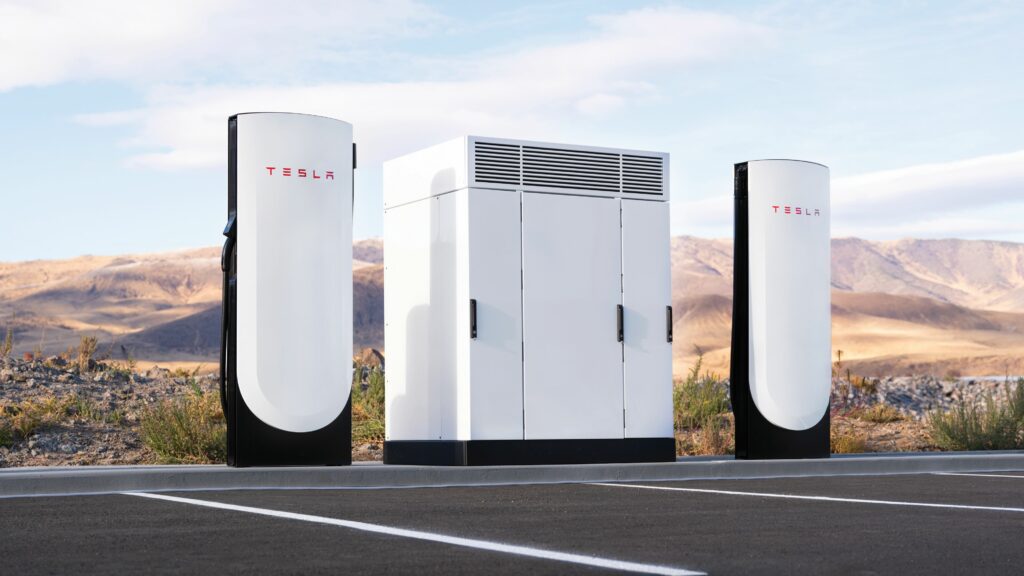
Tesla’s primary Supercharger manufacturing facility is Gigafactory New York in Buffalo (USA). The 1.2 million square foot facility, leased from the State of New York, produces both Tesla Solar Roof products and Superchargers, and the number of V4 Supercharger posts that it has built surpassed 25,000 in June 2025. Replacing the 250 kW V3 Supercharger, the 325 kW V4 marks both a shift to higher power output and, crucially, compatibility with rival EVs.
Tesla also established a Supercharger factory in Shanghai adjacent to Gigafactory 3, with an announced annual capacity of 10,000 charging stations demonstrating its ability to localise production in its largest markets.
NACS and ecosystem strategy
Perhaps the most consequential manufacturing decision Tesla has made is the development and subsequent sharing of NACS. Originally Tesla’s proprietary connector standard, NACS was opened to other manufacturers in November 2022 and is now being standardised as SAE J3400. The connector uses a compact five-pin layout where the same two pins handle both AC and DC charging.
(Image: ABB E-Mobility)
Between May and December 2023, Ford, General Motors, Rivian, Volvo and Polestar all announced that their North American EVs would adopt NACS ports starting in 2025. This shift transforms Tesla’s Supercharger manufacturing from a captive operation serving only Tesla owners into a supplier of charging infrastructure for the majority of the North American EV market.
Digital intelligence
Tesla’s broader manufacturing philosophy is best illustrated by its Shanghai facility. The Shanghai Gigafactory implemented a ‘digital intelligence’ quality management system starting in 2020, which the company credits with enabling rapid scaling of vehicle production while maintaining quality. The system encompasses a proprietary Manufacturing Operating System (MOS) and automatic detection equipment that monitors critical quality during manufacture, with all test data uploaded to the database with full traceability. For chargers, this same philosophy applies.
Tesla’s vertically integrated manufacturing model offers a number of advantages. The ability to coordinate Supercharger development with vehicle battery architecture allows Tesla to optimise charging curves, communication protocols and thermal management across the entire system. The opening of NACS and production of V4 Superchargers with third-party compatibility moves Tesla from being a closed ecosystem to something closer to a platform provider. The key trade-off, however, is that while vertical integration gives Tesla control, it also concentrates risk. If Gigafactory New York faces production issues, there is no alternative supplier.
Modular local production
Kempower represents a third manufacturing archetype characterised by modularity and local supply chains. Kempower has built its production strategy around standardising on 50 kW power modules that can be stacked like building blocks to create chargers of any capacity from 50 to over 600 kW. This modular architecture has profound implications for manufacturing flexibility, capital efficiency and supply chain resilience.
The engineering advantages are straightforward: modularity reduces product variants, simplifies inventory management and enables what Kempower calls “staged path deployment.” Charging site operators can launch at 150–200 kW, generate revenue, then add modules as grid capacity becomes available without replacing the entire cabinet. This approach minimises ‘stranded’ assets and accelerates time to value, a practical benefit that flows directly from Kempower’s manufacturing decisions.
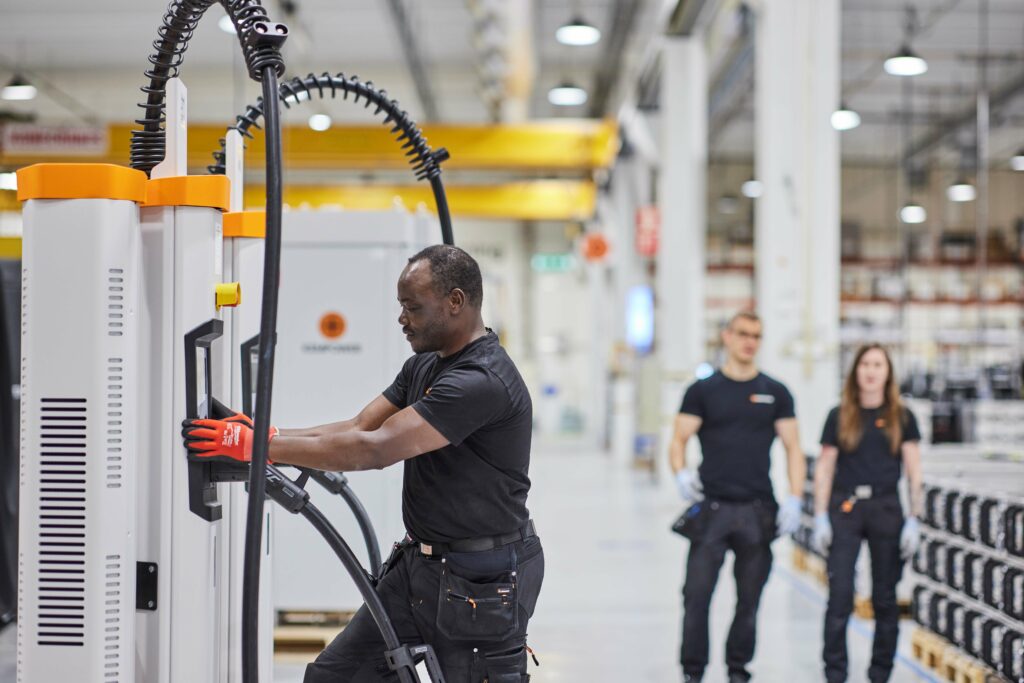
Kempower operates three factories in Lahti, Finland, which serve as its headquarters and primary production hub, and sources the majority of materials and components from local Finnish partners. This localisation acts as a foundational element of its supply chain resilience and carbon neutrality targets. It supports both quality control and environmental, social and governance objectives, reducing transport emissions and enabling faster reaction times to supply disruptions.
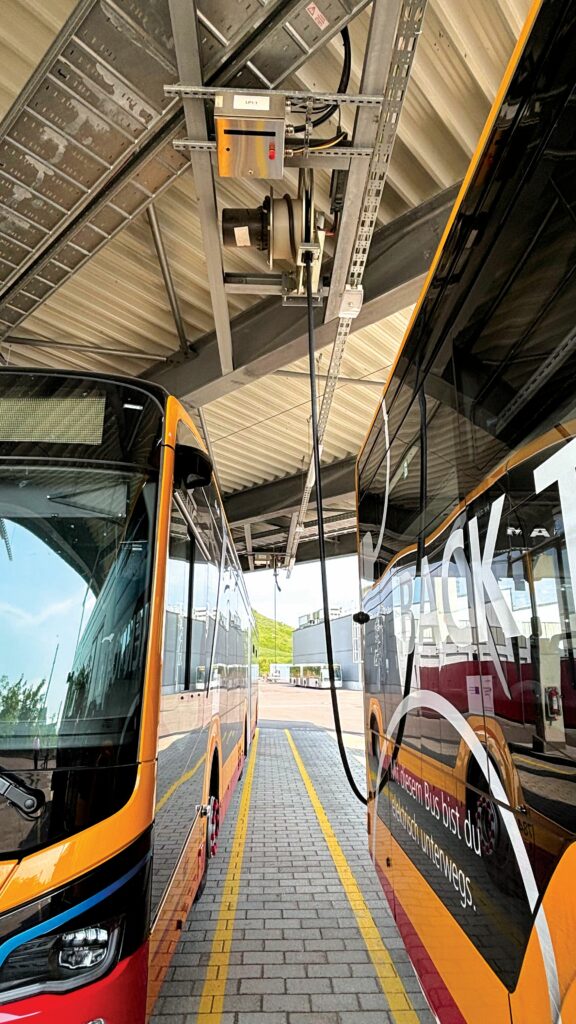
The Lahti facilities have also embraced automated internal logistics in the form of an autonomous electric bus to transport power modules between its two main factories in Lahti, starting in January 2024. Supplied by Finnish robotics specialist Remoted, the bus replaced conventional trucks, improving efficiency, reducing dependency on storage and lowering emissions.
This automation has since expanded. In November 2025, Kempower announced that its local logistics partner Posti had deployed a high-power Mercedes-Benz eActros 600 electric truck to carry charging satellites, power cabinets and modules from three factories to the finished goods warehouse, as well as components from local subcontractors to the factories. This electrification of intra-facility transport contributes directly to the company’s sustainability targets.
Kempower’s most significant recent manufacturing expansion is its facility in Durham, North Carolina (USA), which officially opened in June 2024. The leased 14,000 m2 (154,000 ft2) space represents the company’s fourth factory globally and its first outside Finland. The Durham factory is designed to produce NEVI-compliant DC fast chargers for the US and Canadian markets, supporting CCS, NACS and CHAdeMO connectors.
A notable aspect of Kempower’s manufacturing approach is the integration of cybersecurity standards into production. The company has received ISO 27001 certification for two consecutive years, covering chargers, ChargEye charging management software and back-end systems.
Kempower’s trade-off
Kempower’s modular local production model offers distinct advantages: exceptional flexibility (no retooling needed to change power ratings), reduced capital risk (operators can ‘pay as they grow’) and supply chain resilience (local sourcing in two regions). The company’s transparency on quality metrics and sustainability targets also distinguishes it from competitors.
However, there are trade-offs. Kempower is smaller than either ABB or Tesla, although it has declared the ambition to become one of the top five global players in the DC charging market by 2030. The company’s reliance on local sourcing, while beneficial for quality control, may limit its ability to scale as rapidly as competitors who tap global supply chains. Moreover, the modular architecture imposes a per-module cost floor that monolithic designs might undercut at high volumes.
Perhaps the key takeaway is that Kempower has designed its manufacturing process around the physical constraints of power electronics (heat, modularity, serviceability) rather than around corporate legacy or ecosystem lock-in.
ChargePoint’s asset-light partnership model
ChargePoint represents the most radical departure from the manufacturing models discussed so far in that its policy is not to own any factories. Instead, the company has pivoted to an asset-light, partnership-driven model. This centres on co-developing hardware with strategic partners and manufacturing through global electronics giants, while focusing its internal engineering resources on software, network operations and quality validation. This strategy positions ChargePoint not as a hardware manufacturer in the traditional sense but as a charging ecosystem orchestrator.
In February 2024, ChargePoint announced significant expansion of its relationship with AcBel Polytech and Kinpo Group. AcBel, a Taiwanese power supply manufacturer with 40 years of expertise in power design, became ChargePoint’s co-development partner for hardware. Kinpo Group – which owns four companies, 24 production bases and employs more than 50,000 people worldwide – took responsibility for large-scale manufacturing.
(Image: Tesla)
The partnership combines three complementary capabilities: AcBel’s power electronics design expertise, Kinpo’s lean supply chain and automated production technology across 24 global bases, and ChargePoint’s market position, software platform and charging network know-how.
Kinpo’s manufacturing credentials are substantial. The group has 50 years of experience in lean supply chain and automated production technology, with capabilities spanning semiconductors, consumer electronics, smart home appliances and industrial IoT. Its Thai production base features remote situation rooms with real-time monitoring systems, enabling sales, business, R&D and manufacturing units to coordinate across time zones.
Advanced test facility
ChargePoint’s approach to ensuring quality without owning factories is based on its in-house engineering validation capabilities and a structured product development life cycle that operates independently of manufacturing partners.
ChargePoint’s engineering team follows a disciplined process. At the product architecture phase, engineers apply lessons from predecessor designs to guide material selection and printed circuit board assembly layout, ensuring operating conditions include built-in safety margins. The team uses failure mode and effects analysis to systematically identify potential risks, apply cross-functional input and develop a roadmap for rigorous validation.
The validation cycle follows a three-phase structure familiar to automotive and aerospace engineers. Engineering validation testing focuses on initial validation of design choices and early failure discovery. Then, design validation testing takes designs nearing production and tests them for durability. Finally, production validation testing confirms that mass-production units meet long-term field expectations.
(Image: ChargePoint)
The process is iterative. When failures occur, they trigger immediate root cause analysis, corrective actions and revalidation. Through this continuous feedback loop, ChargePoint aims to ensure that products maintain reliability into deployment.
AI-driven quality control
ChargePoint has also embraced AI to maintain quality oversight across its contract manufacturing operations. The company deployed the Instrumental’s Manufacturing AI platform across its assembly operations. The results, according to a ChargePoint case study, have been significant. Using AI and traceable data records, the company identified and addressed 17 anomalies during the development phase, preventing potential defects from making it into the final design. The platform provided data traceability and analysis that halved the time needed to identify and solve problems.
This AI-driven approach to quality control represents a pragmatic adaptation to the asset-light model – one that relies on data transparency and automated anomaly detection.
Pros and cons
ChargePoint’s asset-light model enables it to scale production without the capital burden of building and operating factories. It can switch or add manufacturing partners as market conditions change. Additionally, it can focus its engineering resources on software, network reliability and user experience – areas where traditional hardware manufacturers may struggle.
However, there are trade-offs. Quality control is indirect, mediated through contract manufacturing relationships. Supply chain transparency is less than what ABB or Kempower achieve with owned factories. Moreover, regulatory compliance (notably NEVI ‘Buy America’ requirements) may be more challenging to demonstrate without a wholly owned US manufacturing presence.
Whether this model can scale to meet the demands of NEVI-funded infrastructure projects – where uptime requirements are high and failure penalties are real – remains an open question. But ChargePoint’s explicit bet is that software-defined quality management can match or exceed the consistency of traditional automated factories.
Capital intensity versus manufacturing control
The four companies considered occupy distinct positions on the spectrum between capital investment and operational control.
ABB represents the traditional industrial model: spend heavily on automation, own the entire production process and achieve consistency at scale. The trade-off is reduced flexibility because retooling a line that produces one charger every 20 minutes is costly.
Tesla follows a similar capital-intensive path but with an important difference in that the factory is subordinated to the ecosystem, and its production metrics are less important than the reliability of its network. The trade-off is outsiders have limited visibility into its manufacturing processes.
(Image: ChargePoint)
Kempower offers a middle path. Its modular architecture reduces the need for retooling when power requirements change, and local sourcing provides supply chain visibility without the capital burden of large-scale automation. The trade-off is geographic concentration – Finland is a stable manufacturing base, but scaling globally requires replicating the local-supplier model in each new region.
ChargePoint has made the most radical choice: minimal capital intensity, indirect control, but high flexibility to switch manufacturing partners. The trade-off is that quality assurance must be accomplished through process rigour and AI-driven oversight.
QA approaches
Each company has developed a distinct quality philosophy rooted in its manufacturing model.
ABB’s quality advantage is predictability. With intensive monitoring of each DC charger and 15 test facilities simulating more than 400 sessions daily, the company has reduced variability to a minimum. The limitation is that this approach works best at high volume – the fixed cost of the quality infrastructure is substantial.
Tesla’s quality system, as documented in Shanghai, relies on proprietary MOS software and big data analytics rather than off-the-shelf inspection tools. This allows Tesla to correlate manufacturing parameters with field performance in ways that component-level suppliers cannot. The limitation is that the system is not transparent to outside engineers.
Kempower’s quality model is built on local supply chain control. By sourcing the majority of components from Finnish partners, Kempower maintains tight traceability without the overhead of ABB-scale in-line inspection. Test lines are shared across products and provide a final validation step. The limitation is that scaling to new regions requires supplier relationships.
ChargePoint’s quality approach is the most process-dependent. Because the company does not own factories, it has substituted a rigorous validation life cycle (EVT, DVT, and PVT) and AI-driven anomaly detection (Instrumental platform) for direct in-line inspection. The reported result (reduced time spent hunting defects and determining their root causes) suggests that this model can work, but it requires exceptional discipline.
Regulatory strategy
The US Bipartisan Infrastructure Law’s NEVI program requires that chargers funded through the program meet BABA requirements, with domestic content increasing over time. How each company has positioned itself for this regulatory reality reveals strategic priorities.
ABB has the clearest NEVI strategy. The Columbia, South Carolina, plant was established explicitly to produce NEVI-compliant chargers. For federally funded infrastructure projects, ABB has a first-mover advantage.
Tesla produces Superchargers in New York and has begun opening its network to Ford, GM and Rivian. While Tesla has not marketed its Superchargers as NEVI products, the company’s US manufacturing footprint suggests compliance would be achievable. The larger strategic question is whether Tesla wants to participate in NEVI funding, given the program’s reporting and uptime requirements.
Kempower opened its Durham, North Carolina, factory in June 2024, producing chargers for the US and Canadian markets with CCS, NACS and CHAdeMO connectors. The facility is new and its production volume is not yet comparable to that of ABB’s Columbia plant. However, the company has signalled clear intent to compete for NEVI-funded projects.
ChargePoint faces the most uncertainty. The company’s asset-light model relies on Kinpo and AcBel for manufacturing. While Kinpo handles global scaling and APAC/European electronics footprints, ChargePoint has a history of navigating BABA via regional domestic contract partnerships – such as its earlier arrangement with Sanmina over building chargers in Texas.
Which model scales?
Each model has a plausible path to scale but the constraints differ.
ABB’s challenge is capital intensity. The model works when demand is predictable and volumes are high. If the market fragments (eg multiple connector standards, regional power requirements, diverse regulatory regimes), ABB’s highly optimised lines may become liabilities.
Tesla’s challenge is ecosystem dependence. Opening NACS to competitors reduces this risk, but Tesla still manufactures chargers primarily to serve its own vehicles, unless the company decides to become a true supplier to other automakers.
Kempower’s challenge is geographic replication. The local-supplier model works excellently in Finland, but could be difficult to replicate in North America, Europe and Asia simultaneously.
ChargePoint’s challenge is quality consistency at scale. The asset-light model has been validated at moderate volumes. Whether AI-driven anomaly detection and contract manufacturer oversight can maintain more than 99% uptime while satisfying NEVI reporting requirements is the central open question for the company.
It is clear, therefore, that there is no single ‘best’ manufacturing model. The right choice depends on capital availability, regulatory exposure, geographic footprint and tolerance for supply chain risk.
ONLINE PARTNERS