










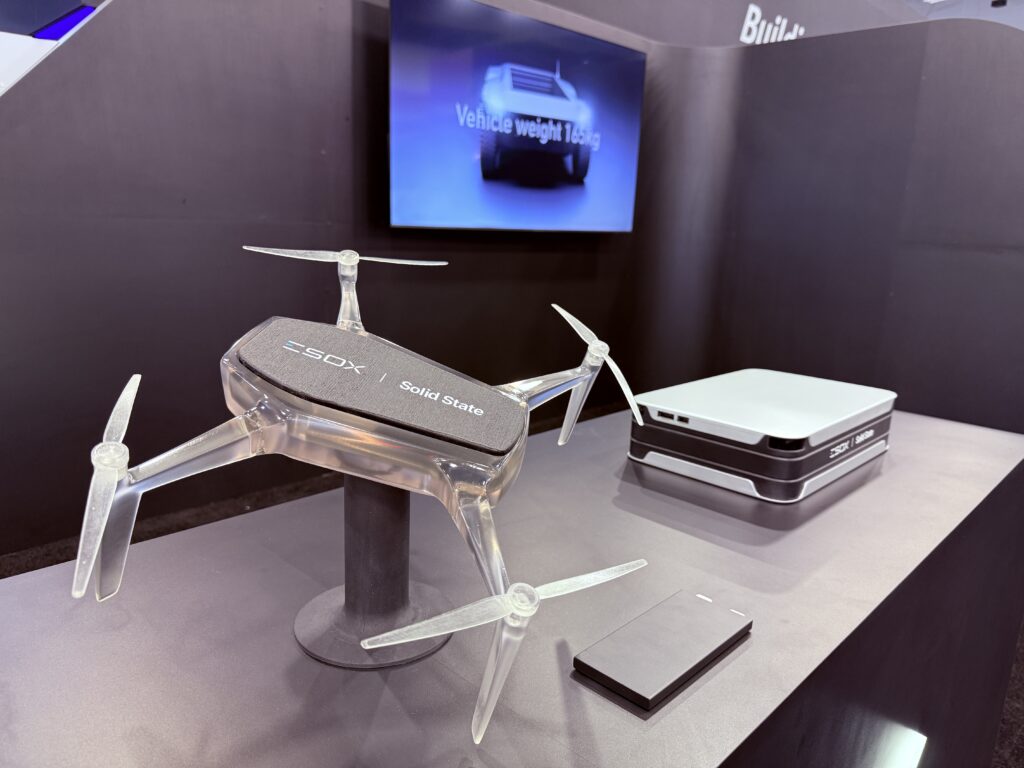
ESOX integrates Donut Lab solid-state batteries in X1 drone and X2 defence UGV demos
(Image courtesy of ESOX Group)
UK defence technology company ESOX Group has outlined plans to deploy Donut Lab’s newly announced solid-state battery technology across military and security platforms, with final testing now underway ahead of production ramp-up in the second half of 2026.
The move follows Donut Lab’s CES 2026 reveal of what it claims is the world’s first production-ready solid-state battery. While Donut Lab is targeting passenger vehicles, ESOX is working under a separate defence licensing agreement to adapt the technology for uncrewed aerial and ground systems, where energy density, thermal stability and supply chain security are becoming strategic priorities. At CES, the company presented two demonstrators designed to validate the technology in real-world defence applications: the X1 interceptor drone and the X2 UGV testbed.
The solid-state cells deliver 400 Wh/kg energy density, offering meaningful weight savings over lithium-ion packs. For small UAVs, where mass directly affects range and endurance, the energy-to-weight ratio translates into extended mission profiles without increasing airframe size or complexity. Longevity is rated at up to 100,000 charge cycles with minimal capacity fade, which ESOX says could reduce replacement frequency and improve fleet readiness across defence operators managing large numbers of uncrewed platforms.
Thermal performance has been a central focus. By eliminating liquid electrolytes and preventing dendrite formation, the solid-state format removes the mechanisms that lead to thermal runaway in conventional cells. Testing data shows the batteries retain over 99% capacity at both -30°C and above 100°C, with no ignition or degradation observed under stress conditions. Fast charging is supported without the thermal constraints typically imposed on lithium-ion systems. The batteries can be manufactured in custom sizes, voltages and geometries, giving designers greater freedom to integrate power systems directly into airframes or vehicle structures rather than working around fixed pack formats.
The X1 interceptor drone is a counter-UAV platform designed around modular battery bays that will accommodate solid-state integration. It features long-range communications, sensor payloads and onboard AI algorithms for target acquisition. First flight trials are scheduled for this month, with an industrialised variant expected in April. The X2 is a compact ground vehicle demonstrator built to test integrated propulsion and battery systems. It uses four 12-inch Theron Motors in a tank-steer drivetrain configuration and is attracting interest from UGV manufacturers looking for turnkey propulsion solutions. ESOX is using the platform as a testbed for solid-state deployment in ground applications.
ESOX is emphasising the European origin of its battery supply chain. The solid-state cells are made from what the company describes as abundant, geopolitically secure materials sourced within allied networks, with production based in Europe. This aligns with NATO strategies to reduce dependency on Chinese-controlled segments of the battery value chain, particularly as demand for batteries in defence applications rises alongside procurement of uncrewed systems. “Ensuring an assured and resilient battery supply chain is becoming as important as performance itself,” said Dan Walmsley, CEO of ESOX Group. “Our solid-state technology enhances survivability, endurance and safety while anchoring production capacity within allied industrial systems.”
The solid-state programme sits within a broader ESOX technology stack that includes high-torque electric motors, no-code control system software and Digital Twin 2.0 simulation tools. The company is positioning itself to supply integrated electric propulsion and energy storage systems as defence manufacturers accelerate adoption of uncrewed and autonomous platforms.
Click here to read the latest issue of E-Mobility Engineering.
ONLINE PARTNERS