








Enabling EVs as energy exporters
(Image: Ricardo)
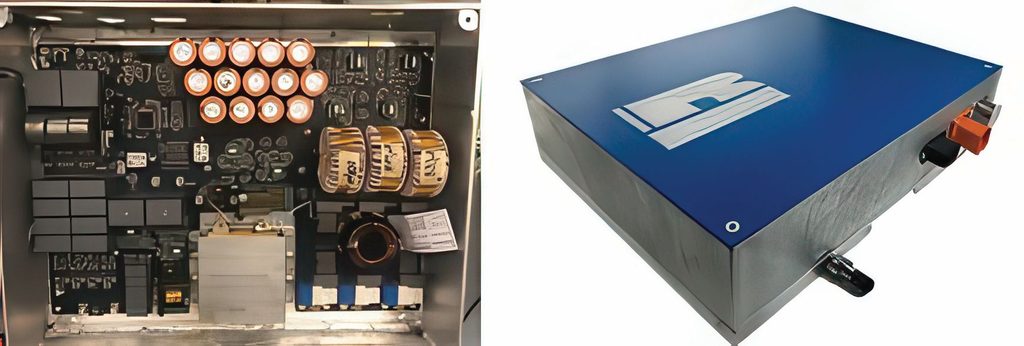
Ricardo has developed a highly integrated bidirectional DC/DC converter and on-board charger (OBC) for use in passenger vehicles that allows EVs to export energy to the grid, writes Nick Flaherty.
As of writing, EVs have separate components to perform the functions of charging the high-voltage (HV) battery (the OBC) and the 12 V low-voltage (LV) battery (the DC/DC converter). Furthermore, these components are, in most cases, unidirectional, allowing power to flow only from the electric utility to the HV battery and from the HV battery to the LV battery, respectively.
The OBC is based on a resonant power electronics topology that integrates the function of the DC/DC converter to the same isolation transformer. The design is based on silicon carbide switches in the HV power stages and with gallium nitride used in the LV power stages.
Together with vehicle-to-grid (V2G) control protocols based on ISO 15118-20, the unit allows for bidirectional power flow on demand from the EV supply equipment. The integrated DC/DC–OBC was tested in a bench environment up to 11 kW and displayed peak efficiency of 94%. The integration of the DC/DC and OBC components resulted in mass savings of 25% and material cost savings of 35% relative to two individual units.
In parallel, a smart-charging simulation environment is being developed, which incorporates a digital twin of the charging chain with a holistic simulation environment, multilevel component models and representative information flow between all element agents.
This digital twin will incorporate the results of the demonstration actions and enable upscaling to show the impact of these technologies. To ensure the interoperability and the optimisation along this charging chain, a consortium with relevant partners/stakeholders (energy providers, grid operators, charge point operator, EV equipment providers as well as a vehicle manufacturer) is testing the system in four countries (Belgium, Germany, Italy and Portugal) as part of the European Horizon research programme.
This A-sample design is a starting point for companies looking at offering V2G capability, with B- and C-samples possible within 12 months.
Click here to read the latest issue of E-Mobility Engineering.
ONLINE PARTNERS