






An electrically powered gyroplane for urban air traffic
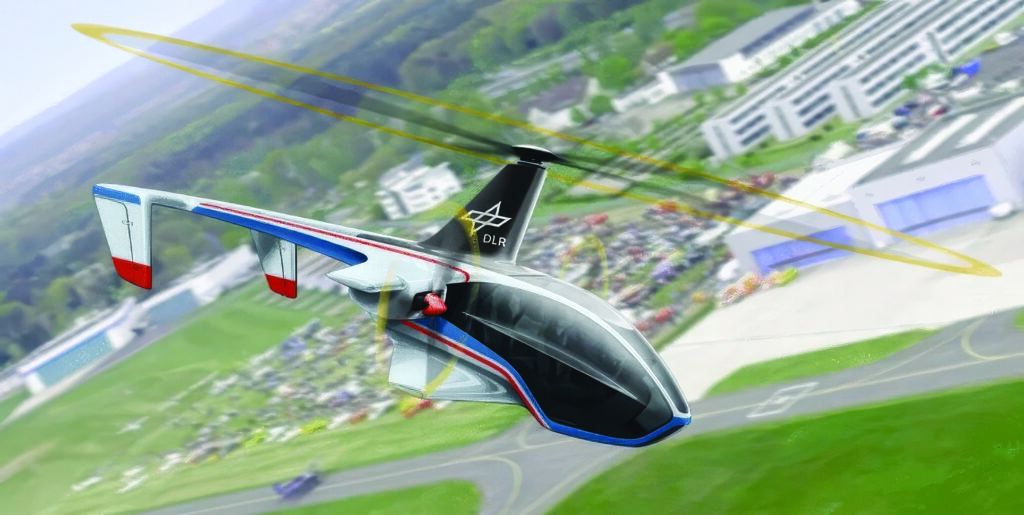
(Image: DLR)
Researchers in Germany have looked at two different drive systems for a new electric gyroplane with two electric motors for propulsion and one electric motor for pre-rotation, writes Nick Flaherty.
The aircraft is being developed by the S2TOL (Silent Short Takeoff and Landing) project by the DLR and Institute of Jet Propulsion and Turbomachinery (IST) at RWTH Aachen University in Germany for urban and regional air traffic.
A significant reduction in noise emissions is expected by redesigning and arranging the propellers and rotors, while a thrust vector control system will further optimise the short take-off capability.
In contrast to a helicopter, the rotor on a gyroplane is not driven by an engine, but is in a so-called autorotation state during the entire flight. The autorotation is permanently maintained by the incoming airflow so the gyroplane has inherent safety features that are advantageous for transport in lower airspace. For example, in the event of a malfunction, the freely rotating rotor allows for a parachute-like landing, making it safer to use in urban airspace.
Critical flight conditions known from fixed-wing aircraft, such as stall or spin, are also not possible with gyroplanes. Owing to the freely rotating rotor blades, a complex main rotor gearbox, as used in helicopters, is not necessary. This significantly reduces the manufacturing and operating costs of a gyroplane compared with a helicopter. The rotor blades are hinged to the rotor hub via a central flapping joint, so that they react to the air forces prevailing at the rotor blades with a free flapping motion. In addition, the gyroplane has a pre-rotation mechanism that accelerates the rotor to take-off rotational speed before taking off.
For the first variant, propulsion is provided by two large open propellers, while the second variant uses two ducted propellers – so-called Jetpellers from Jetpel – that offer further potential for noise reduction. The static thrust for both variants has already been proven in bench tests conducted to examine whether the two drive systems are generating sufficient thrust for two-seater gyrocopter demonstrators with a mass of about 450 kg built by AutoGyro in Germany. These will serve as the basis of four-seat versions.
The data obtained from simulations can help minimise the subsequent risks in flight tests and will serve as a database for thrust model validation to be used in the flight simulation of the gyroplane. In addition, the test data can be used to make assessments of the temperature management of the drives.
The noise aspect in particular, plays a decisive role in the design of the new aircraft. The aim is to limit the noise level to 50 dB(A) at a distance of 300 m.
The design envisages a short take-off capable aircraft that is suitable for transporting up to four people with additional luggage for short distances of up to 100 km at 80 knots. To enable particularly short take-off and landing distances, and to improve flight performance in general, the rotor of the gyroplane can be additionally powered electrically, particularly in the take-off phase but also in flight. This technology has been patented.
Compared with a fixed-wing aircraft, significantly shorter take-off and landing distances are achieved, and the high manoeuvrability enables steep approaches and flying close to cities.
Increasing the range to 500 km and upping the cruising speed to 150 knots could be possible with a hybrid-electric engine.
Click here to read the latest issue of E-Mobility Engineering.
ONLINE PARTNERS