







Dovetail Electric Aviation
(All images: Dovetail Electric Aviation)
Converting aircraft to electric
Nick Flaherty examines how Dovetail Electric Aviation is developing and certifying an integrated electric propulsion system to convert legacy Business & General Aviation airframes into zero-emission commercial aircraft for short-haul regional flights
Dovetail Electric Aviation’s system includes electric motors and battery packs as well as, alternatively, hydrogen fuel cells or a combination of batteries and an on-board generator for longer-range missions.
Fewer moving parts in an electric motor mean a longer TBO — almost three times that of a comparable turboprop engine — as well as less costly maintenance. Dovetail estimates the electric conversion can be amortised in less than three years, providing a cost-effective route to decarbonising the Business & General Aviation segment of air travel.
“The original mission for Dovetail was to retrofit existing airplanes with electric powertrains. Initially, there was no intention to develop all the components in-house, but to be a system integrator and certification provider,” says Michele D’Ercole, chief technology officer at Dovetail.
“After some months into such endeavour, it became clear to the management that the building blocks were not available or not yet mature enough.
Hence, during the past two to three years, the team pivoted to develop some of these specialised building blocks internally, starting with the motor and the energy source. While developing these two major blocks, we have been looking at the possibility of using fuel cells and at the possibility of hybrid electric products leveraging legacy fuel-based generators.”
There are two sides to the company’s business case: retrofitting existing airframes such as Cessna and Beechcraft platforms, and selling Dovetail’s proprietary powertrain building blocks. On the conversion side, the focus is on Business & General Aviation turboprops carrying up to approximately 20 passengers, such as the single-engine Cessna Caravan, twin-engine Dornier, various Beechcraft types and other platforms.
Powertrain
“Dovetail’s engineers have already gone through a comprehensive learning phase that culminated with the manufacturing of our second-iteration motor. We’re now working at tweaking that design towards the final fully compliant configuration,” says D’Ercole. “This is a 670 kW electric motor, in the same power range as the magniX magni650 and the P&WC PT6, but with a ruggedised and simplified architecture.” A magniX magni500 (560 kW) powers Harbour Air’s eBeaver, the electrified de Havilland DHC-2 Beaver that became the world’s first all-electric commercial aircraft to fly. The larger magni650 – in the same class as Dovetail’s own motor – was selected by NASA and magniX for the Electrified Powertrain Flight Demonstration programme, in which a de Havilland Dash 7 testbed is having two of its four Pratt & Whitney Canada PT6A turboprops replaced with electric motors.
“An electric motor, at the end of the day, is very simple when compared to a legacy aircraft engine in terms of number of parts, temperature and vibration conditions and overall stresses the parts are subjected to, so the level of complexity is greatly reduced. We are combining lessons learned from legacy aircraft engine development programs together with PM motors extensive knowledge, getting the best of both worlds.”
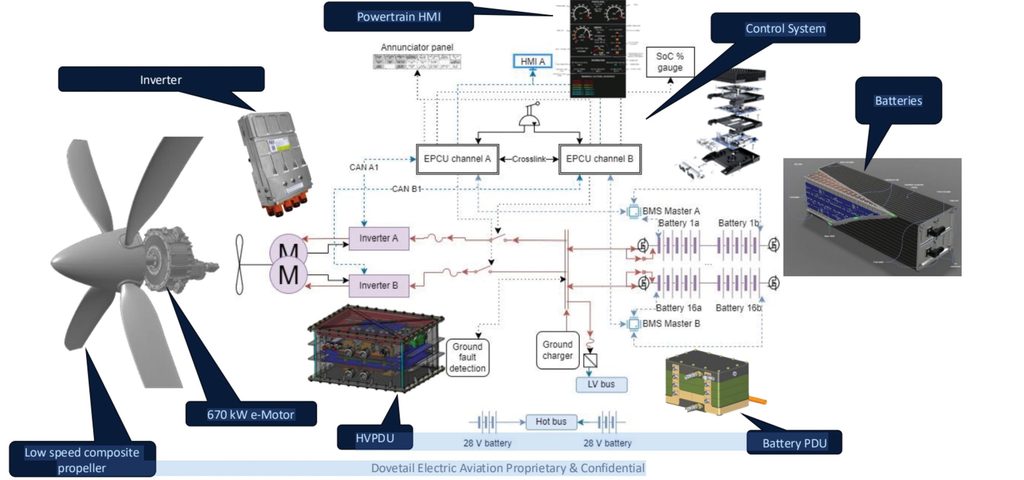
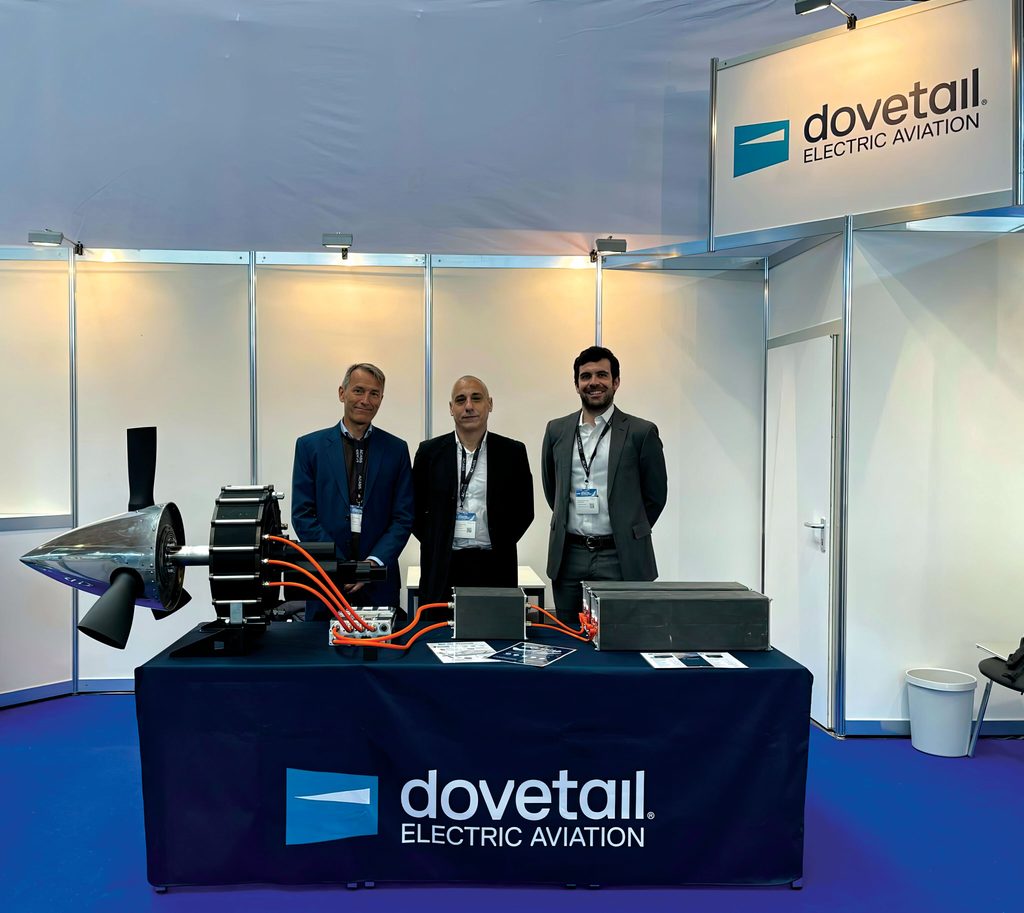
Dovetail’s electric motor is a direct-drive (no gearbox needed) one-stage rotor, in-runner spoke configuration with a liquid-cooled stator and sealed rotor air cavities. The magnets are embedded in the rotor, with no need for a composite retention sleeve around the rotor itself; it is believed that this feature will reduce the certification program risks. The motor is driven by a SiC-based inverter – a design choice, carried through Dovetail’s DovePower system, that trades the higher switching losses of legacy silicon IGBTs for a lighter, more compact power-electronics package at the same throughput.
Its 96-slot, 80-pole configuration allows the motor to reach approximately 97% efficiency across a wide range of power levels and speeds, from 600 to 1900 rpm and beyond.
Its mechanical architecture uses qualified, aviation-legacy materials – steel, titanium and aluminium – for all its major components, which Dovetail says make it around 20% lighter than competing motors of similar power rating, while providing higher reliability and availability.
However, the motor’s auxiliary functions – and those needed to provide aircraft-level services such as powertrain cooling, cabin air conditioning and anti-icing – now need new electric-driven solutions, rather than using the traditional power take-off from a gearbox found on a legacy turboprop. “We decided to have a motor that is more flexible and directly applicable to different airframes. This brings the need, or rather the opportunity, to also optimise the other on-board legacy aircraft systems. To make a comparison, this would be like transforming a petrol-based car into a modern electric car, not just replacing its engine and adding some batteries, but working at its brakes, its steering system, its air conditioning system, wipers and interior cockpit etc – and this is exactly what Dovetail is targeting by developing its own Supplemental Type Certificate (STC) solutions,” says D’Ercole.
One example of this approach is the system that controls the propeller. On a conventional piston and turboprop aircraft, a mechanical/hydromechanical governor acts as a continuous rpm-sensing mechanism, boosting oil pressure from the engine and directing it to or from the propeller hub’s internal piston to change blade angle. Dovetail, working with Hartzell – one of the major providers of propeller systems – is instead introducing a novel electronic/digital propeller control unit.
This digital propeller control unit uses software logic to precisely modulate thrust and manage high-torque demands, optimising the propeller speed selected by the pilot regardless of changes in altitude or airspeed, and ensuring reduced cabin noise and peak engine efficiency.
“We have been working with potential customers and propeller suppliers to identify the optimum rpm range,” says D’Ercole. “We decided to be on the lower side of rpm for advantages in noise reduction, as the majority of the noise for these airplanes comes from the propeller – an engine that allows for a lower 1400 to 1900 rpm take-off range is quieter.”
A second example of this system-level optimisation, applied this time at aircraft level, is the in-house developed Electric Powertrain Control System (EPCS), which communicates via a combination of digital, analogue and discrete signals with each subsystem – the cockpit HMI, the inverters (and, through them, the motor), the BMS and the power distribution units – and coalesces all of that data. It is, in effect, the ‘brain’ of the entire aircraft.
Battery pack
Dovetail is developing its own modular battery pack called DovePack, leveraging its proprietary immersion cooling solution to enable fast charging, higher safety levels and very high volumetric density.
DovePack does not rely on a traditional cold plate; instead, individual cells sit in direct contact with a dielectric cooling fluid eliminating the fans, heat sinks and cold plates of conventional battery-cooling architectures.
Each standard module has 384 cells arranged as four strings of 96 cells in parallel – a 96S4P configuration – measuring 600 x 200 x 150 mm and is rated to an IP67 ingress-protection standard. However, the battery module form factor can be customised with five or six strings in parallel.
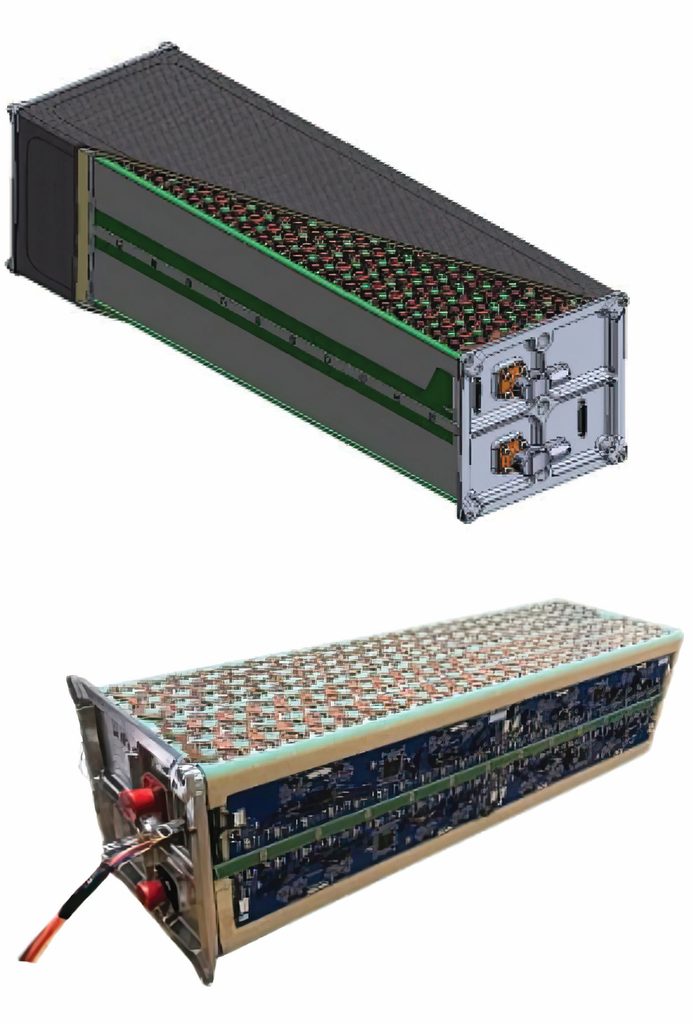
While DovePack’s gravimetric energy density – in the 250–270 Wh/kg range – is on par with other players, and set to improve as more power-dense cells reach the market, its volumetric energy density is considered to provide one of the most compact solutions on the market for this kind of application, at over 465 Wh/L. DovePack also targets best-in-class charge rates, with the pack validated for a 3C charge rate and rated for around 2000 cycles at 80% depth of discharge, even if this may affect the battery pack’s life in some cases, depending on the specific customer’s mission profile.
“While the battery cells are traditional 21700 cylindrical lithium-ion ones, and cells with slightly different chemistry from different suppliers can go through our product V&V process (such as Molicel and others), we are focusing on the battery-pack configuration, the BMS and whatever is connected to the battery packs such as the cooling system, the battery power distribution unit and the high-voltage power distribution unit that connects the battery pack to the inverter and the motor. We have a subordinate BMS on each battery module to allow maximum flexibility and one master BMS managing the various modules. Depending on the aircraft certification level, the number of master BMS units can be customised, if/as required by the Failure Hazard Analysis considerations and based on the certification authorities’ requirements.”
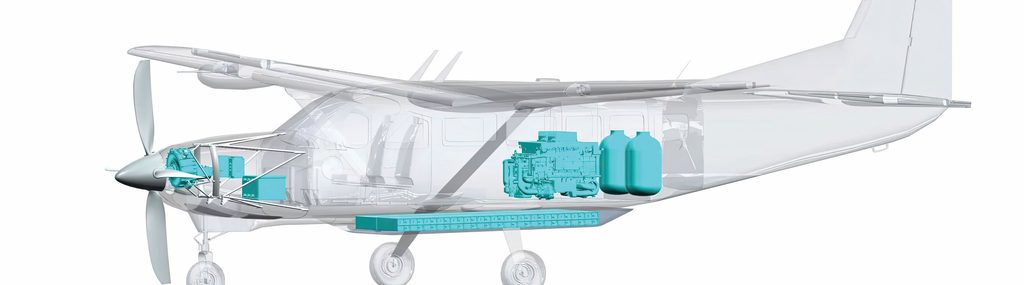
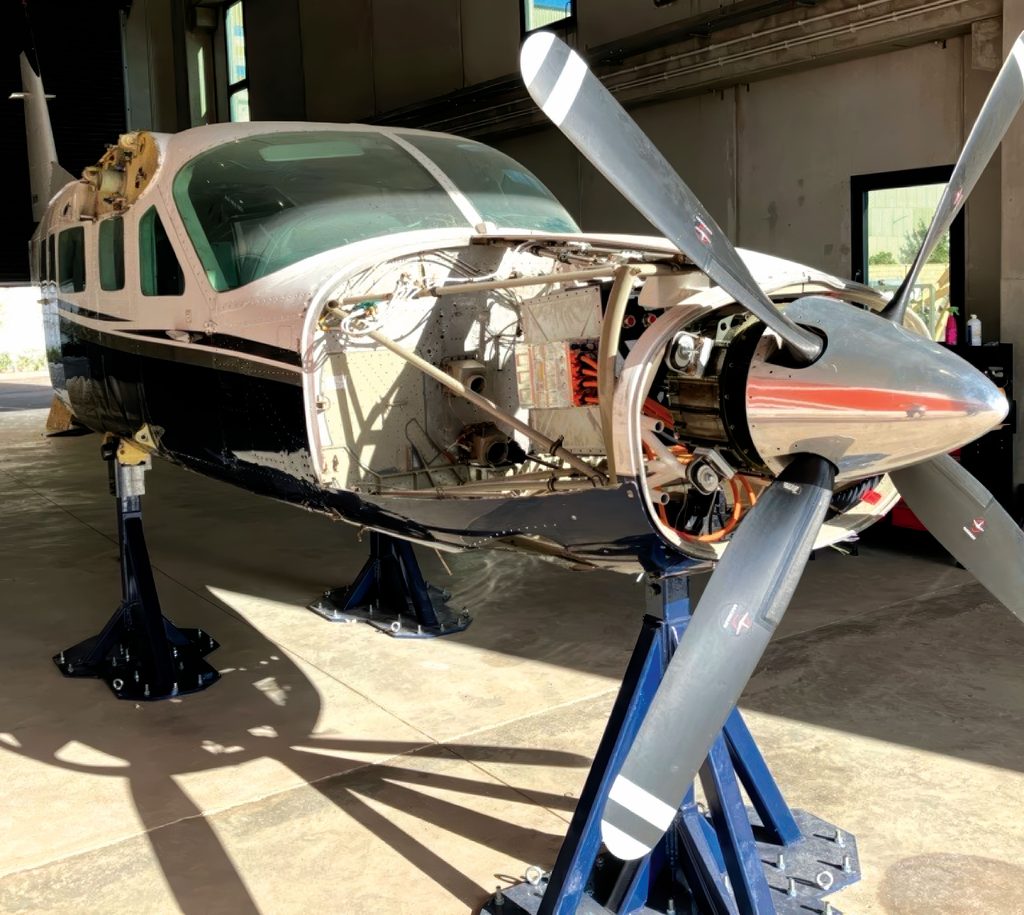
For the Cessna 208 Caravan conversion, 30 modules fit under the aircraft’s belly. Dovetail is leveraging the same overall form factor and envelope for the legacy cargo pod option that is already certified to minimise the aircraft’s aerodynamic profile changes and hence facilitate the STC approval.
“Depending on the aircraft application, we can use various airframe locations in the fuselage, beyond or inside the fire zone(s), to install our battery packs, even inside the wing box in case of a larger airframe.”
For many standard missions and aircraft applications, it is not necessary to recirculate the dielectric fluid across the modules while in flight.
However, for quick-charging operations, hot-and-high ambient conditions, hybrid systems where batteries are frequently recharged in flight or very demanding operating profiles – for example, some eVTOL, parachuting or agricultural-aviation missions – a customised on-board cooling-fluid recirculation system may be needed, as well as ground-conditioning equipment to accelerate charging on the tarmac. Dovetail is developing standardised options for each application.
DovePack’s technology has been tested for thermal runaway, a key failure mode in which the breakdown of one cell creates a hotspot, leading other cells to fail and compromise the functionality of the pack, its structural integrity and hence the safety of flight. At best, this can destroy the battery pack. At its worst, with a pack in the wing space or inside the airframe, thermal runaway can lead to a fire that could escalate into a catastrophic event.
A comprehensive DovePack test campaign at submodule level demonstrated benign thermal-runaway behaviour. When simulating the failure of two adjacent cells, the cooling system was able to contain the event, protecting neighbouring cells and preventing failure propagation by venting the hot gases generated by the failed cells through the pack’s exhaust.
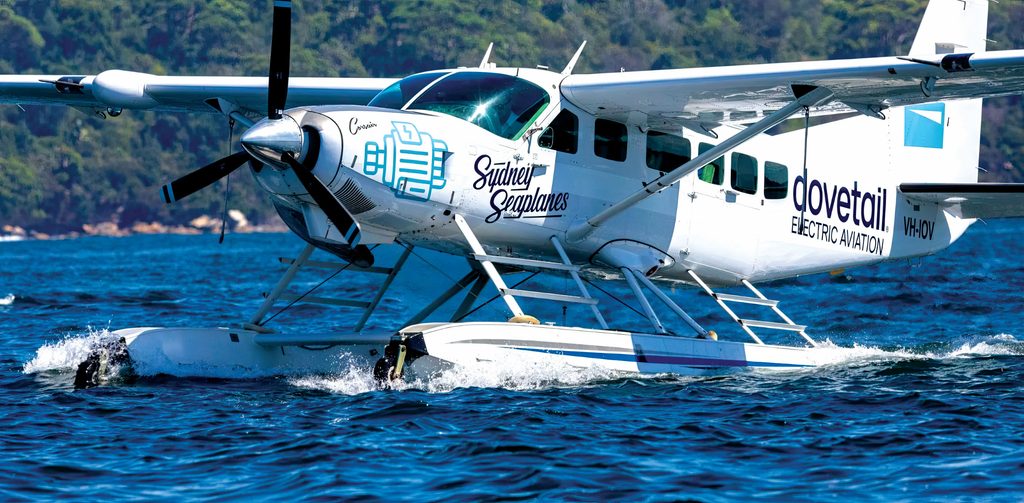
The Cessna Caravan aircraft is widely used around the world for regional transport, cargo, island hopping, scenic flights and skydiving operations. It is especially well suited to electric conversion owing to its short-cycle mission profile, strong installed base and operational versatility.
Norwegian operator Ludens Aviation has been announced as the launch customer for the first Dovetail-converted electric Cessna Caravan – the programme’s first binding customer agreement, and a major commercial milestone on the company’s path to certification and entry into service.
Under this agreement, Ludens Aviation – following completion of the retrofit programme and issuance of the relevant EASA STC – will become the launch operator for Dovetail’s first electric Cessna Caravan conversion.
“Electric aircraft and skydiving are a perfect match: short cycles, fixed patterns above the same field, and a community that cares about noise and emissions. With this agreement, we are not just ordering an aircraft – we are building the operating model, the charging infrastructure and the financing template that will put electric Caravans to work commercially in Norway. We look forward to seeing the first one climb above Voss,” says Kjetil Kriken, CEO of Ludens Aviation.
The two companies are moving forward with airframe sourcing, technical planning, operational arrangements and certification-related activities. The Caravan conversion demonstrator is planned for the second half of 2027.
“We will initially have static ground tests that will replicate the system architecture on a Cessna Caravan fuselage and soon after we’ll install the powertrain on the Flight Test Bed to get to our first flight. From there, we’ll start to work at the type certification programme”.
Dovetail is also working with Zeusch Aviation – the agreement was announced at the 2025 Paris Air Show – to explore the potential for hybrid-electric retrofits for the Beechcraft King Air, one of the most versatile and widely used twin-engine turboprops in commercial and special-mission aviation, using Dovetail’s proprietary battery and electric propulsion technologies integrated with a turbogenerator working as a range extender. Dovetail says the hybrid configuration could cut the King Air’s carbon footprint by up to 40% and its noise footprint by up to 30% in full-electric mode, enabling longer-range flights while reducing emissions and lowering operating costs, and supporting mission-critical operations such as medical flights, aerial mapping, surveillance and other special missions.
Hydrogen
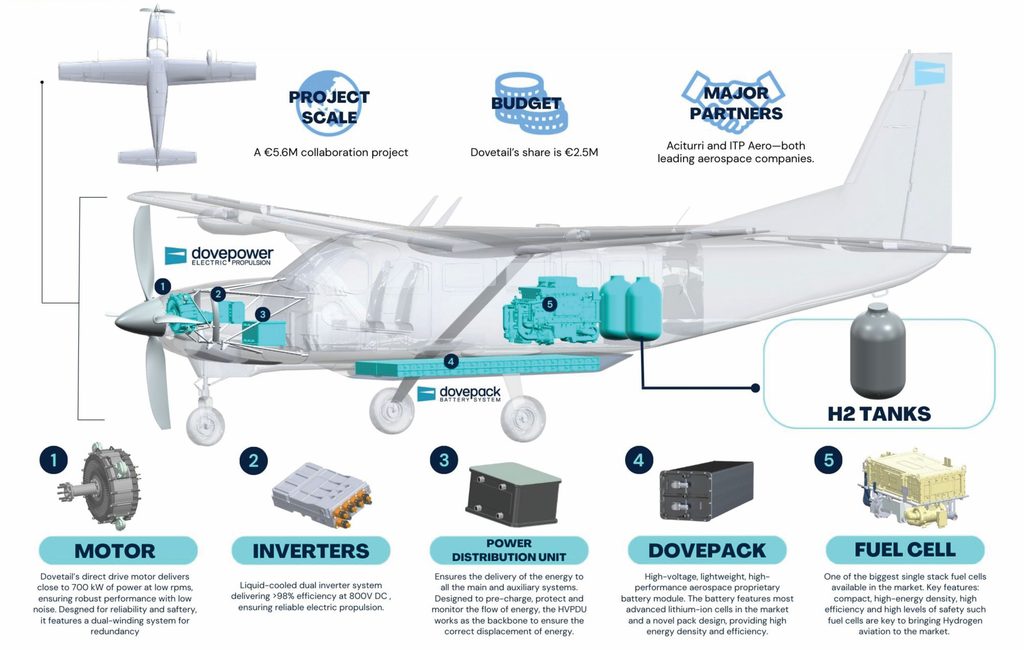
Dovetail has previously explored hydrogen fuel-cell energy systems to understand how to achieve extended range while maintaining zero emissions.
Spanish aeronautical company Aciturri has led a project called ‘Sustainable hydrogen-electric propulsion technologies for next-generation aircraft’ with Dovetail and ITP Aero as the main partners.
“The team has successfully demonstrated how such a system can work; however, the certification and safety challenges for such a configuration remain a question mark. The other showstopper is the absence of an established world-wide hydrogen supply chain. Even if we were able to eventually meet the aerospace certification requirements, in my opinion, the issue remains how you move hydrogen from its point of production to the airplane, and the definition of industry standards and regulations around it. Focusing on developing full-electric solutions first for short flights, and hybrid-electric systems leveraging legacy gas-turbine generator units for longer distances, may be the right approach before eventually switching to fuel-cell energy sources. We’re seeing a similar approach in the auto industry today.”
Conclusion
The simple, direct-drive motor and modular DovePack battery system give Dovetail a flexible platform for converting proven aircraft rather than waiting for new electric airframes to enter service. That retrofit strategy could shorten the route to commercial operation, preserve the value of existing fleets and address missions such as skydiving, island hopping, freight and short regional services where predictable sectors and frequent cycles are better suited to battery propulsion.
Dovetail’s decision to develop critical components itself also reflects the lack of full maturity of the electric-aviation supply chain. The 670 kW motor, compact immersion-cooled battery packs and SiC inverters are intended to reduce weight, simplify maintenance and support rapid battery charging, while the modular architecture allows installations to be adapted to different airframes and certification requirements. The same building blocks can underpin both complete conversions and component sales, broadening the company’s commercial opportunity.
The launch agreement with Ludens Aviation gives the programme a credible operational use-case and a first binding customer commitment.
Meanwhile, Dovetail’s studies of hybrid-electric configurations – coupling a turbine or piston engine-driven generator to the company’s baseline powertrain – and the initial experience with fuel cells show how the company can extend its technology beyond short, all-electric flights, providing a credible multi-generational product roadmap.
Rather than betting on a single energy source or aircraft design, Dovetail is building a portfolio around flexibility to take advantage of the move from experimental programmes towards dependable commercial service.
The next step is validation. Ground testing, the planned 2027 Caravan demonstrator flight and the subsequent STC process will validate performance, safety, charging, maintainability and economics in real operating conditions.
Timeline
2020
Concept design & wind tunnel testing of DAX-19, the original Distributed Propulsion Aircraft concept developed by Dovetail’s co-founder Dante Aeronautical
2021
Key strategic partner secured for motor supply. European strategic investors secured
2022
50 aircraft conversion orders placed. Lead strategic investor secured
2023
$3m grant awarded by Australian Federal Government. Demonstration of complete Electric System
2024
Partners with CRISALION Mobility to develop aviation-grade battery packs for its five-seat Integrity eVTOL. Demonstrates 600 kW hydrogen-electric powerplant
2025
€2.5m grant received to develop hydrogen powertrain system. Partners with Zeusch Aviation on a Beechcraft King Air conversion
2026
Ludens Aviation in Norway announced as the launch customer for the first Dovetail-converted electric Cessna Caravan, marking a major commercial milestone in the company’s path to certification and deployment
2027
e-Caravan conversion demonstrator
Bio
As CTO and head of engineering, Michele D’Ercole leads Dovetail’s global engineering activities, supporting the development, industrialisation and certification of the company’s electric propulsion solutions, including DovePower and DovePack.
He joined the company in April 2026 from Hyperworks, where he led the feasibility phase of the Veneto Hyper Transfer project as chief hyperloop officer.
Throughout his career, D’Ercole has held senior engineering and executive roles at traditional global organisations including Fiat Avio, GE Oil & Gas and GE Aviation, but also new electrification players such as magniX or Hyperworks. His background combines deep technical expertise in turbine and propulsion systems with strong experience in industrialisation and organisational leadership. At GE Aviation Czech, he served as engineering director and later president & general manager for small commercial turboprop programs. At magniX, he played a key role as COO and acting CEO, contributing to the development and certification of electric propulsion technologies for aviation.
D’Ercole holds a Master of Science degree in aeronautical engineering, awarded by La Sapienza University of Rome, and has lived and worked across Europe, Canada, Australia and the United States.
Click here to read the latest issue of E-Mobility Engineering.
ONLINE PARTNERS