












Compression pads to extend battery performance
(Image: Saint-Gobain Tape Solutions)
Saint-Gobain researchers have developed predictive models for accurately forecasting the mechanical behaviour of compression pads in battery packs, writes Nick Flaherty.
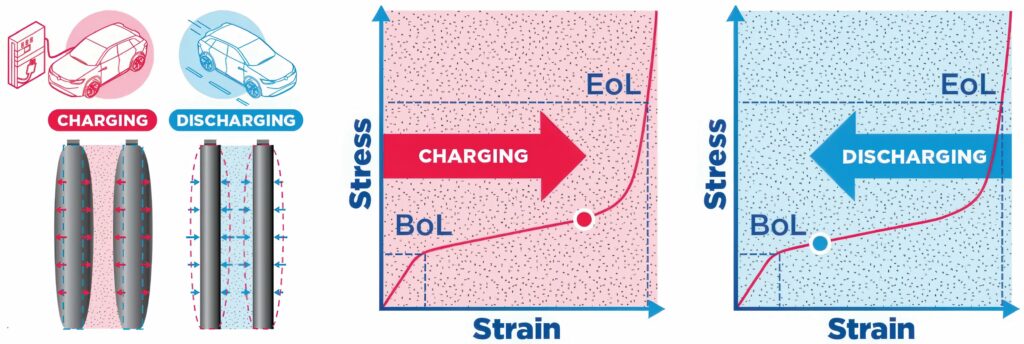
Lithium-ion cells exhibit expansion and contraction during charge and discharge cycles as well as irreversible swelling due to ageing. Compression pads are critical components for ensuring the lifetime performance of battery packs.
The primary function of a compression pad is to act as a compliant cushion between cells and accommodate the volumetric fluctuations by exerting consistent and optimised pressure. By absorbing the stress from cell expansion and maintaining structural integrity within the module, compression pads mitigate degradation mechanisms to maximise the durability and safety of the battery system over thousands of cycles.
The researchers have characterised the fundamental mechanical properties of elastomeric pads under a range of conditions, such as different compression speeds and temperatures, which are directly relevant to realistic battery applications. The long-term mechanical resilience of the pad is measured by evaluating performance over thousands of charge–discharge cycles at different operating temperatures, confirming their ability to maintain consistent pressure over a long time.

Using modelling and simulation allows developers to explore the design space virtually, accelerating the development of optimised designs of compression pads for battery pack applications.
By helping maintain the right amount of pressure on the cells throughout operation, compression pads support better capacity retention and longer battery life. They also help accommodate cell movement while reducing vibration and providing electrical insulation within the battery module.
To simulate the conditions in the battery pack, cyclic fatigue tests are implemented across a wide temperature range, from subzero temperatures up to 60–70 C. A 3000 cycle constant-strain cyclic compression test also simulates long-term operational stress on the material.
“Research over the past decade has shown that the level of pressure applied to the cell directly impacts its lifetime and capacity retention. There is an optimal pressure range, for example, typically around 20 to 40 kilopascals for pouch cells, which maximises performance and longevity. If the pressure is too high or too low, the battery can degrade much faster or even fail prematurely,” said Weilin Deng, senior research engineer at Saint-Gobain.
Modelling is important because there is no single solution because battery requirements vary depending on cell chemistry and design. For example, prismatic cells need moderately stiff materials, while pouch cells typically require softer compression pads and solid-state batteries require very stiff compression pads.
The digital tool allows the compression properties of materials to be adjusted accordingly. Using compression force deflection data, performance is evaluated at different compression levels – such as 20%, 50% and 70% – to match specific application needs without relying solely on lab testing.
The tool recommends suitable materials and optimal thicknesses while displaying the corresponding stress–strain curves. For example, it may suggest using a material such as PF150 at a specific thickness to meet defined critical-to-quality requirements.
It also supports multi-material designs, combining different foams to evaluate the combined compression behaviour.
Click here to read the latest issue of E-Mobility Engineering.
ONLINE PARTNERS