





BYD’s FLASH Charging is an exercise in systems engineering
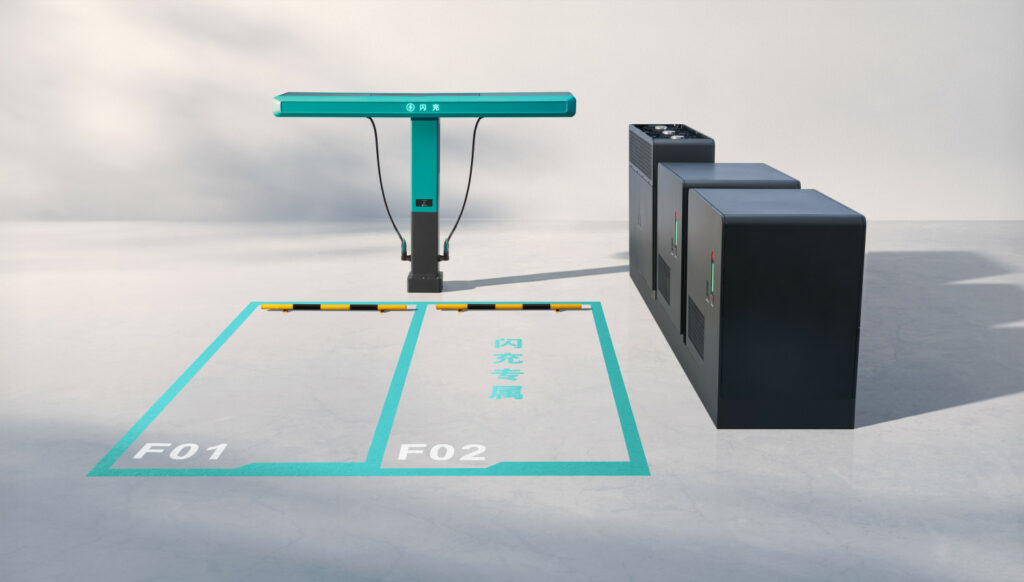
(Image: BYD)
Behind the recent headlines surrounding BYD’s “flash charging” technology is an intriguing case study in holistic system integration. While the peak power of 1,500 kW (1.5 MW) is impressive, a much broader systems engineering effort has gone into orchestrating the performance of a new battery architecture, a high-current delivery system, and an intelligent, grid-friendly infrastructure. The result is a redesigned energy transfer ecosystem aimed at resolving the long-standing trade-off between charge time, energy density, and grid impact, writes Peter Donaldson.
Rapid ion transport
The main bottleneck in ultra-fast charging has always been the battery’s ability to accept a massive influx of lithium ions without inducing lithium plating or catastrophic heat generation. The new Blade 2.0 battery incorporates BYD’s proprietary “FlashPass” Ion Transport System, which represents a multi-layered solution to this problem**,** combining cathode engineering, electrolyte chemistry and anode architecture. → Comma added after “problem” to separate the main clause from the participial phrase.
First, the Flash-Release cathode has a modified crystal structure and conductive coating to lower the energy barrier for deintercalation – the process of removing a molecule that has been inserted among others in a solid structure. This ensures that lithium ions can be rapidly ejected from the cathode lattice during charging, preventing a backlog at the start of the process.
Second, the “Flash-Flow” electrolyte is an AI-optimised formulation designed to provide enhanced ionic conductivity and a wider electrochemical stability window. This electrolyte is designed to facilitate high-flux ion transport between electrodes while maintaining a stable solid-electrolyte interphase layer, which is critical for cycle life under high C-rate conditions.
The third and perhaps most critical innovation is the Flash-Intercalate anode. By engineering multidimensional ion intercalation sites, the anode can rapidly absorb lithium ions without causing concentration polarisation or dendrite growth. This directly mitigates the primary failure mode associated with fast charging.
The result is a lithium-iron-phosphate cell that achieves a significant reduction in internal resistance, enabling the pack to sustain a peak 10C charge rate, according to BYD. The subsequent safety validation – passing a simultaneous flash charge and nail penetration test without thermal runaway – demonstrates a robust thermal management system capable of handling extreme Joule heating, even after 500 fast-charge cycles.
Thermal management and grid buffering
Delivering 1,500A continuously at 1,000V requires a very substantial cable and connector. BYD’s FLASH Charger incorporates advanced liquid-cooling for the connector head, maintaining thermal stability at the critical contact point. Furthermore, the T-shaped overhead pulley system mitigates the cable’s weight and stiffness to ensure most drivers can use it easily.
From a grid perspective, a single 1.5MW load is a disruptive, transient event. BYD addresses this by providing every FLASH Charging station with a co-located energy storage system that charges slowly from the grid during off-peak hours. This topology allows BYD to offer instantaneous megawatt power without requiring utility-scale grid upgrades at every location. It decouples the high-speed charging event from the grid’s limited slew rate. (This is the rate at which the grid can be increased or decreased**,** typically measured in megawatts per minute.) → “decreases” corrected from “decreases” – original read “be increased or decreases”, which is a subject-verb agreement error; corrected to “decreased”. Comma added after “decreased” before the adverbial phrase.
Flagship launch
BYD is to launch its FLASH Charging technology in Europe with its Denza Z9GT high-performance estate car**/station wagon, which has a 122 kWh** Blade 2.0 battery. The company says that the battery can charge from 10% to 70% in five minutes, and from 10% to 97% in nine minutes, enabling a claimed maximum range of around 800 km (497 miles) on a single charge under WLTP conditions with a rear-wheel-drive example. → “kW/h” changed to “kWh” – kilowatt-hour is written as a single closed compound unit without a slash. The slash implies division (kW per hour), which is incorrect.
Click here to read the latest issue of E-Mobility Engineering.
ONLINE PARTNERS