










Beckhoff Automation drives control technology for hydrogen production and net zero energy
(Image courtesy of Beckhoff)
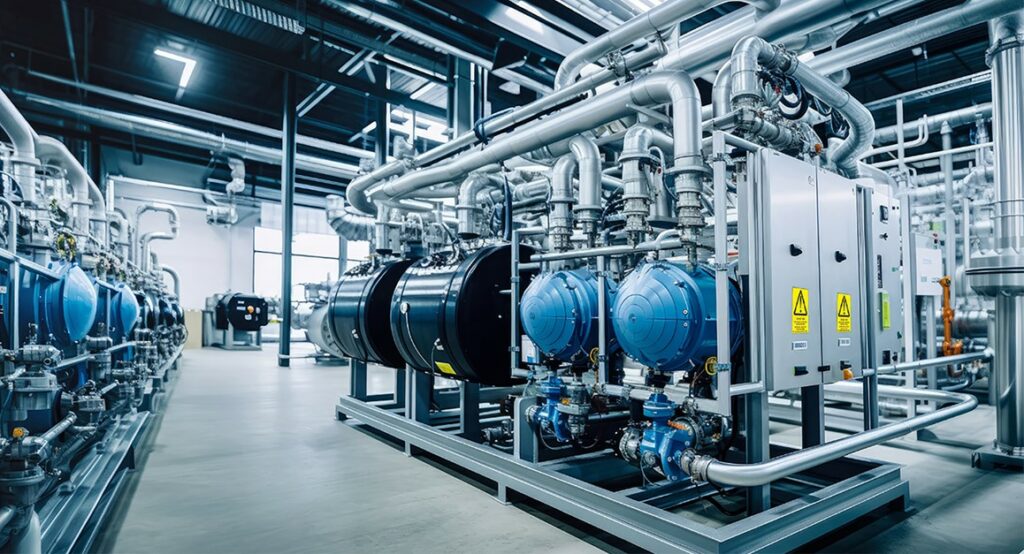
Surging global investment in hydrogen production is now driving a new wave of technical innovation across the entire value chain. According to the International Energy Agency, the number of hydrogen projects announced worldwide rose by 50 per cent in 2023 alone, with the possibility of achieving production of 38 million tonnes per year by 2030 if every planned project reaches fruition. As decarbonisation continues to disrupt established energy models, hydrogen’s resurgence is no longer aspirational. It is emerging as a true enabler of Net Zero at scale. From providing a firming mechanism for renewables to powering future-ready transport and heavy industry, hydrogen is unlocking opportunities where the demands for reliability, safety and efficiency are absolute.
Technological progress in the sector remains shaped by the demanding characteristics of hydrogen itself. Its molecular properties and wide operating envelope, from high flammability and small molecule size to requirements for high pressures or extremely low storage temperatures, demand a new generation of automation. Legacy control architectures, built on isolated, fixed-function systems, struggle to address these challenges. Modular, PC-based platforms are changing the conversation. In electrolysis applications, these solutions enable precise, repeatable process control over every variable. Operators rely on real-time data acquisition to keep voltage, current, temperature and pressure within acceptable tolerance bands for efficient electrochemical separation. Embedded analysis functions unlock predictive maintenance, flagging the earliest signs of mechanical or electrical degradation before downtime escalates.
Moving the hydrogen from generation to storage, the platform flexibility comes to the fore. Hydrogen can be stored as a pressurised gas, liquefied at cryogenic temperatures, or absorbed in metal hydrides. Each storage pathway brings its own thermal management needs and pressure-control demands. Companies pushing the boundaries in this space, such as GKN Hydrogen, use metal hydride-based systems to combine compactness with safety. Precision control is critical. Systems continuously monitor and synchronise temperature and pressure at multiple points, ensuring efficient, safe transfer and release even as operating conditions fluctuate.
Hydrogen mobility infrastructure, meanwhile, brings its own operational imperatives. Dispensing fuel at pressures up to 1,000 bar means every phase of the process must be monitored with split-second accuracy. Here, automation platforms undertake sensor data acquisition, leak detection and logic-driven safety shutdowns in parallel with seamless cloud-based data transfer. This real-time information exchange supports not only local operation but also fleet-wide oversight, enabling rapid remote diagnosis and adaptive maintenance scheduling, as demonstrated by operators like Nel Hydrogen.
Open, scalable automation architectures enable operators to integrate a broad array of sensors, actuators and edge devices, guaranteeing that systems remain upgradable as technology and regulatory requirements evolve. Resilience requirements are driving architectural changes across the sector. PC-based solutions bring redundancy into networking, control layers and data storage, safeguarding continuous operation in the face of failure risks that are largely absent from conventional fuel systems.
Safety, ultimately, is the non-negotiable throughout the hydrogen economy. Automation platforms are now integrating functional safety layers that process fail-safe signals alongside live process data. For hazardous zones, intrinsically safe input/output modules equipped for operation in explosion risk areas eliminate significant installation complexity and support distributed plant setups that can keep pace with the future scale of hydrogen facilities. As hydrogen gains traction across sectors, suppliers like Beckhoff are deploying these PC-based automation ecosystems to bring flexibility, monitoring and safety to every part of the process. In a market underpinned by rapid project growth and an unforgiving risk profile, advanced automation capabilities are becoming fundamental requirements for the reliable, efficient and secure hydrogen economy the future demands.
Click here to read the latest issue of E-Mobility Engineering.
ONLINE PARTNERS