










In conversation: Jim Edwards
(All images: Helix)
Changing the scales for motors
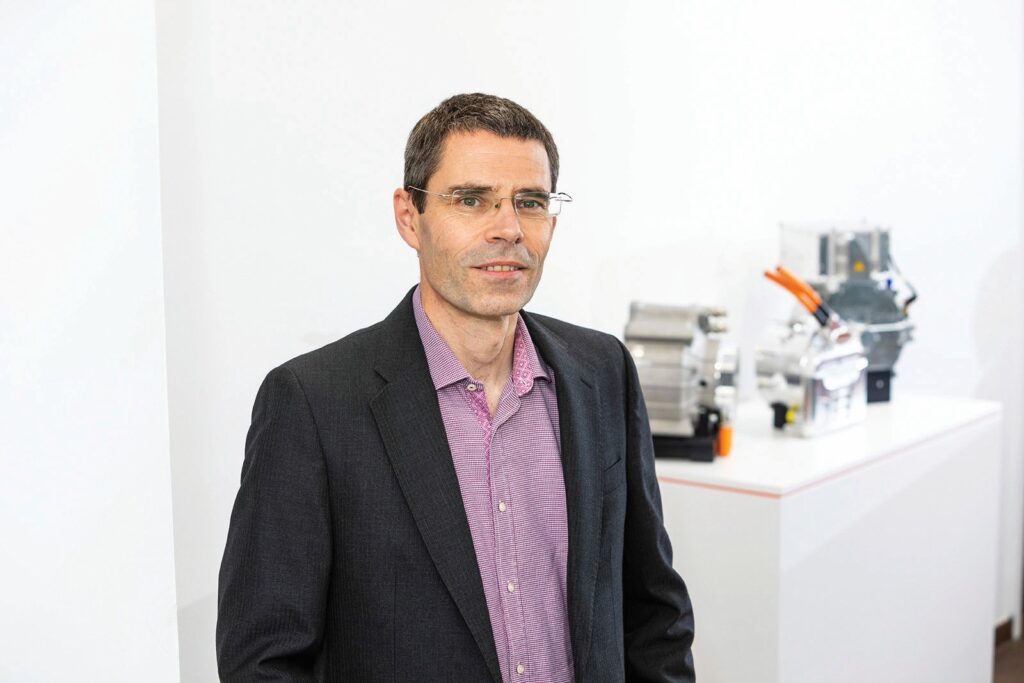
Helix’s chief engineer Jim Edwards is using motorsport technology to reduce the size and weight needed for electrification. Will Gray explores further
In the world of electrification, battery technology is often cited as the area with greatest opportunity for development. Improvements over recent decades have been clear to see, with EV ranges increasing year on year – but Jim Edwards believes that motor technology has an equally important part to play, particularly in high-performance and heavy-duty sectors. Now, after a career that has slowly grown into electrification, some of his biggest achievements could be just around the corner.
Electrification was far from mainstream when Edwards began his career, but he had an environmental focus from the off. In 1994, when he took on his first job at Ford, he analysed drive cycles to minimise real-world emissions for the Escort and Mondeo turbo-diesel engines. Then, when he moved to Milbrook Proving Ground, he worked on optimising a 20-strong range of bi-fuel LPG and CNG vehicles for Vauxhall, before helping to develop the first hybrid bus for London (UK), taking his first steps into the EV space.
That project began in 2003, when the city’s focus changed from reducing NOx emissions to reducing CO2 emissions. The client had originally developed a gas turbine bus – which was excellent at achieving the former, but not so good on the latter. So, in response to the change in priority, they came to Edwards and his colleagues with a ready-made design for a range-extended battery EV and tasked them with optimising its operation.
“I was involved in calibrating the hybrid system, looking at the bus architecture and drive cycle, and identifying where we could refine its operation to get the best of it in a real-world application,” he explains. “We set up a model of the London Transport bus cycle and, using the vehicle inertia and drag, we were able to predict the power requirements of the motor and look at how best to operate the engine and battery system – regenerating energy, not fully charging packs so you could regen down the hills, and making sure the engine switched off as often as possible to minimise idle emissions. It was a ‘first-of-a-kind’ system and we got 30% below the baseline CO2 emissions for an equivalent bus per passenger.”
Developing hydrogen
Edwards’ next project at Millbrook was another bus, but this time with hydrogen fuel cells. His work involved installing hydrogen fuelling infrastructure and running the bus in the Variable Temperature Emissions Chamber (VTEC). Edwards recalls: “The chamber had a rolling road and a big recirculating air system, and it could fit up to three double-decker buses and run them from minus 40 to plus 50 degrees. The bus had several 3 m long hydrogen tanks on the roof, and we knew that if one of the pressure relief vales was to vent in an enclosed space, such as the VTEC, then that could be very serious. So, we set up a lot of hydrogen sensors and made sure everything was vented to the extraction system. The chances were tiny, but you can’t accept that risk.”
That hydrogen experience drew Edwards to Intelligent Energy, which at the time was involved in a wide range of developments in the fuel cell space, from putting air-cooled fuel cell stacks into scooters with Suzuki to producing a tiny 5 W hydrogen-powered mobile phone charger. “That charger was a nice piece of kit,” recalls Edwards. “But unfortunately, it didn’t take off.” Given his automotive background, Edwards’ focus was placed on the development of fuel cell systems for passenger cars.
“We had 100 kW, two fuel cell stacks, which were evaporatively cooled using a proprietary technology,” he explains. “The system introduced liquid water as a fine mist, which would evaporate and absorb the heat and pass out the exhaust as a gas. It had a significant power density benefit and we put that system into a vehicle from a premium European automotive manufacturer. Around the same time, we also ran a fleet of five hydrogen taxis for the London Olympics in 2012, taking VIPs into the Olympic village.”
The business has since gone on to be successful in air-cooled systems for drones, however, and Edwards still sees plenty of potential for hydrogen to fit in within the automotive energy mix. “Currently, there’s not so much spare fuel about to make it really cheap, and the fuel cell stacks require precious metals, so they tend to be expensive. But in places where you’ve got a lot of renewable generation, which has to be stored somehow, hydrogen is a very good way of doing it,” he says. “So, I think it will get into niches where it works well – captive fleets, articulated lorries, trains; any place where you have a defined drive cycle and can put the infrastructure in to suit it. For those cases, it’s a very good zero carbon answer.”
Onto electric
Edwards’ career journey moved to the battery electric space next, when he joined current employer Helix in 2015. He took on the wide-reaching role of lead engineer, spanning many functions including interfacing with the customer, carrying out technical liaison, analysing drive cycles and managing a cross-functional team of electronics, electrical and mechanical designers, scientists and workshop technicians. “It was a role that suited generalists,” he says, explaining how he stepped in at such a level despite minimal experience in battery electric technologies.
His first management role involved the development of a small e-booster – an electric supercharger. “These traditionally involve an electric motor attached to a turbocharger compressor, geared to around 100,000 rpm,” he explains. “The difficulty is that in a passenger car, you need up to 10 kW
to drive it and that causes two problems – the motor overheats as it’s hard to get the losses out of it, and if it doesn’t overheat, the battery discharges because it doesn’t have the capacity for more than 5 or 10 minutes of that demand.
“To overcome that, we did a very smart thing. We designed a starter generator, so you could crank and generate electricity on the front-end accessory drive. Then, we designed the motor that drove the compressor wheel, built an epicyclic gear into it and connected the other element through to the pulley wheel on the front-end accessory drive, which meant that the motor only had to do part of the job because the other power was being provided straight from the front-end accessory drive. As a result, the motor is doing less work.
“The other thing was that because you’ve got the generator there as well, you can produce the electricity locally and drive it straight over to the wheel at the other side, so you don’t need to take it to a battery pack. You can generate it in real-time, and you can switch off the compressor by changing the speed because it’s part of an epicyclic gearbox. It was a beautiful solution and we were working with Magna Power to bring it to high volume – but it just came to fruition as the automotive industry decided it didn’t want internal combustion engines!”
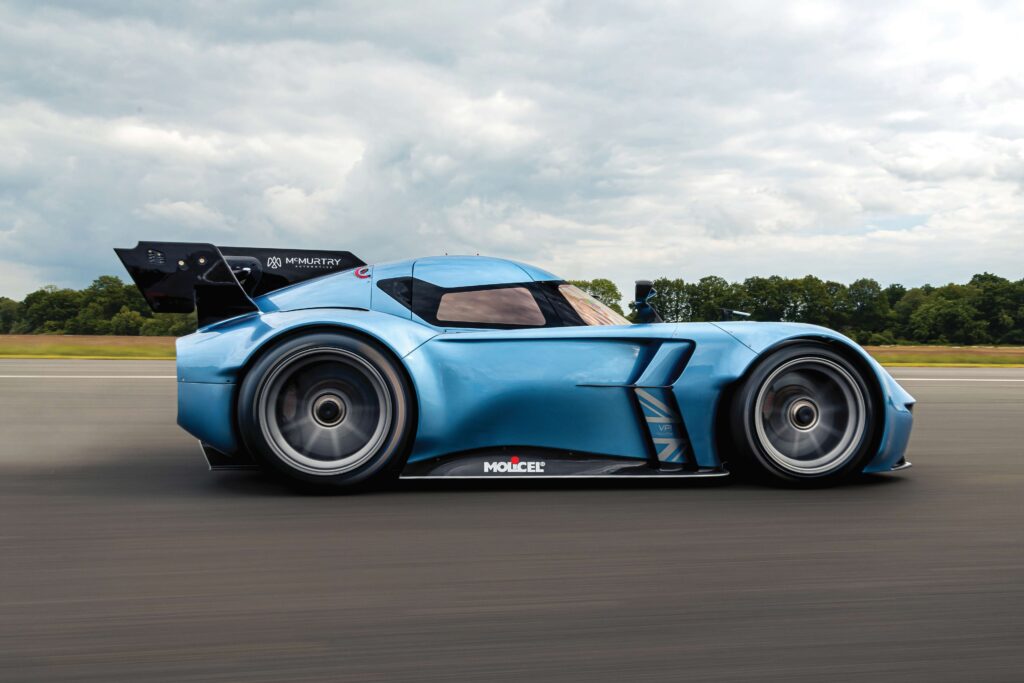
The demise of the e-booster project steered Edwards inevitably into pure battery electric projects, the first of which was providing race motors for an electric race series – although he still cannot disclose which one. Using an existing design, which had already gone through the design process, Edwards was tasked with managing the build and the delivery. With that complete, he then moved onto arguably one of his highest profile products: the Aston Martin Valkyrie. Designed by Adrian Newey, when he was still at Red Bull, the 1000 bhp V12-engined hypercar was created to mimic the performance of an F1 car as closely as possible – but without Edwards, it quite literally would never have got started.
“I did the motor that sits between the clutch and the gearbox and starts the engine,” he explains. “It also delivers push-to-pass capability; it’s a generator; it’s an alternator; it provides the reverse gear capability – because the main engine gearbox does not have a reverse gear – and because it’s a straight-cut gearbox, it provides gear speed matching on the gearshifts. It also allows the car to run at low speed – up to about 12 kph – on electric only.
The motor was only 20 kg, but it was 120 kW and it sat on the end of a V12 quite happily for its whole life. For a hypercar, it was a great solution!”
The automotive sector was a major part of Helix’s work at that point, but over time the client base has evolved from the original motorsport and F1 focus into a far wider remit, covering everything from defence to marine applications. Automotive, in fact, has dropped away since the Valkyrie project, with more and more OEMs bringing EV development in house, but Helix is still as busy as ever, applying that cutting-edge motorsport-driven mentality to many different industries. Edwards has risen to become chief engineer and is inspired by the acceleration of technology made possible by the company’s background.
“Because we’re situated in the heart of the motorsport and F1 triangle, we’ve got access to all of these manufacturers with incredible machining capabilities and an ability to do the ‘what-ifs’ where nobody else would go,” he explains. “We also have a lot of people with a motorsport background in our business – there’s a tidal flow between us and the F1 teams – so our base DNA is in the high-performance arena and I think that is our key differentiator.
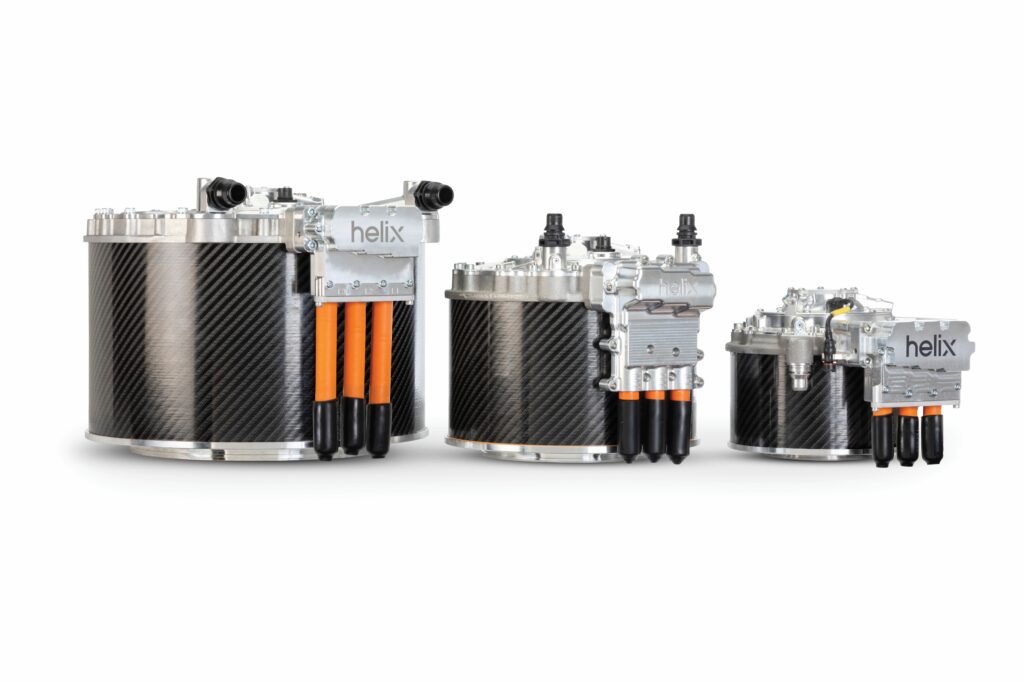
“There has really been a drive to accelerate technology through motorsport, then filter it down into the more conventional motors. The first motor we did for the race series right back when I started, for example, was making about 100 kW continuous. But within two years, by integrating some of the motorsport technology, we had a motor that was doing 200 kW continuous in the same size. Now in that space, we have 400 kW continuous. So, that technology has moved massively in what many see as a static market.”
Small and light
Edwards’ core performance targets are exactly the same in every project: reduce the size and reduce the weight – the two focus factors that take highest priority in motorsport. “Our background is in space- and mass-critical projects, so that philosophy has been built into our motors,” he continues. “Moving to something like a train is only a matter of dropping the peak temperatures that you want to see, to give longer life on some of the insulation materials, and suddenly you have a motor that is a tenth or a twentieth of the size of a conventional train motor.”
The truly ‘blue sky’ projects carried out at Helix are under the wing of its experimental ‘X Division’, the work of which Edwards describes as “the search for the art of the possible.” That then feeds down into the core technology across marine, off-highway, defence and aerospace – creating motors that are smaller and more powerful than ones that have gone before. As a result, Edwards and his colleagues are aiming to bring motor development to the fore, in an industry which all too often simply focuses on new battery technologies as the only real source of advancement opportunity.
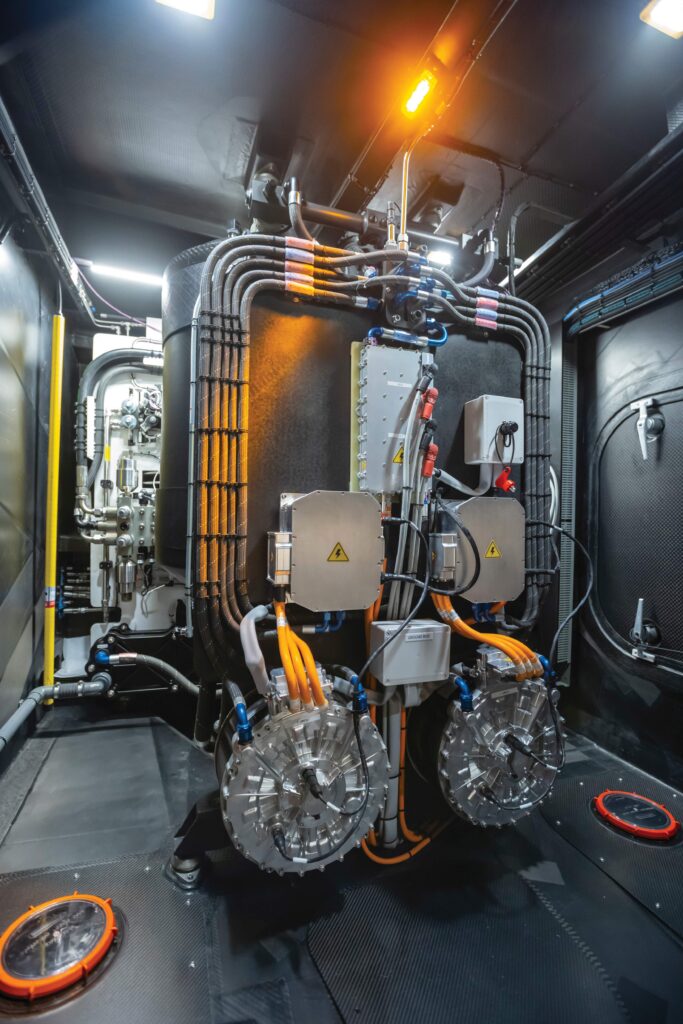
“If you look at it from an efficiency perspective, it’s all about size and mass,” he concludes. “If you’re using space for motors, you can’t use it for battery or payload – and that goes for every sector. Wherever size and weight are constrained, we can provide a better solution.
“That plays particularly to marine projects, which are a bit unusual. In cars, you have a lot of power-to-weight and when people put their foot down, they want to accelerate. In marine, you have a relatively gentle acceleration because there is a massive drag due to the viscosity of the water. So, where in a road car you might put your foot to the floor for 10 seconds but then lift off to maybe 10% throttle, in marine, you go to full throttle and you could be sat there continuously for hours.
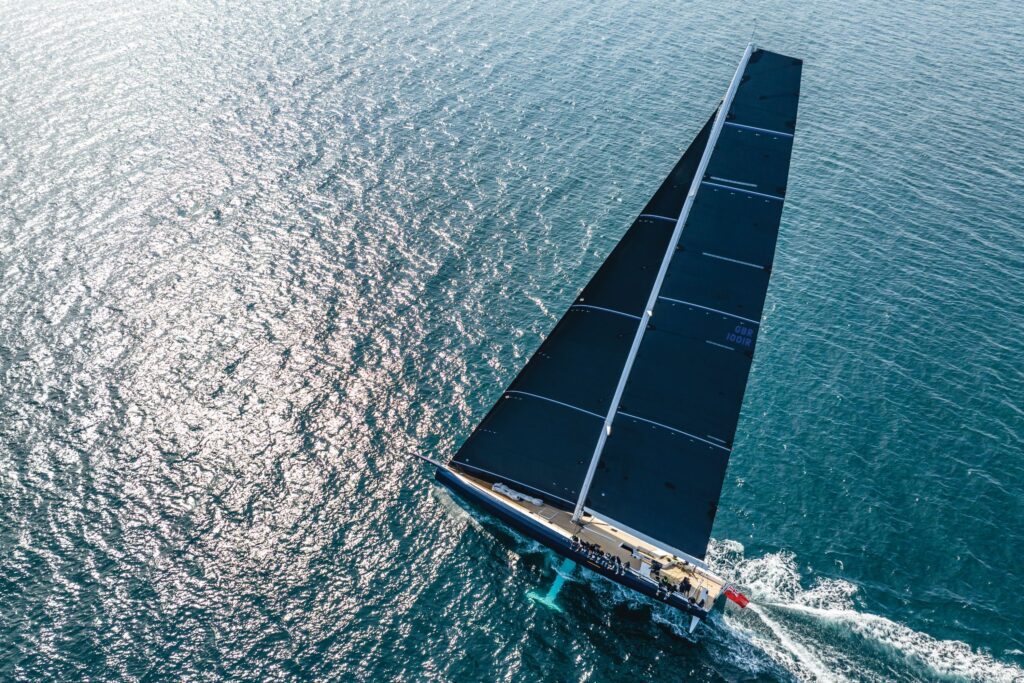
“That is a completely different drive cycle and it mandates a slightly different configuration, so there is a lot of optimisation opportunity in that area. We’ve worked on E1 Racing and Magic Carpet E, which is a wonderful carbon fibre sail racing vessel that we fully electrified to eliminate the use of a generator while they’re under sail racing. We’re supplying to outboard manufacturers, stern drive manufacturers, catamarans and at least three defence applications for marine operations.
“It’s the same for a number of the other applications where they have a conventional system and they either want to improve performance or have quieter operation. That really lends itself to electrification, but often there’s not enough space to put the extra kit in. So, we provide those solutions to customers who need that functionality – and that’s critically important at the moment.
“We’ve done quite a few proto-parts for mining vehicles, for example, where electrification brings some indirect benefits that you often don’t think of – like cutting down the energy they usually need to drive air through the mine and taking away volatile fuels that can cause explosive atmospheres. Meanwhile, in construction, many of the vehicles need good sight lines and anything that gets in the way of a driver seeing what’s around their wheels and bucket is a really bad thing for the operator – so as engines get bigger, with more and more after treatment, we can provide benefit to them by putting in a really small motor.
“Then there’s aerospace, where we are seeing a lot of interest in space launch vehicles because they’re very mass constrained. That is very much about efficiency and dropping mass because that’s your payload. They can literally put a price-per-kilo on the satellites, so they’re very clear-sighted about that because they’re charged by the kilo. We are also working with jet-engine manufacturers to look at improving the efficiency of gas turbines by having electric support in some areas of their operations, so they’re not constrained in one area when most of the cruising is done in another area. Again, it’s all about minimising mass for those applications and that plays really well to our core strengths.”
It is clear, then, that there is plenty of scope for electric motor development in all industries – however, recent changes in magnet licensing in China are threatening to put pressure on that development. To Edwards, though, this presents an opportunity to revisit assumptions around motor design. “It will change structures to some extent, so the future is going to be about making the best of low or zero magnet content and different magnet materials,” he concludes. “That will probably be the next impact on motors.
“A lot of automotive manufacturers don’t use magnets at all, but that tends to lead to a bigger motor and they can handle that because the cost is reduced and they have space. High-performance vehicles and the other industries I mentioned don’t have that luxury. So, I believe it will certainly impact those premium motors, but in terms of how we get around that, we will ultimately achieve the same efficiency and improve power in different ways – I have no doubt about that!”
Click here to read the latest issue of E-Mobility Engineering.
ONLINE PARTNERS