



Liebherr piling machines
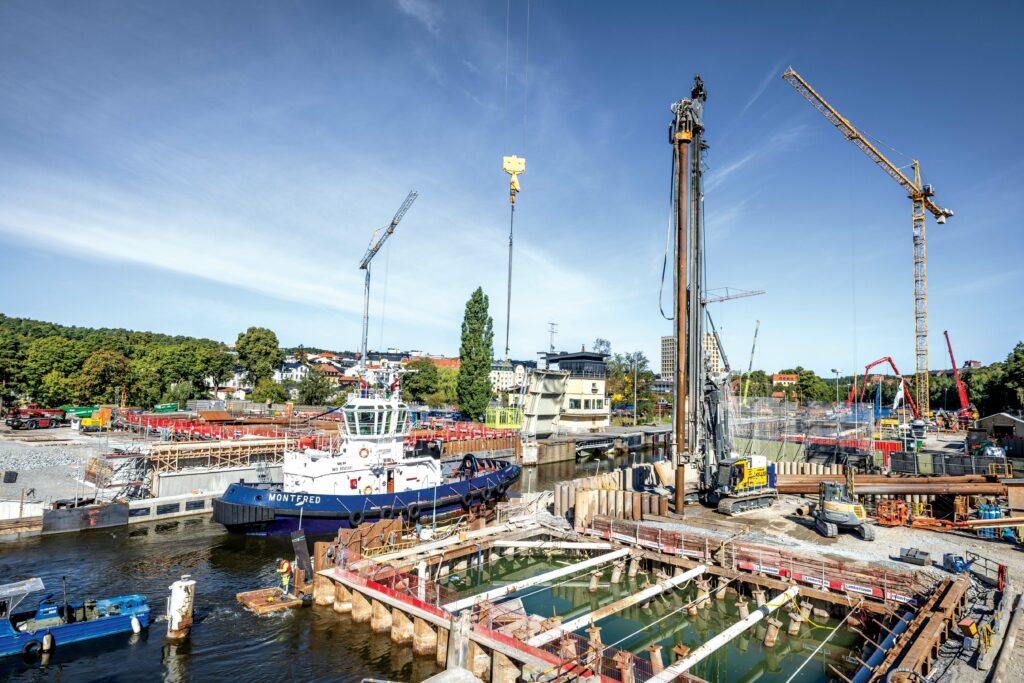
(Image: Clemens Niederée)
Changing the game in construction
Piling is – quite literally – the foundation of construction and while the machines that do it barely move, electrifying their operation is essential for net zero. Will Gray reports
The quest for net zero will only ever be achieved if the world develops ways to decarbonise construction, and heavy-duty on-site machinery is one of the major elements in that industry. Large-scale building work often involves huge crawler cranes, diggers, drilling machines and pile drivers, which are used to create the foundations of everything from tower block apartments to schools and offices.
The construction industry is one of the largest sectors in the global economy, but it is also one of the largest sources of carbon emissions. In the UK alone, the sector is worth roughly £170–£200 billion annually and it employs more than two million people across trades, engineering, architecture, manufacturing and infrastructure, with energy infrastructure and transport among the biggest growth areas at the time of writing.
The 1.5 million new homes that the UK government is currently targeting, which are being built at a rate of around 300,000 per year, often require intensive piling for foundations – and even the very power sources that the UK is heavily investing in to meet its future green energy requirements – such as the wind turbines, electricity grid infrastructure and hydro storage – involve huge construction operations for installation.
Globally, construction is one of the world’s largest industries, driven by a combination of population growth, urbanisation, data centre infrastructure and energy transition projects. According to the UN Environment Programme, construction accounts for around one tenth of global emissions of CO2. Much of this is down to the emissions from cement and steel production, but the emissions of on-site operations are estimated at around one tenth of that total amount – so it remains a significant sector to decarbonise.
Piling and drilling rigs, for example, use between 30 and 80 litres of diesel per hour, sometimes even more than 100 litres under heavy drilling conditions. Hydraulic piling hammer rigs, which pound heavy concrete, steel or wooden piles deep into the ground, typically consume between 20 and 50 litres per hour. Once in operation, they run constantly – not just for the 20 minutes or so it takes to drive a pile, but also for the similar amount of time it takes to install the next pile in the machine.
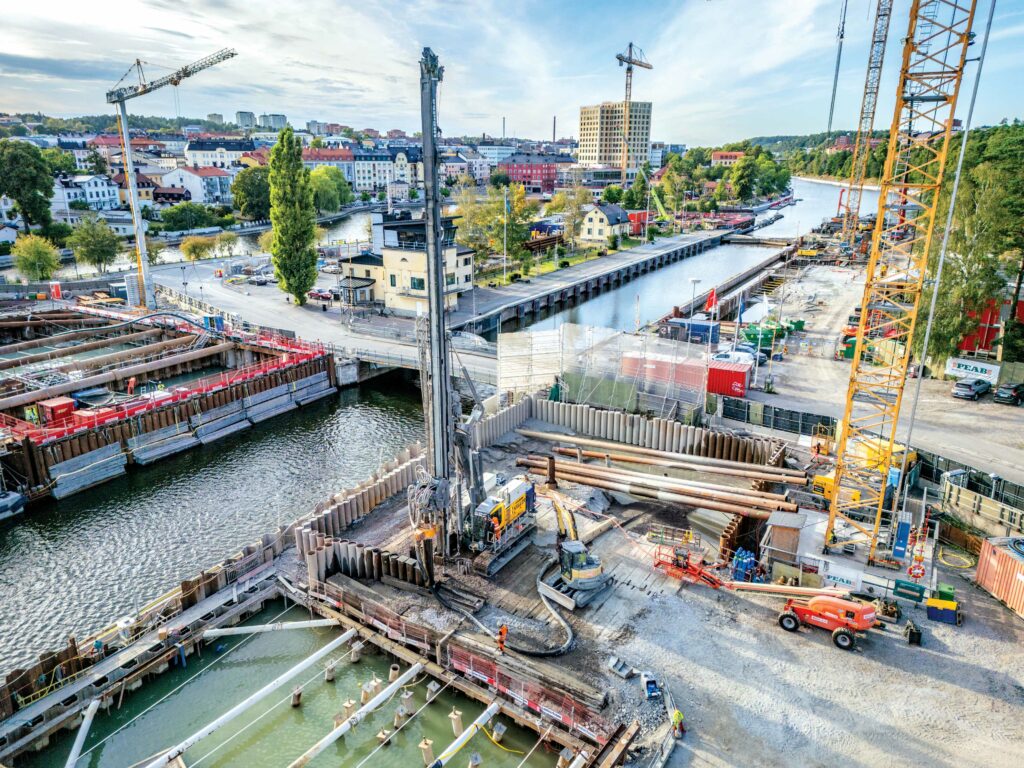
All the time, they are emitting CO2 into the local environment – at a rate of around one tonne per day for a large hydraulic hammer piling operation. Their electrification is being driven not just by the companies that use them but, in a large part, also by the localised emissions requirements effective in the places in which they operate. Stefan Mewes, product manager for pile driving equipment – construction machinery at Liebherr-Werk Nenzing in Austria, explains: “In Scandinavia – in Gothenburg or Stockholm – if they are looking for a job site, contractors are only allowed to have an electric machine on the job site.
“If construction companies only have machines with diesel, they get no permissions – and there are a lot of cities like this. Munich, Berlin, Milan, even London, where it’s more restricted even for cars, companies need these machines otherwise they will not get permission to work inside the city. There’s also no smoke being emitted by them and a lot less noise, so there really is a big environmental advantage for a job site.”
There is no single, one-size-fits-all electrification concept for every application in construction – each specific job has different limitations. A compact wheel loader in horticulture, for example, has different requirements to a 100 tonne crawler excavator for mining at 5000 m in remote locations. As a result, the first challenge when it comes to electrification is identifying the right competences for the right use-cases.
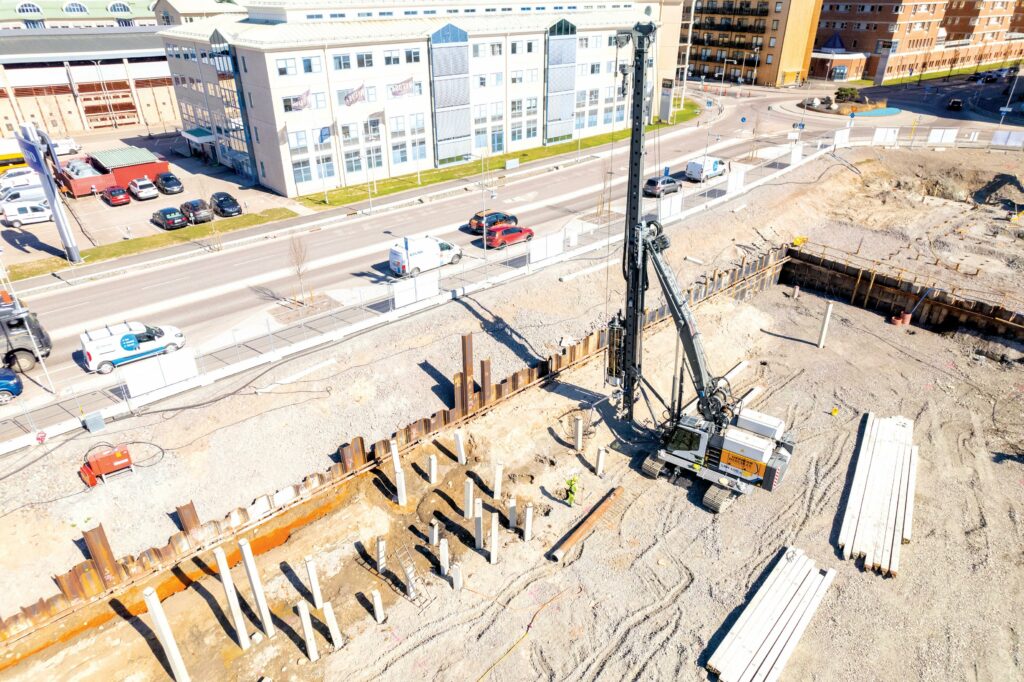
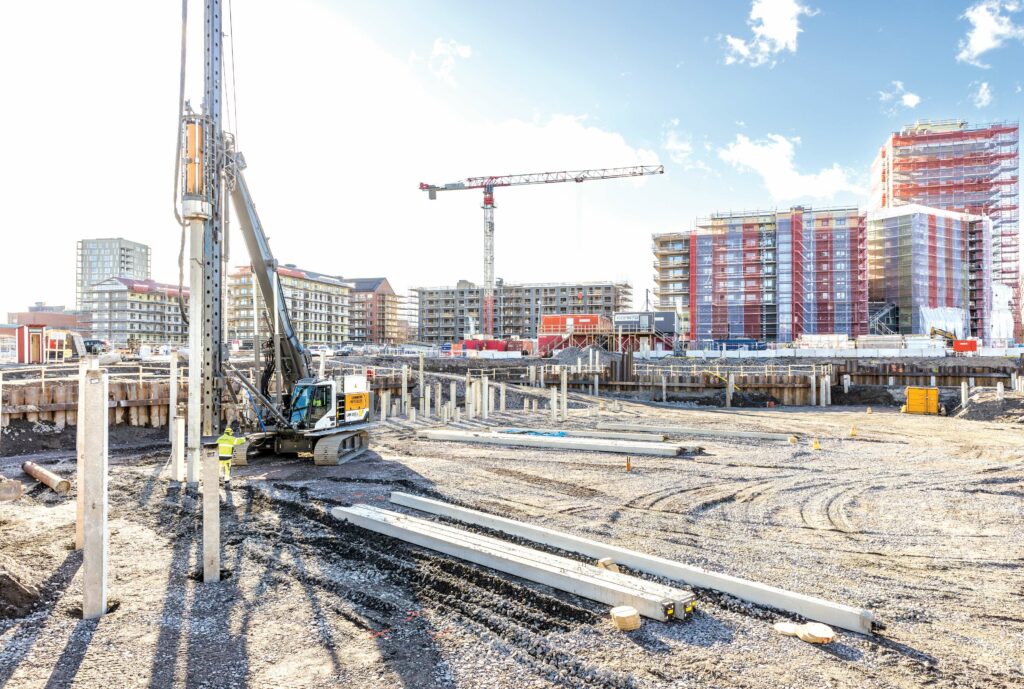
In the case of a pile driver, the primary energy use is when it is doing its work role, rather than driving around the site. In fact, most of the time it barely moves at all. “Many piling points can be reached without any movement of the vehicle, so it just stands still a lot of the time,” explains Mewes. “There is an outreach of 8 m from the leader and it can lift or lower the leader 6 m. So, from one position of the carrier, it can reach 10 pile positions with no movement.
“This is not a race track. We are sometimes changing position only five times a day – it’s a tiny amount. The machine comes to the site on a truck, so all we do is move it off the trailer and into position. We have a job site in Denmark, for example, where they are driving 10,000 concrete piles for the next 2–3 years – and in that period they will maybe drive around 5 km in total. That’s it!”
It is similar for many machines in Liebherr’s range – and, as a result, they have actually been involved in electrification for decades – but only when plugged in. Grid-connected electric machines are an integral part of Liebherr’s portfolio, particularly in tower cranes, material handling machines or mining excavators, where machines are often deployed as semi-stationary equipment and a grid power connection is readily available. This has led their battery-electric efforts to focus more on their smaller, more mobile vehicles – but since 2019, the larger machines, from piling machines to mining trucks, have been given a chance to become ‘unplugged’.
“Everything happened pretty fast,” recalls Mewes. “Liebherr launched the LB 16 unplugged drilling rig at a construction show in 2019 and it was on its first job site only a few weeks later. It took about one year to go from concept to reality. The Liebherr Group always like to be a leader in technology, pushing borders, pushing development, and we were driven by requests from the market, especially places like Scandinavia.
“It was the right time with the technology. Our company started with the LB 16 unplugged – where 16 means the drilling torque – and this is a small machine in this business. We put the components together with the motor, the battery concept, the heating and cooling system, and this was the start to also see what the market reaction was. Soon after getting on the first job site, there were more and more enquiries coming in for other machines, for crawler cranes and also for bigger drilling rigs.
“We have expanded the unplugged drilling rig now to an LB 30, which is double the size of the first one in torque, so it can achieve a bigger diameter and go deeper. We have also introduced five crawler cranes, including with 300 tonnes lifting capacity, along with three drilling rigs and the two piling machines.
There were not so many electric examples around in other machines except cars and the LB 16 unplugged was the first machine in this deep construction business. That machine allowed us to gain experience and it also showed that it was the right time.”
Drivetrain
The LRH 100.1 unplugged, and its bigger brother, the LRH 200, are the world’s first battery-powered piling rigs. The deep foundation machines can be connected to and powered by a conventional electric supply – as with many other vehicles of the Liebherr brand – but they can also be powered by battery, without a cable – hence the nomenclature, unplugged. Compared with the conventional diesel engine version, there are no restrictions in performance.
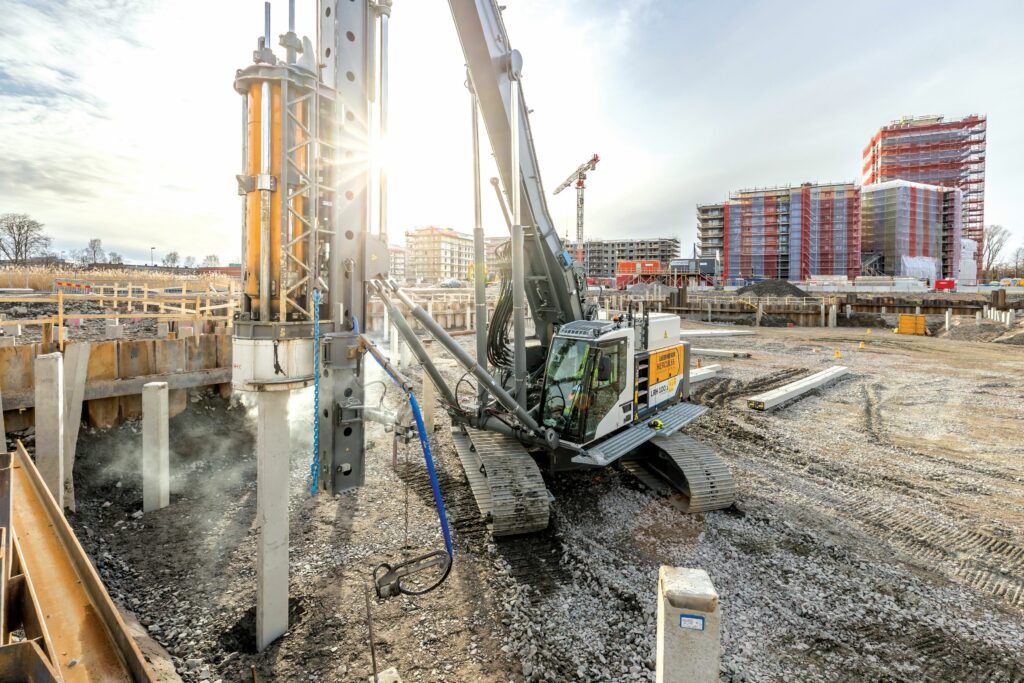
The bulk of the machine is made up of the carrier, which includes the cab and also houses the electric drivetrain – positioned in the same locations where the diesel engine and gearbox used to be, with a pair of battery packs on the upper deck. Protruding from the front of this carrier is a tall mast, the leader, in front of which is the hammer and hydraulic rig that is used to drive the piles into the ground against soil resistance. The piling operation simply involves using the electric motor to power the hydraulics that lift and accelerate the drop of a ram weight to deliver the impact energy multiple times until the piling is complete.
“In the cabin, the operator has two joysticks and they can tell the system the ram stroke and the impacts per minute. Then, just by moving the joysticks, they can move the leader,” explains Mewes. “There is not much work to do except to stop the machine once the pile is driven. The energy involved normally depends on the pile cross-section and, as the operators are paid by the number of piles driven per day, they typically need the operation to be as fast as possible. So, it was important that the electric machine had at least the same performance as the diesel engine.”
Liebherr adapted its conventional hydraulic piling rigs into battery-electric machines while maintaining familiar architecture. They can operate on mains voltage at 400 V AC (running on 3-phase with neutral and protective earth wires) or they can use the onboard battery system. The rig has two hydraulic pumps, each of which delivers 275 litres per minute for the working tools, with a separate pump delivering 130 litres per minute for the kinematics. The maximum working pressure is 350 bar and the hydraulic oil tank, which is designed for the use of synthetic environmentally friendly oil where possible, has a capacity of 600 litres.
When the carrier has to move, traction is delivered through a pair of crawler tracks, with fixed axial piston hydraulic motors. These can provide a tractive force of 440 kN in the LRH 100 or 665 kN in the LRH 200 – which enables the huge heavy unit to reach a crawling speed of 2 or 1.3 kph, respectively. The side frames have hydraulic chain tensioning and the vehicle is kept stationary with a hydraulically released, spring-loaded multi-disk holding brake.
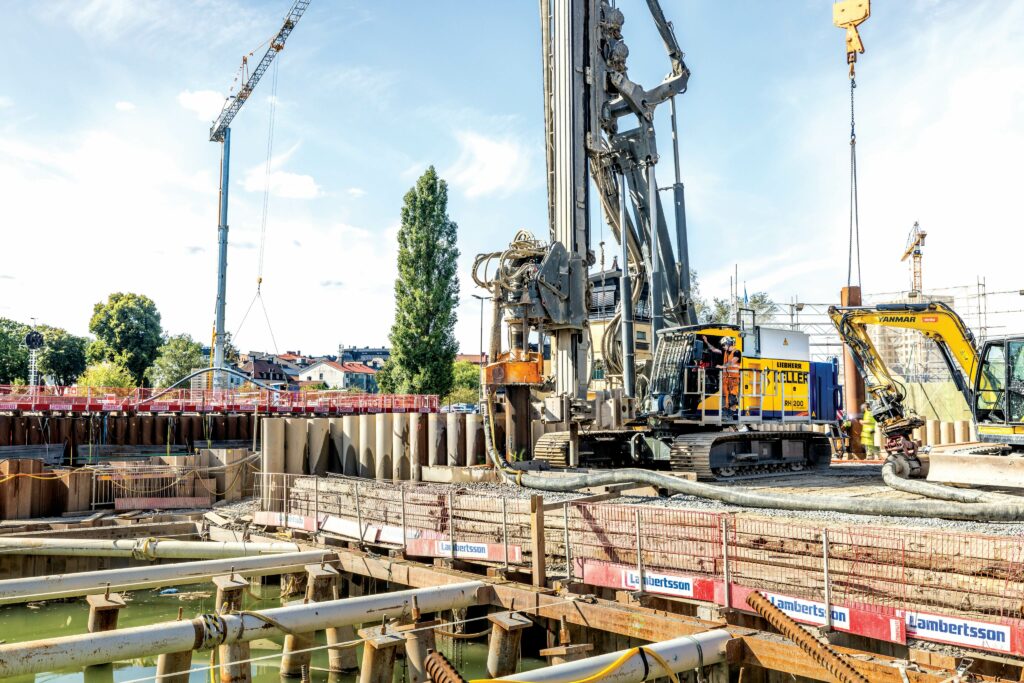
“We use a direct AC electric motor to run the regular functions of our construction machine,” explains Mewes. “The hydraulic system is all the same as the one on the diesel version, but on this vehicle we just transfer the electric energy from the batteries or direct mains plug-in system to run the electric motor. The piling mechanism is still a hydraulic operation, with an upper carrier and lower carrier, a hydraulic cylinder at the leader and a hammer, which is lifted by the hydraulic cylinder and accelerated downward by hydraulics.
“Instead of the engine, gearbox and cooling system, we have the electric motor, battery management system, the thermal system and the terminal system. The motor is located where the diesel engine normally is. We have added a charging plug in the middle of the tracks, which can be positioned front or the back, and we added an area at the top of the upper carrier for the battery storage. It is a direct drive solution, so we eliminate losses in the gearbox from the diesel engine, and we have a belt drive to take the output of the motor to the wheels.”
The diesel motor achieves between 1600 to 1800 rpm, whereas the electric motor can run from 500 to 2300. However, Liebherr has introduced an innovative frequency converter to maintain a consistent 1000 rpm at all times. “The diesel engine is always changing, running at more or less revolutions per minute. So, having a motor that can run at one speed has significant advantages,” says Mewes. “It allows also to have a constant speed of the hydraulic motor, constant hydraulic pressure, constant hydraulic oil flow and constant speed of the winches, so that’s far better for operation.
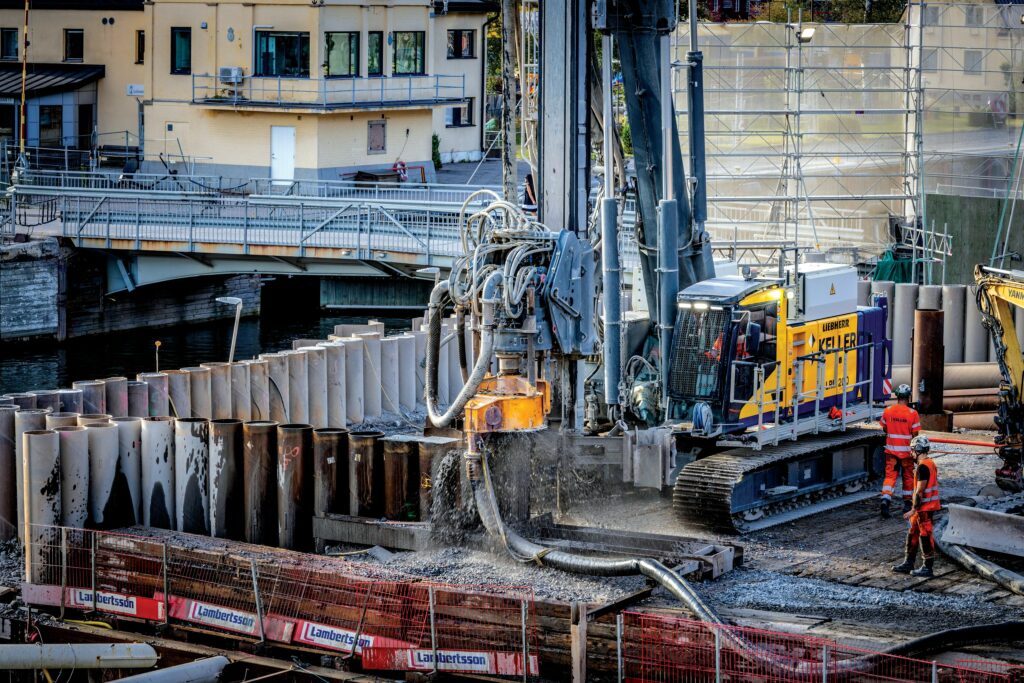
“As it is a frequency-converted motor, we can adjust the frequency and control the voltage, and this is the best way to control the speed of our motor. All other components in the upper carrier – the cooling systems and so on – are running with direct current of 700 V, and we have another converter to deliver 24 V for the onboard electrics. We’re using the same systems across the board on all of the unplugged machines – the carrier is the same as we use for the LB 30 drilling rig unplugged, the piling rig unplugged and the crawler crane, and we use a lot of the same components across these machines.”
Charging and operation
All of the Liebherr range of deep foundation machines provide the option for plugged-in or unplugged operation, making them quite unusual in the EV space. Their relatively static operation allows on-site power to provide direct recharging while in operation – much in the same way as a mobile phone can still be used while it is plugged into a charging socket. The electricity on most job sites is between 380 to 400 V, which Liebherr converts into DC of around 700 V to charge the batteries.
The system uses off-the-shelf high-performance Li-ion nickel manganese units from Akasol Batteries, which promise a life of 10 years or 4000 cycles. The standard unit provides 300 kWh of storage, with options for 400 or 600 kWh, and charging can be carried out at 400 V AC, with a maximum of 20 kW at 32 A, 40 kW at 63 A and 80 kW with 125 A. The 300, 400 and 600 kWh batteries provide four, eight and 12 hours continuous-use power, respectively, which may sound limiting for a construction site – but the way the power is used, when compared with how the diesel version operates, ensures it will comfortably last a full day shift.
“With a diesel motor, the operator starts it up in the morning and it runs for the whole day,” explains Mewes. “It takes around 20 minutes to drive a 20 or 30 m pile into the ground, and the process of bringing the next pile in – depending on crew capability – will usually take around the same amount of time. The diesel machine just keeps running throughout that entire process, staying on idle while the pile is loaded, whereas the electric machine pretty much falls asleep.
“During the pile loading process, there is no need to use up any energy with the electric, except a small amount that we use to process data. We have a system that can transfer all the data wherever our customers are in the world, wherever they are on the road, so we need some energy to deliver that as a piling diary. The standard unit has a capacity of 588 kWh and that is good for a day shift on a typical job site, which is 12–15 hours. Then, they can charge the batteries again overnight using job site electrics or gensets.”
The biggest challenge, Mewes says, is convincing customers that there is little to no danger that they will run out of battery power on site. “They like the diesel engines because they can see it is always running,” he smiles. “When we show our customers the electric, we have to explain that the battery is never empty and they cannot really believe that they always have some energy in the machine, even if the battery is running out. On some sites, for example, they’re working two shifts, non-stop, so they just plug it in.”
On most electric vehicles, keeping battery weight to a minimum is vital to achieve the highest possible range. On the piling carriers, and other vehicles in the unplugged range, that is far less important – because the range is barely a few kilometres per day. In fact, weight only becomes an issue when it comes to transporting the machinery to and from site, where the extra weight reduces fuel consumption on the carrier and increases transportation emissions. However, despite the significant weight addition of the battery storage, Mewes says the removal of other aspects related to the diesel machine means the electric version tops out at a mere 200 kg more than its diesel equivalent.
Once on site, that additional weight is actually a benefit, and Mewes explains: “We use counter-weights in the back of the carrier to help the stability of the piling rig. So, the weight of the battery can help us in critical situations, particularly where we have inclination piling, backward and forward and sideward – so battery weight is actually a benefit sometimes.”
Tuning efficiency
Liebherr only launched the unplugged range of its heavy-duty machinery once it had the knowledge that the available components could be combined to deliver the same performance as the existing diesel-based machinery – but it is the efficiency gains that have proved most impressive. “A diesel unit needs 8 or 9 litres of fuel per hour, which is around 90 MWh, but from our experience with the electric machines, they only need 30–32 MWh,” explains Mewes. “So, thanks to the electric efficiency compared to burning fuel, it only requires one third of the energy that a diesel engine would use – that brings with it significant cost reductions, which is very attractive to a lot of customers.
“For the pile driver, the efficiency of the hammer is important, and the transfer of energy into the pile is 95% with the electric motor. I believe a diesel motor has around 50–55% efficiency, but an electric motor has 99% efficiency. We have also seen the benefit in maintenance and servicing of the machines. A diesel-driven engine requires a service every 500 hours, whereas the electric machines stay more or less maintenance-free.”
The elimination of the diesel engine, gearbox, oil filters and other ICE-related requirements, and the reduced material stress owing to the smoother electrical operation causing fewer vibrations, add up to a reduction of 40–50% in maintenance costs compared with the diesel engines – and with the electric machine itself costing around 25% more than a regular machine, Mewes says that the lifetime savings make it “absolutely appealing.”
The electrification comes with the addition of some complex digital systems and remote monitoring capabilities. The operator controls remain as simple as before, but behind the scenes, the software that the Liebherr Group has developed takes control. “There is a complete control system in there but all the operator sees is a display in the upper carrier or in the cabin,” he says. “It is also possible to download a mobile phone app, so wherever in the world our customers are, the status of the operation and of the battery charging can be seen. The machines also have GPS, so the operator knows exactly where the machines are and the Liebherr computer program ‘My Jobsite’ sends all the data to the customer, providing a full diary of the complete job site. So every pile has its own story!”
Core to the operation is the company’s in-house software, which manages all the onboard safety systems, with an insulation monitoring system that continually checks to ensure electric safety and sends the driver a notification for manual shutdown if there is a leakage or any potential faults, and a battery management system, which monitors the key parameters – the voltage, current, charging, deep discharge and balancing of the different cells – and keeps everything in check. “This is all managed from the inside,” adds Mewes. “From outside, nothing is noticeable.”
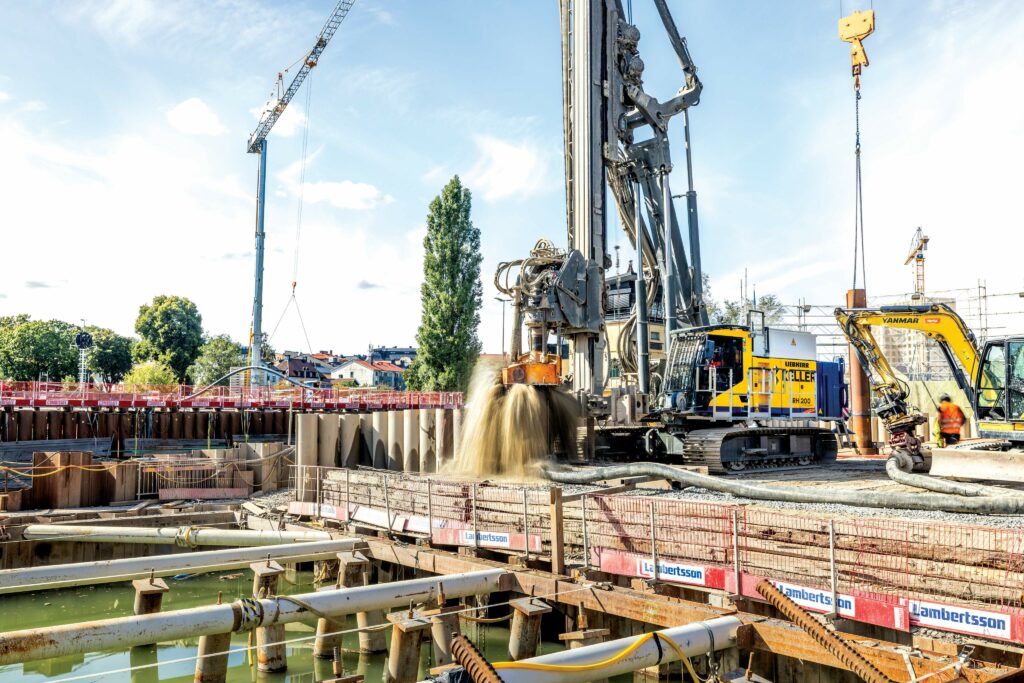
The electric piling rigs are now running throughout Europe – in Austria, Denmark, France, Germany, Great Britain, Netherlands, Norway, Sweden and Switzerland – and also in the USA, Canada, Dubai, Hong Kong and Australia. Given the scale and diversity of operational locations, the team had to robustly engineer the electronics, battery system and drivetrain to be capable of operating reliably in both extreme heat and extreme cold conditions. Key to that was the twin-circuit cooling approach that Liebherr has developed in house.
“The system has two circuits – one for battery cooling and a second for all the components,” says Mewes. “Without any changes in the design, this allows our machines to run everywhere from the cold Scandinavian Arctic to the hot climate of Dubai. The thermal management system keeps the batteries always at a storage temperature of 15–20 C, so if it’s too hot or too cold we have it cooling or heating up. We have tested the machines in working outside temperatures from minus 26 to 65 C.”
The machines are even wired for driverless operation when required – but this only comes into play when they arrive on a site. “They are transported on trucks, barges, railroad transportation, ships – so we use the remote control to offload them,” says Mewes. “We can drive the electric machine from the barge, the ship, the truck, and so it is not necessary for somebody to sit inside the cabin for unloading and uploading – but we can also do that with the diesel engine machines.”
The machines are adaptable, with the capability of changing the tool in front of the leader to enable them to be used to carry out a variety of different construction operations. “Instead of the hammer, we can use a rotary head or, for soil mixing, we have two different devices, but all we have to do is change the tool; we never do any changes to the set-up of the machine.”
Looking to the future
Electric piling is clearly here to stay. The proven capabilities and heightened efficiency of the machines make them a financially sensible play, even without consideration of the positive environmental aspects or the increasing mandate of cities for emissions-free construction.
“Electric energy-driven construction machines are definitely coming,” concludes Mewes. “This is the future – but there will always be improvements. We are already thinking about exchanging some hydraulic components now, like the hydraulic winches for the ropes and some of the hydraulic cylinders used to move the leader back and forward. There will be no change with the hydraulic hammer because it’s already a high-efficiency, perfect tool to drive these piles. Also, the rotary head stays the same for drilling the piles, but there is some investigation being done into further increasing the efficiency of the carrier and boom.
“Although the weight is not relevant on site, it is for transportation because bigger and stronger also means more load to travel, and more cost. So, people are still looking for a lighter machine, but they also want the biggest hammer to drive the biggest piles – we have to balance that with stability. Development never ends and nobody knows where it goes next – maybe, one day, the rotary heads for the drilling machines will have electric motors. We do more and more for the individual components and it comes together as an overall improvement. It’s not Formula One – it’s much slower than that! – but it’s very much the same approach.”
Liebherr’s electric range
Liebherr’s two piling rigs sit within a growing range of unplugged construction vehicles, which started with drilling machines and has also expanded into crawler cranes. Michael Flecker, Liebherr’s head of sales for crawler cranes, started his career at Liebherr in 2005 as an international fitter. He was central to the introduction of the first unplugged crawler cranes at the end of 2020 and has quickly seen the advantages they offer for all those involved.
“Demand for electric construction machines is particularly high among customers in northern Europe – led by the Scandinavian countries and Great Britain, which are pioneers in the field of zero emissions,” he says. “Five unplugged machines are as loud as one diesel-powered machine. Many customers choose our battery-powered machines because they believe in the technology and want to be the first to use it in their market. In some countries, this is actually a distinct competitive advantage.”
Crawler Cranes
These large mobile lifting machines are commonly used on major construction, infrastructure, energy and industrial projects for lifting extremely heavy loads – for example, erecting bridges, high-rise buildings, petrochemical plants and wind turbines. They use tracked undercarriages to distribute the weight over a wide surface area, enabling them to operate on soft ground and uneven terrain.
The crane body is comprised of a crawler base with a rotating upper structure, on top of which is a boom system for lifting, counterweights for stability and powerful hoist winches. The largest examples can lift more than 3000 tonnes, depending on configuration, and they are often required to move around a site while carrying suspended loads.
Crawler cranes represent one of the most advanced electrification programmes in heavy lifting equipment and Liebherr now offers five battery-electric versions: the LR 1130.1 unplugged, LR 1160.1 unplugged, LR 1200.1 unplugged, LR 1250.1 unplugged and LR 1300.2 SX unplugged. The cranes retain the structural and hydraulic characteristics of the conventional LR crawler crane family, while replacing the diesel powertrain with electric motors and battery systems. As with the piling rigs, they are designed around a dual-operating concept with capability to work directly from a mains power supply or operate autonomously from onboard batteries.
The vehicles use a high-capacity Li-ion battery system combined with a full electric drive architecture, with the capability of operating for up to eight hours on battery power depending on duty cycle and load demand, and a charging time of between 4.5 and 8.5 hours, depending on available site infrastructure. The largest machine, the LR 1300.2 SX unplugged, has a 392 kWh battery pack and a 438 kW electric motor, enabling up to 13 hours of operation without a mains connection.
The smallest model, the LR 1130.1 unplugged, delivers a maximum lifting capacity of 137 tonnes, a maximum hoist height of 126 m and a maximum radius of 78 m. The LR 1160.1 unplugged increases capacity to 160 tonnes with a 136 m hoist height and 84 m radius; the LR 1200.1 unplugged offers 220 tonne lifting capability, a 148 m maximum hoist height and a 103 m working radius; the LR 1250.1 unplugged reaches 250 tonnes capacity with the same 148 m maximum hoist height and a 97 m radius; and at the top of the range, the LR 1300.2 SX unplugged provides a 300 tonne maximum lifting capacity, 169 m hoist height and 143 m maximum radius.
The machines are specifically suitable for urban construction, tunnels, industrial plants and environmentally sensitive projects where diesel exhaust and noise restrictions are critical and zero local emissions are required. The electric driveline also substantially reduces operating noise. As with the piling rigs, drive is not the primary concern – the vehicles move very little on site – but the LR 1250.1 unplugged batteries contain enough energy for general lifting operations, erecting the main boom with a luffing jib and travelling up to 650 m on site.
Drilling Rigs
These heavy construction machines are used to create deep holes in the ground for foundations, geotechnical work, mining or energy applications. In the construction industry, they are primarily used to install bored piles and foundation shafts that support buildings, bridges, tunnels and other large structures. The machines are of similar design to pilling rigs and typically consist of a tracked carrier, a vertical mast or leader, a rotary drive system and specialised high-torque drilling tools such as augers or drilling buckets, which cut into soil, clay or rock while extracting material from the borehole.
Modern rigs can drill holes several metres in diameter and reaching depths of more than 70 m, and Liebherr is leading the way in creating battery-electric unplugged versions that reduce emissions and operating noise on urban construction sites. The company has two electric drilling rigs – the LB 25 unplugged and the LB 30 unplugged – which both use the same core philosophy as the unplugged cranes and pilers, offering identical operating performance to their equivalent diesel machines.
The LB 25 unplugged has an operating weight ranging from 71.1 to 82.1 tonnes, depending on configuration, with a maximum drilling torque of 252 kNm and a drilling depth of 53.2 m for diameters up to 3300 mm. The larger LB 30 unplugged increases operating capability significantly, with an operating weight of up to 85.5 tonnes, a maximum drilling torque of 297 kNm and a depth of up to 70.8 m for diameters of up to 3400 mm, making it more suitable for large-scale bridge foundations, high-rise projects and deep geotechnical installations.
Across the unplugged family, the focus is on reducing emissions, lowering noise and maintaining full-duty-cycle productivity. The rigs are intended for projects where diesel emissions, vibration and acoustic output are major operational constraints – an increasingly important factor across the world. By electrifying heavy deep-foundation equipment without reducing torque, drilling depth or pile handling capability, the construction sector can continue to operate with a zero-emission foundation.
Four ways to a more sustainable future
The Liebherr Group invested €708 million in R&D activities last year, with the focus firmly on new machines, components, digital solutions and forward-looking technologies that seek to reduce emissions, improve site conditions and take construction into a new era.
As part of this, the company has been working closely with universities, higher education institutions and research organisations around the world. The work has focused on a range of different aspects covering autonomy, alternative drive technologies, electrification and digitalisation. Here are a few of the areas they have focused on.
Digital assistance
The development of new digital solutions has been a priority as they often deliver improved efficiencies on existing machinery but also come as a precursor to potential electrification in a wide range of operational activities.
The company’s biggest advances for deep foundation machines have been the MyJobsite App – a one-stop-shop that will record, display, analyse, manage and evaluate machine, construction site and position data in deep foundation work; the LIPOS positioning system – which enables more precise execution of piling or drilling processes using satellite navigation technology to assist the driver in aligning attachments and tools precisely; its Process data recording PDE system; and the Foundation Equipment Planner – which helps engineers and project planners calculate load capacities and ground pressures for every permissible configuration.
Alternative drive
Electrification is not the only focus for Liebherr’s emissions reduction – and in 2025, a key milestone was achieved with the first wheel loader powered by a hydrogen engine. This is already in field operation and central to its development was the in-house LiGO Injection Systems technology, which enables flexible injection of alternative fuels such as hydrogen, methanol, ethanol or ammonia. At the same time, Liebherr has been expanding its range of battery-electrically operated machines to include excavators, wheel loaders, mining trucks, pilling rigs and cranes. The Liebherr Liduro Power Port, an energy storage system for power supply on construction sites, allows for locally emission-free operation and charging of hybrid or fully electric construction machinery and equipment on sites.
Refurbished technologies
Developing new emissions-free technologies is not the only element to making construction sites more environmentally friendly. The responsible handling of existing products is also a key element for sustainability, and that means keeping machines and components in operation for as long as possible. The innovative remanufacturing programme from the Liebherr Group achieves this by taking a more methodical approach to management and servicing – taking components such as engines or gearboxes and completely dismantling, inspecting, reconditioning and restoring them to an as-new condition. This helps reduce demand for new raw materials and lowers CO2 emissions across the product life cycle – while also offering an economically attractive and technically tested alternative to new components.
Specifications
LRH 100.1 unplugged and LRH 200 unplugged
Max drive power: 255 kW
RPM: 1000
Battery capacity: 300 up to 600 kWh
Charging: 20 kW at 32 A / 40 kW at 63 A / 80 kW at 125 A
Capacity: 4–12 hours continuous use
Max speed: 1.3–2 kph
Hammer weight (max): 18,000 kg
Pile length (max): 24.5 m
Pile weight (max): 16 t
Click here to read the latest issue of E-Mobility Engineering.
ONLINE PARTNERS