
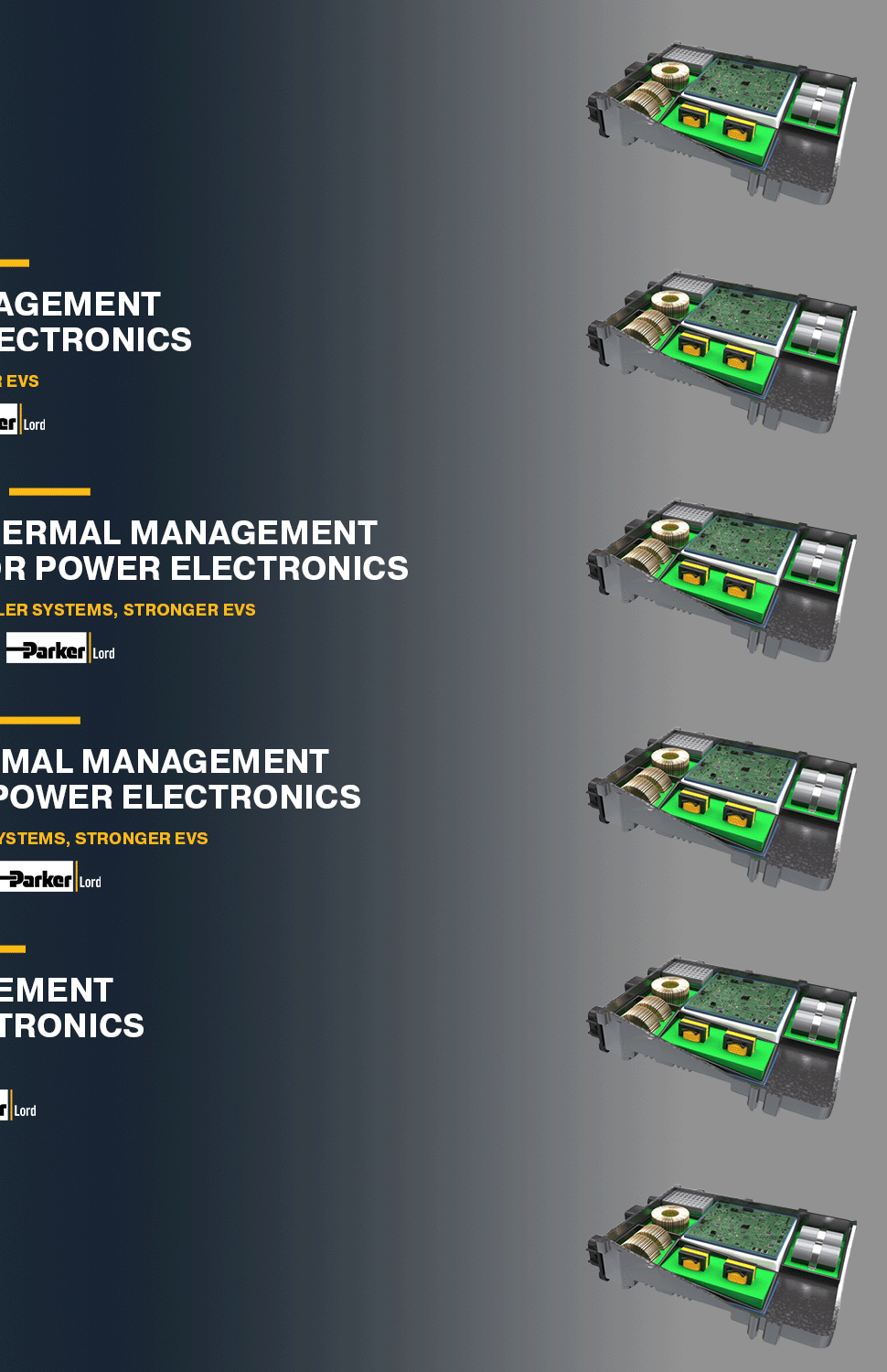





Structural adhesives for EV battery enclosures
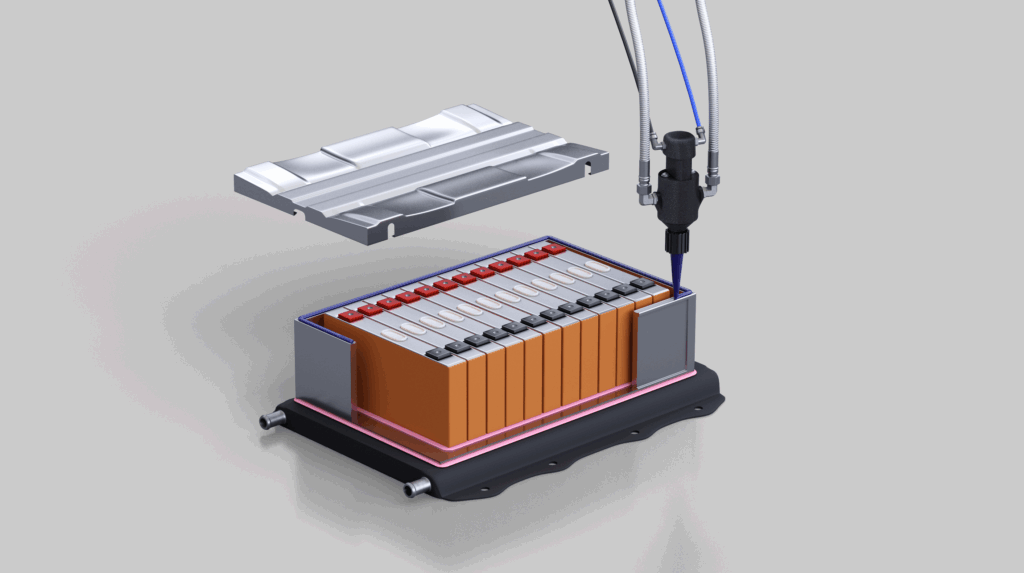
(Image: Parker LORD
Making the EV battery pack a structural component of the vehicle has placed unprecedented demands on joining technologies. As engineers strive to increase energy density, manage thermal loads, and ensure crashworthiness, the limitations of traditional welding and mechanical fasteners become increasingly apparent, writes Peter Donaldson. Adhesive bonding has emerged as a critical enabling technology, and the combination of Parker LORD 5206 acrylic adhesive and LORD Accelerator 55GB is specifically engineered to meet the challenges of battery enclosure manufacturing.
Multi-material capabilities
Today’s battery enclosures often combine aluminium frames with steel mounting brackets, both with a variety of surface finishes and coatings. A common concern is whether an adhesive can reliably bond this mix of metals without extensive preparation — a capability that streamlines the assembly process by eliminating costly steps. According to adhesives engineer and Parker Lord business development manager Eric Wyman, the 5206/55GB system is formulated to do exactly that. “It bonds well to unprepared aluminium and most steel coatings,” he confirms. “It can also bond well to unprepared electro-coating, powder-coating and paints. It was designed with an eye toward minimising surface preparation.”
The accelerator also enables precise control of the adhesive bondline thickness due to the 0.01″ (0.025 cm) diameter glass beads it contains.
Structural integrity and crashworthiness
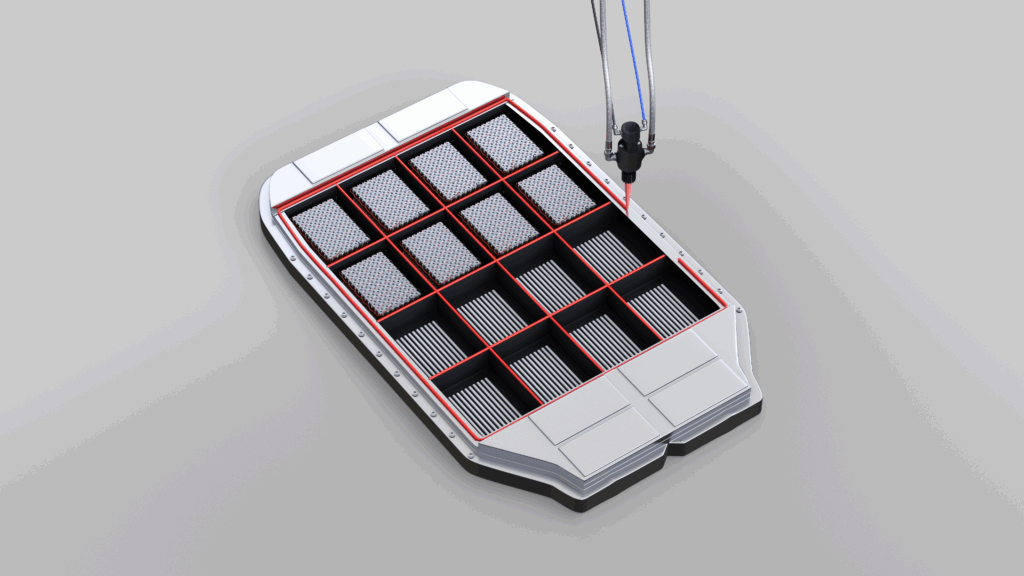
Beyond joining components, the adhesive is also designed to play a key role in the pack’s mechanical performance. For engineers focused on structural integrity, the system can be used to bond reinforcement ribs and cross-members directly inside the tray. Unlike spot welds or fasteners, which concentrate stress, the adhesive distributes loads evenly. Wyman notes that using the adhesive in this structural manner “would help increase the total pack strength, especially when compared to welding or fasteners alone,” directly contributing to the enclosure’s crashworthiness.
Thermal cycling and vibration
EV batteries are subjected to extreme and repetitive conditions. While the data sheet confirms an operational range of -40°F to +300°F (-40°C to +149°C), surviving static temperatures is different from enduring thousands of thermal cycles. According to Wyman, “5206/55GB’s proprietary toughening system allows the material to absorb vibrations and small dimensional shifts due to temperature. This has been shown through high-frequency fatigue testing, and this product has been in use for a decade now.”
In service, it also resists dilute acids, alkalis, solvents, greases, oils, moisture, salt spray and weathering, says the company. Furthermore, it provides “excellent” resistance to indirect UV exposure.
Electrical isolation and production notes
In the high-voltage environment of a battery pack, electrical isolation is paramount. With a dielectric strength exceeding 10 kV/mm, the adhesive can act as a reliable insulator. However, Wyman offers a critical note for system design: “More often than not, adhesives with dielectric capability are used with another method of providing dielectric protection (redundancy) due to the risk of a skip in the bead, thus limiting the dielectric strength to that of air.”
Finally, while the adhesive provides an excellent environmental seal, its high strength means it is not a reworkable gasket. For production, its ability to reach handling strength in ~25 minutes – and cure faster with applied heat – allows it to integrate seamlessly into high-volume assembly lines.
Click here to read the latest issue of E-Mobility Engineering.
ONLINE PARTNERS