















New battery design for longer-range EVs
(Image: University of Surrey)
Researchers in the UK have developed a battery design that could significantly extend the range of EVs, writes Nick Flaherty.
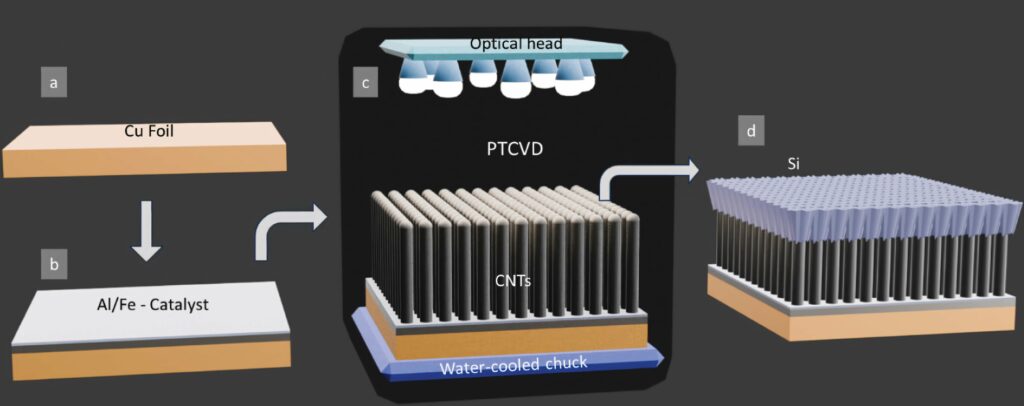
A team at the University of Surrey’s Advanced Technology Institute (ATI) has developed a technique for making silicon-coated carbon nanotubes (CNTs) that can be used for high-volume roll-to-roll production of anodes for lithium-ion batteries.
The resulting anode delivers some of the highest energy storage capacities reported for silicon–CNT systems while maintaining stability over hundreds of charge cycles.
The Vertically Integrated Silicon–Carbon Nanotube (VISiCNT) structure grows dense forests of CNTs directly onto copper foil and coats them with a thin layer of silicon in just seven minutes. This creates a flexible, conductive scaffold that can absorb the expansion of the silicon while maintaining performance.
This architecture achieves very high capacities of 3.5 Ah/kg, but also accommodates volumetric expansion and mitigates material delamination. In addition, the high-quality growth of CNTs on copper foil is demonstrated at a rapid rate of 21 μm/min at 415 C, which the researchers say is suitable for roll-to-roll scale-up and large-scale manufacture. Other CNT processes are typically above 700 C.
Exploring various VISiCNT structural variants showed that shorter CNTs of less than 5 μm with a higher defect density (ID/IG ≥ 1) deliver some of the highest reversible capacities, exceeding 3500 mAh/g, which is close to the maximum possible for silicon and far higher than that for the graphite
(370 mAh/g) used in today’s batteries. However, although this is at low loadings, it does show good cyclic stability.
“This work is an important step towards bringing CNT–silicon anodes out of the lab and into real-world manufacturing. We can grow CNT structures directly onto copper foil at speed and tailor the silicon layer for stability, meaning this approach could be integrated into existing battery production lines with minimal disruption,” said Professor Ravi Silva, principal investigator and director of the ATI.
“There’s been a growing push for battery innovation because many of today’s technologies are limited by how much energy batteries can store. Our VISiCNT design offers a practical route to harness silicon’s huge storage capability without sacrificing cycle life,” said researcher Dr Muhammad Ahmad, research fellow at the ATI.
“This is a much-needed breakthrough, delivering very high capacity, fast charging and long-term durability, while bringing us closer to batteries that can power EVs and everyday devices for much longer on a single charge.” A key advantage of the new approach is that the CNTs are grown directly onto copper, which is already used for commercial batteries using a scalable manufacturing process. This could make it easier to integrate the technology into existing industrial production lines.
Click here to read the latest issue of E-Mobility Engineering.
ONLINE PARTNERS