










Temperature boost shrinks DC-link capacitor
(Image: TDK)
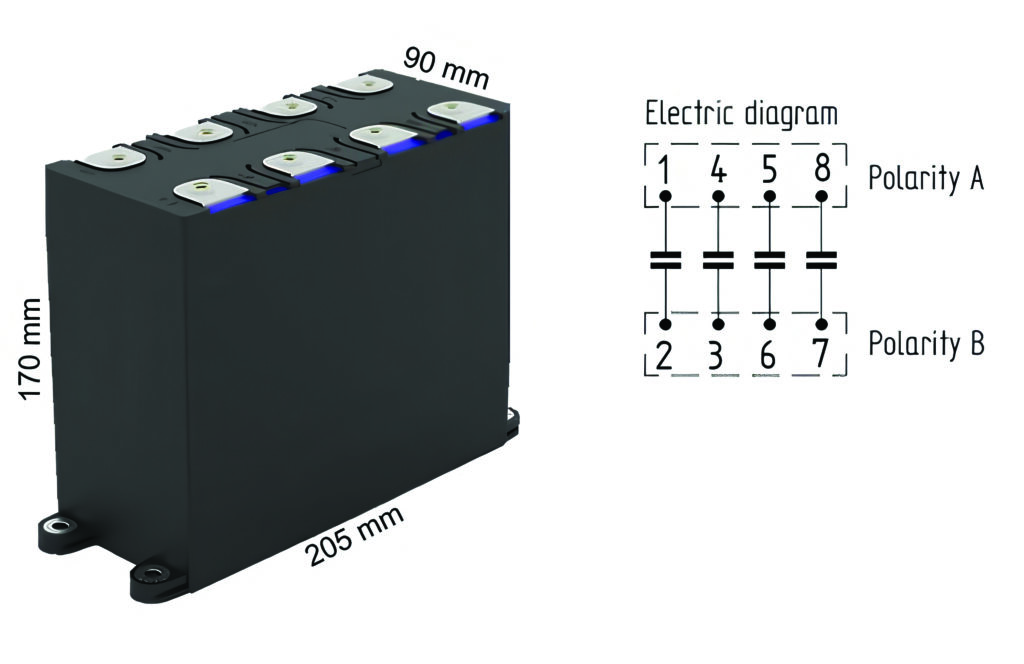
TDK has developed a high-temperature dielectric film for modular high-power DC-link capacitors, writes Nick Flaherty.
Silicon carbide (SiC) and gallium nitride (GaN) semiconductor devices push converters to higher power densities and temperatures that conventional polypropylene (PP) capacitors can’t tolerate. The ModCap UHP overcomes this limitation with a PP–cyclic olefin copolymer (COC) blend dielectric rated 25 K higher than standard film capacitors. This results in 40% smaller DC-link designs for EVs.
Modern DC-link capacitors must withstand higher electric fields and current densities in compact designs. They need low equivalent series inductance for fast response and frequency-stable equivalent series resistance (ESR) to limit losses during high-frequency switching. Internal design is critical because parasitic effects like skin effect, resonances and uneven currents can raise ESR and lower efficiency.
Thermal management is also crucial. Placing capacitors near power semiconductors reduces loop inductance but exposes them to more heat. With less aggressive cooling and higher junction temperatures, capacitors must handle greater thermal stress and operate reliably at higher temperatures and currents without reducing their lifespan.
Building on earlier work with PP-COC blends, Borealis and TOPAS Advanced Polymers recently introduced an ethylene–propylene–norbornene (EPN) material. This material blends PP, a proven, easy-to-process dielectric, with a COC, which is a dielectric with higher-temperature capabilities.
COC alone cannot be stretched into a film, but when blended with PP, the result is a material that processes like standard PP while retaining COC’s high-temperature strength.
Biaxially oriented EPN (BOEPN) films provide key properties for DC-link capacitors. At moderate temperatures, the film self-heals as effectively as standard biaxially oriented PP (BOPP), matching its dielectric strength and capacitance density. At higher temperatures BOEPN films maintain good self-healing capability, lower leakage current and higher breakdown strength. This combination prevents thermal runaway under DC voltage stress and ensures robust operation at elevated temperatures.
Capacitors using BOEPN withstand higher electric fields above +85 C, enabling higher capacitance density without derating or shortening the device lifetime. Integrating BOEPN into a ModCap design allows the rated electric field to be pushed even further than with BOPP.
ModCap UHP shares the same modular concept, terminal layout and external dimensions as the existing BOPP-based HF series, ensuring mechanical and electromagnetic compatibility. Both have low inductance of around 8 nH for fast transient handling, with low ESR across a wide frequency range. They offer identical capacitance values, high voltage strength and a 200,000 h lifetime at rated voltage and temperature.
This enables a 40% reduction in size for the DC-link capacitor with a 25% reduction in cost and additional savings from a smaller external busbar.
ModCap UHP is currently available in rated voltages from 1350 to 1800 V, with versions ranging from 900 to 2000 V under development.
Click here to read the latest issue of E-Mobility Engineering.
ONLINE PARTNERS