






Taiga Orca/Nomad

(All images: Taiga)
Electrified adventure
Taiga’s compact and robust new powertrain is at the centre of a revolution, creating silent-running emission-free jet skis and snowmobiles for the masses. Will Gray reports
Jet skis – or personal watercraft (PWC) as they are more formally known – and snowmobiles may both appear relatively niche markets in terms of vehicle volume, but Canadian company Taiga has spotted an opportunity to reduce their environmental pollution through electrification – and the resulting machines are pretty exciting.
Jet skis were originally powered by inefficient two-stroke engines and became notorious for noise and pollution, emitting significant amounts of unburned fuel (in some cases up to 25–30%). A shift to four-stroke, direct fuel injection engines in more modern models reduced pollutants by up to 90%, but they are still an important sector for emissions reduction.
According to the Watersports Foundation, there are currently just under 1.4 million registered PWCs in the US alone, over half of which were purchased in the past five years. The average vehicle is 14 years old and roughly 55,000 are being retired from the US fleet each year, with 35% of the annual registrations given to new craft.
Dominant established PWC brands – such as Yamaha, Kawasaki and BRP (Sea-Doo) – are yet to shift commercial focus from internal combustion engines ICEs), so several smaller brands have taken the lead on electric. Taiga was one of the first, with T3mp3st, Narke, Supermarine, Viva and Roxen all also now putting their own take on the electrification approach.
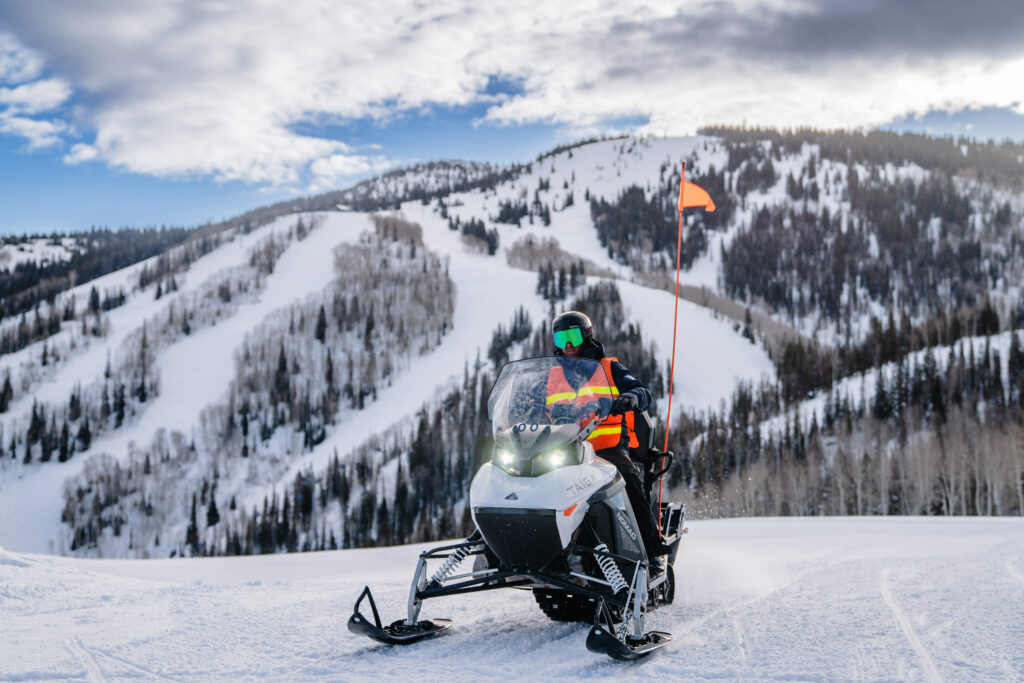
Taiga is also a leading snowmobile electrification pioneer, and although major manufacturer BRP now sells electric versions under its Ski-Doo and Lynx brands and Finnish start-up eSled also offers a solution, Taiga was again the forerunner. As a result, its Orca jet skis and Nomad snowmobiles have been showcasing the advantages of electric for many years.
“We knew this was a very interesting market opportunity and we thought people would get into the market, but our electric product is twice as performant as our competitors right now,” says Paul Achard, co-founder of Taiga Motors. “The reason for that is we purpose-built this technology for the application whereas they’re trying to implement EV technology developed for on-road use.
“BRP, for example, release electric motorcycles and they’re trying to take the battery packs designed for an electric motorcycle and stick that into a snowmobile, but since they’re using different cell chemistry and different cooling techniques, they’re not able to push to as high a specific power and energy density as we can.
“The number one benefit of electrification is the emissions reduction. These markets have very loose emissions regulations. The classification of the vehicles means that in many cases they don’t have to run catalytic converters and a snowmobile, for example, emits around 6–10 times the amount of NOx emissions per kilometre than your typical automobile.
“It’s a small market in terms of emissions offsets, but each vehicle emits so much more pollution than an equivalent car, it’s actually a pretty interesting emissions reduction opportunity. The electric marine space is seeing the same issues, with relatively limited emissions regulations leading pollutants to be dumped straight into ocean water.”
The elimination of the smells and noise associated with ICE craft in both cases is also a major benefit of electrification and Achard adds: “On a petrol snowmobile, particularly when you are riding in a group, you’re just running through a cloud. When people first try a Nomad, people often say they noticed they didn’t smell like fuel when they got home!
“We’ve also reduced the peak noise output by up to 30 dB compared to our ICE competitors and at that point, you really just hear the mechanical noise – the track on the snowmobile or the jet pump on the watercraft. Riders still get audible feedback, but bystanders don’t have that constant irritant, so it improves public perception too.”
Founded in Montreal, Canada, Taiga is the brainchild of three McGill University students who built up their knowledge of electrification through projects including Formula Student and the SA Clean Snowmobile Challenge. They won the latter two years in a row and people started contacting them to see whether they could buy one of their electric snowmobiles.
“We could see that the battery technology was getting to the point where you could offer a sufficient range for these types of applications, provided you could manage the powertrain thermally, so we founded the company and did some serious market research to help develop our plans,” recalls Achard.
“Snowmobiling is a fairly niche market, but we also knew there were other powersports markets out there, such as the watercraft, so we got into that as well. The two products share essentially the same drive unit, battery modules, electronics architecture and vehicle controller dash unit.
“The application engineering ends up being a little bit different, but the core building blocks are the same. We also have a cloud architecture, which enables us to push over-the-air updates and links the vehicles up to the Taiga app, so whether you own a Nomad or an Orca, the user experience is quite seamless between the two vehicles.”
Powertrain
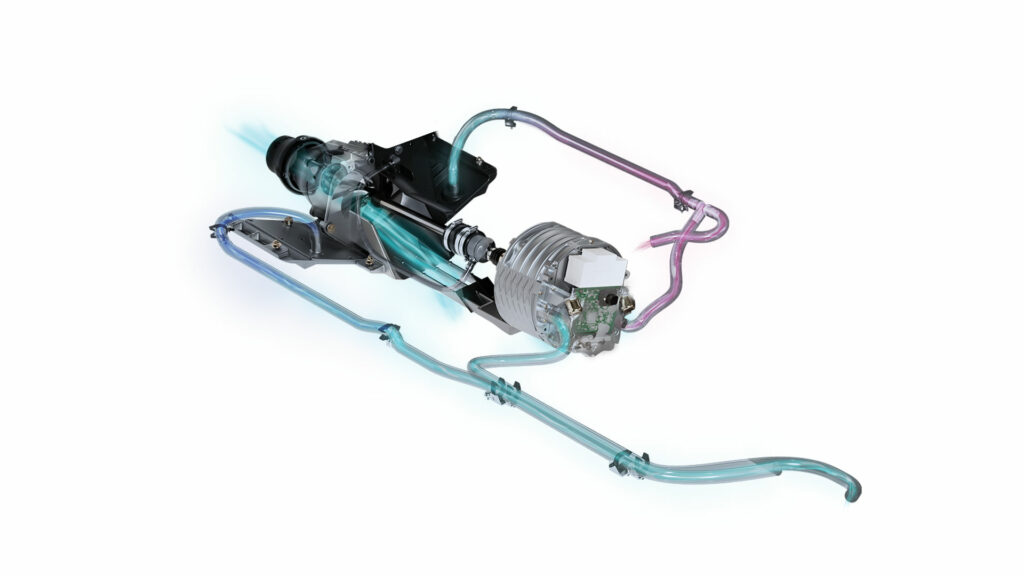
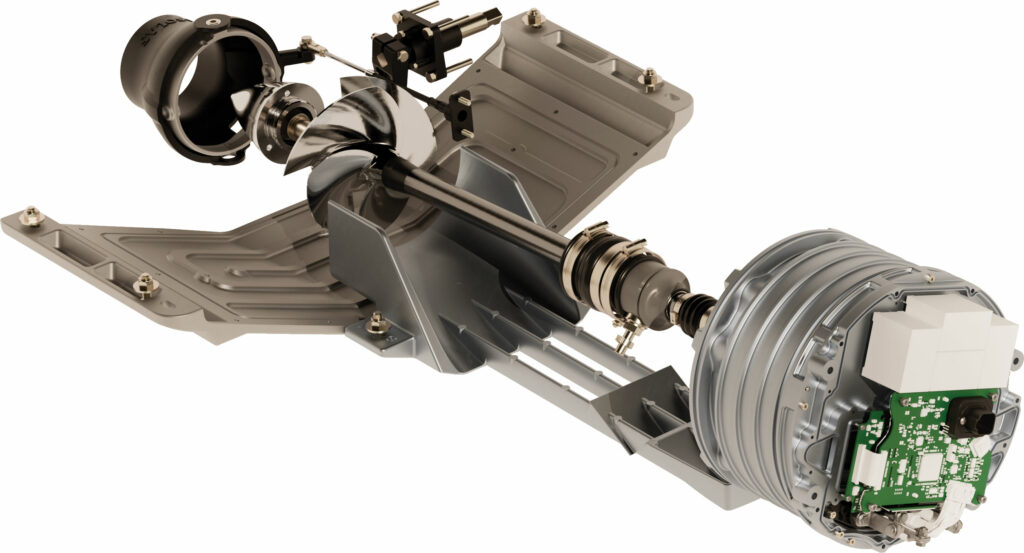
At the heart of Taiga’s Orca and Nomad vehicles is the Tractive Unit, a single housing containing a Taiga-designed Internal Permanent Magnet motor and an inverter. The entire package weighs around 25 kg and outputs 120 kW of peak power. It is mechanically capable of more, but has been limited by voltage and thermal considerations.
The cylindrical unit measures around 350 mm x 350 mm, with the power electronics residing in the rear section and the front section containing all the electromagnetic parts. Achard explains: “There was a lot of conversation around a radial flux or an axial flux pancake motor, but we went radial flux, mainly due to the well-established production methods.
“There are people out there making interesting axial motors, but we needed something that would scale up, with good supply options. Also, because of our vehicle applications, the axial form-factor doesn’t actually help us that much, so we’ve stuck with the traditional motor designs, much the same as you’d find in a Model 3.
“Nothing was available in the market that really suited our needs or that had the form factor to package it the way we wanted to. Even if there had been, a motor with the performance levels that we needed will cost around $5–6000 off-the-shelf, so we were able to drive the cost of production way down with our own design and supply chain.”
The Tractive Unit in the Orca is nestled in the bottom of the hull and has a direct connection to the jet pump impellor for propulsion. In the Nomad, meanwhile, it sits in the front portion of the vehicle, with a single-stage fixed synchronous belt drive linking the motor to the track assembly and stepping down the speed.
The torque curve of the motor follows a “fairly traditional constant torque curve” up to the power limitation, at which point it tapers down. During dyno development, a core focus was placed on transient behaviour and stability at different points in the torque-to-speed map and once tuning was done, there was no residual issue with noise or vibration.

A Taiga-developed Vehicle Control Module (VCM) is used to convert the user inputs into the torque requests and while the same baseline torque curve is used for both the Orca and Nomad, some small adaptations have been made to suit each. The company has also developed several different drive modes to provide different levels of user adjustment.
“The main requirement for the Tractive Unit was to accommodate the power needs of the drive system in a lightweight package, and everything had to be sized to meet that,” continues Achard. “We then followed an iterative development process to create a system that could maintain stable operating modes within those performance criteria.
“The VCM takes a digital throttle request and operates on a logic to map it to a torque request for the motor, depending on the chosen power mode. If the vehicle hits a thermal limit, for example on the battery, the VCM can also derate the power to prevent the component from further overheating.”
Each of the vehicles comes with three standard modes: range, sport and wild. These provide an increasing factor of maximum available power and affect the top speed and acceleration within certain speed ranges. In response to customer feedback, Taiga has also recently added a further level of user adjustability.
“The additional mode allows a user to play with some of the sliders that make up the modes and create their own custom setting,” adds Achard. “If someone is running a fleet of snowmobiles, for example, this is very useful because they can adjust the behaviour of the vehicle according to how they want their guests or employees to be using them.”
Battery system
The Taiga powertrain is designed to run at between 360 and 500 V, depending on the battery configuration. The vehicle is currently available with just the standard 24 kWh battery pack, which uses NMC (nickel, manganese and cobalt) pouch cells, and a larger, higher-voltage battery for longer range is currently under development.
NMC was preferred over longer-lifetime LFP (lithium iron phosphate) batteries because of their higher available performance and cost-effective scalability, and Achard explains: “LFP is more appropriate for large battery packs with low peak power requirements. We’re trying to push high C-rates and NMC offers the highest performance at a cost that’s scalable.
“We have designed our own pack using 32 Ah cells, with 200 of those per vehicle, so that stacks up to 24 kWh per battery. They’re segmented into four mechanically separate modules, with all four connected through the cooling system and the high-voltage busbar system, with everything built and assembled in-house.
“We have an automated machinery production line that takes the cells we buy from the supplier and builds up the modules. Once they are complete, we hand assemble the rest of the battery, depending on which vehicle we are assembling, then we set up the battery management system. We have a lot of control over everything that way.”
The batteries are built up into two very distinct shapes depending on whether they are to fit in an Orca or Nomad chassis. Achard says the team worked through “many complicated and funky configurations” during the development process before selecting configurations that best fit into specific zones to optimise the centre of gravity (CoG) position.
“The battery drives the show when it comes to vehicle architecture,” reveals Achard. “Watercraft and snowmobiles are both relatively sensitive to shifts in CoG, which affects planing efficiency on the water and weight bias between the skis and track on the snow. That can affect handling and range, so we had to think carefully about the layout.”
The environment in which both vehicles operate puts them in the high-risk category for electrification – with the Orca immersed in seawater at all times and the Nomad having to cope with snow spray whenever it moves. As a result, Taiga has been required to meet high standards when it comes to electrical protection.
Both vehicles are designed to meet the requirements of UN 38.3, a critical United Nations safety standard for shipping lithium batteries, which tests transportation conditions such as altitude, temperature extremes, vibration, shock, short-circuits and overcharging to ensure the batteries will not explode, leak, catch fire or rupture.
The battery packs are also developed to IP standards, minimising the potential for isolation concerns caused by significant amounts of water ingress. Taiga has also developed and integrated a bespoke isolation monitoring system on both vehicles, which detects any degradation of the isolation quality in the vehicle.
“The system protects against any type of event the user might not immediately perceive,” says Achard. “It will continuously check for degradation and if water gets in the pack, for example, it disables the vehicle from driving. That allows the vehicle to automatically catch issues before they manifest themselves into bigger problems.
“If an issue occurs out at sea, the vehicle has a partial shutdown protocol, which can limit the power going through the high-voltage connections and only shut down the system if something went seriously wrong. If you’re going to go on the water or in the woods, it’s important to be able to make it home as confidently as possible.”
Cooling system
One of the most unique aspects of Taiga’s design is the approach to the electrical system’s thermal management. Despite water and snow being seemingly useful mediums for cooling, the relatively low optimal operation temperatures of the motor and, in particular, the battery makes for an interesting engineering challenge.
“Thermal performance was one of our biggest points of focus during development,” admits Achard. “The snowmobile is expected to operate in freezing conditions and the watercraft is operating in much warmer climates, so we had to make sure our battery had appropriately sized systems for both heating and cooling.”
The battery temperature must be maintained at around 40 C for its optimum performance and Achard adds: “When you get into the details of heat transfer engineering, we’re working with a heat sink that is down as low as -40 C in the snowmobile and at around 20 C in the case of the watercraft.
“Cooling the battery is actually a lot more difficult to do than cooling an ICE running at 150 C because the difference between the coolant and the heat sink is a lot lower. So the more heat transfer potential you lose, the harder it is to cool sufficiently to keep the motor and the battery at operating temperature.
“One of the big benefits of the pouch cell architecture over a cylindrical cell architecture is the capability for more precise control of the thermal aspects. The pouches are nice and flat and rectangular, so that gives us a lot of access to extract heat from the cell or add heat to it very effectively.
“We use a glycol-based cooling system with proprietary architecture that runs the coolant across the face of each cell. That gives really high thermal transfer rates from the battery to the coolant, and the same loop will then run through the Tractive Unit, with software able to balance the system and send appropriate amounts of coolant to each area.”
The watercraft rarely requires cold starts, given most use cases are in warmer climates, but the snowmobile needs a few minutes of conditioning to bring it up to optimal temperature range when the outside environment drops to sub-30 C. Despite this, it can be driven immediately, with power degraded.
Once everything is up to temperature, there is no additional energy loss in the system due to the cold weather, and Achard notes. “With the snowmobile, we actually tend to see better range figures in cold temps because the snowpack is harder, so there’s less drag. So, ironically, colder temperatures are almost beneficial to our use case.”
Once on the trail or on the water, both craft typically operate at high-performance levels. Unlike a road vehicle, where the motor is usually taken gently through its acceleration curve, these two vehicle types are subject to a more on–off style of operation and are held at full throttle for a far higher percentage of their run time.
The heat created by this constant power draw from the battery has a knock-on effect on the cooling requirements and Achard explains: “We have a 120 kW powertrain operating out of a 24 kWh battery, so that requires us to cool the battery quite aggressively when we are running such high continuous or peak power requests.”
To monitor battery temperatures in operation, the system takes a series of spot samples from within the modules and uses bespoke thermal modelling to determine the overall thermal response. This temperature sampling enables it to best determine the state of the pack at any given moment and manage it accordingly.
Achard explains: “We are building off of the latest automotive technologies to develop our own recipe for it to work appropriately with our specific cell chemistry, using thermal modelling and getting all that data ingested properly at a fast enough speed to react to transient conditions.
“Each module collects point samples of voltage and temperature data and transfers them over LIN protocol to the BMS, which then decides whether the battery needs to be derated.
The point sampling does not always read the exact hot spot of the module, so we rely on thermal modelling and intelligent thermal management to operate efficiently.
“The system then uses controllable valves to switch certain cooling loops on and off. In a snowmobile, for example, it’s actually possible for the battery to overcool itself and need to be heated back up again. In that situation, the system can cut off the glycol circulation for the battery and isolate it from that cooling loop, sending all coolant exclusively to the motor.”
Given their operational environments, the Orca and Nomad rely on different heat exchangers for cooling: the watercraft has a heat plate integrated into its hull, sat in direct contact with the seawater, while the snowmobile uses an evaporative cooler beneath the vehicle to extract the heat from snowmelt, a well-recognised approach on those kinds of vehicles.
“The snowmobile throws snow and ice onto the evaporative cooler, which is a pretty efficient cooling medium,” concludes Achard. “The watercraft is another story because the body of water you’re operating in is so warm, so we have had to work hard to reduce any thermal inefficiencies in our cooling loop as much as possible.”
Charging
The Orca and the Nomad both have an integrated onboard charger that runs at around 6.6 kW, giving capability to charge off a Level 2 station. The grid power is fed directly to the vehicle, with the onboard charger converting that back into DC current to be able to charge the battery to full in around three hours.
The vehicles’ charging curves follow a relatively conventional patten, with higher C-rates pushed between zero and around 40% and charge power derated as the charge levels rise higher on the curve. The climatic conditions are also taken into account to optimise battery longevity.
In addition, Taiga offers the option to add DC Fast Charging (DCFC) capability and the company has seen growing adoption for that system in recent years. “When these vehicles were first on the market, people were not that interested in DCFC because they didn’t think they’d have access to that charging solution,” explains Achard.
“However, as things have progressed within the industry, we have started to see DCFC becoming more and more popular with users, so we have added the capability to charge at up to a rate of 2C, which provides a 50 kW peak charging rate capable of charging the vehicle in less than 30 minutes.”
The availability of charging systems is one of the challenges when it comes to EVs on the road, and it would be fair to imagine the same would be the case both in marine-based craft and in the remote locations snowmobiles typically operate. When it comes to watercraft, however, Taiga is doing all it can to ensure that this is not the case.
There are already more than 20,000 fast chargers around the world that are compatible and last year Taiga entered into a strategic partnership with Aqua superPower, which is installing a rapidly expanding number of what it calls ‘e-boat corridors’ offering specially developed Aqua-Taiga chargers for electrified watercraft throughout Europe.
That Aqua-Taiga network now spans more than 60 sites across North America and Europe, with units installed at no cost to the marina and fully operated and maintained by Aqua. Users are able to access the charge stations via the Aqua App and pay for charging through secure contactless payment or an RFID card.
“Many marinas in the US and Europe have had shore power installed for years and it is already very common to see 220 or 240 V on the dockside to support charging at Level 2 capacity,” says Achard. “DCFC capability is more difficult, but more and more marinas are investing owing to the increasing popularity of electric boats.
“Aqua is working on deploying DCFC stations to marinas worldwide and the coverage map is developing quite nicely, particularly in Europe. If you’re going along the coast of France and Italy, you can actually string along quite a few fast-charging stations in marinas that have been put in place by Aqua.”
Top-up charging through regenerative braking is not an option on the water – although Achard believes research could be done to evaluate the potential of using a propeller for braking beyond the effect of hull drag forces. However, on snowmobiles, there are big benefits from regeneration to be had, particularly for ski hill operators.
“They’re spending so much time going downhill and riding their brakes, they end up going through brake pads very quickly on ICE snowmobiles,” says Achard. “On the Nomad, they’re actually able to offset that by using regen – so, not only are they extending their range on a daily basis, they’re also reducing the wear of brake components.”
The regen works on the one pedal driving style, so the moment the user comes off the throttle it automatically engages braking and starts inverting power back into the battery. The intensity can be adjusted, or it can be turned off completely, while a fully decoupled mechanical system is still available to provide additional braking when required.
Chassis and performance
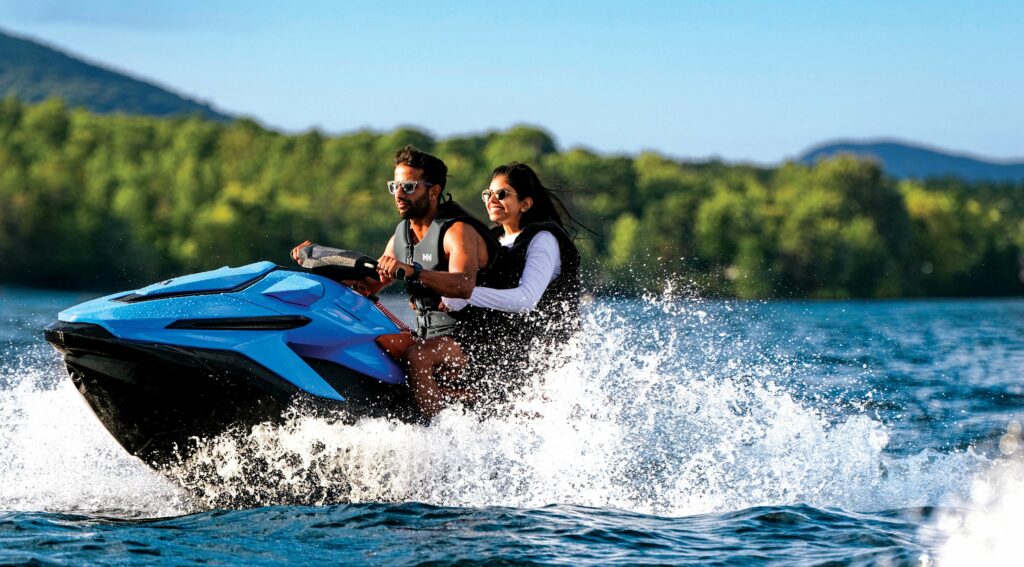
The Orca and Nomad chassis were designed from scratch and while they follow a similar approach to existing ICE vehicles, the packaging was specifically developed around the unique electric powertrain architecture. The company eschewed the option of partnering with a third party, preferring not to be reliant on others for the core design.
“We have sought to drive our own destiny when it comes to the chassis development,” says Achard. “The entire vehicle – the bill of materials from A to Z – has been developed and specified by us. We take some off-the-shelf components, but the vehicle architecture is 100% designed and driven by us.
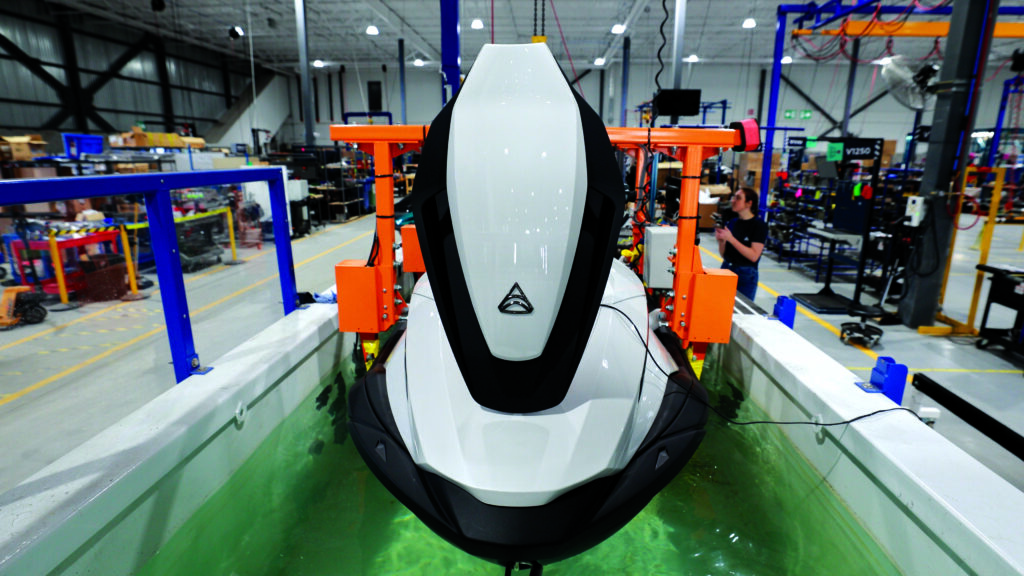
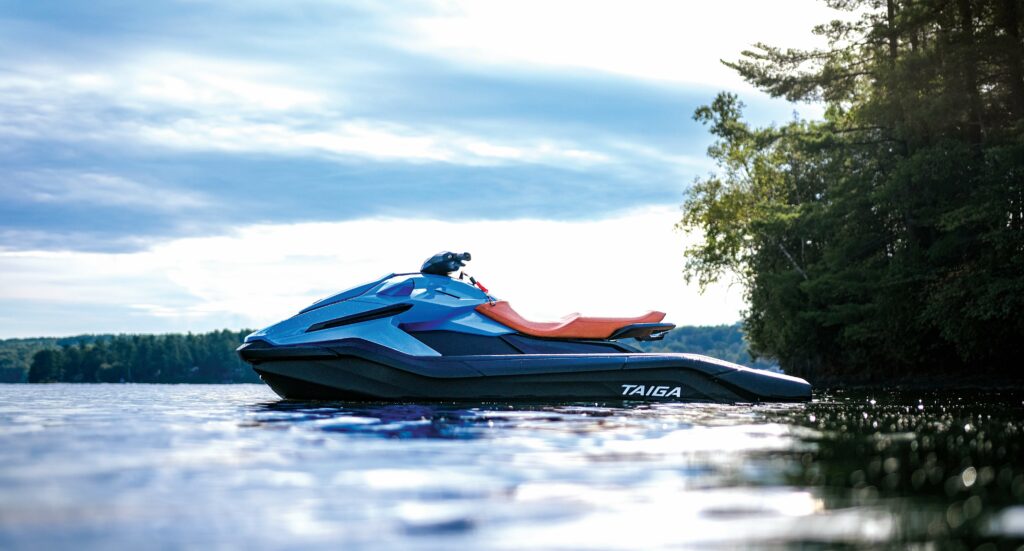
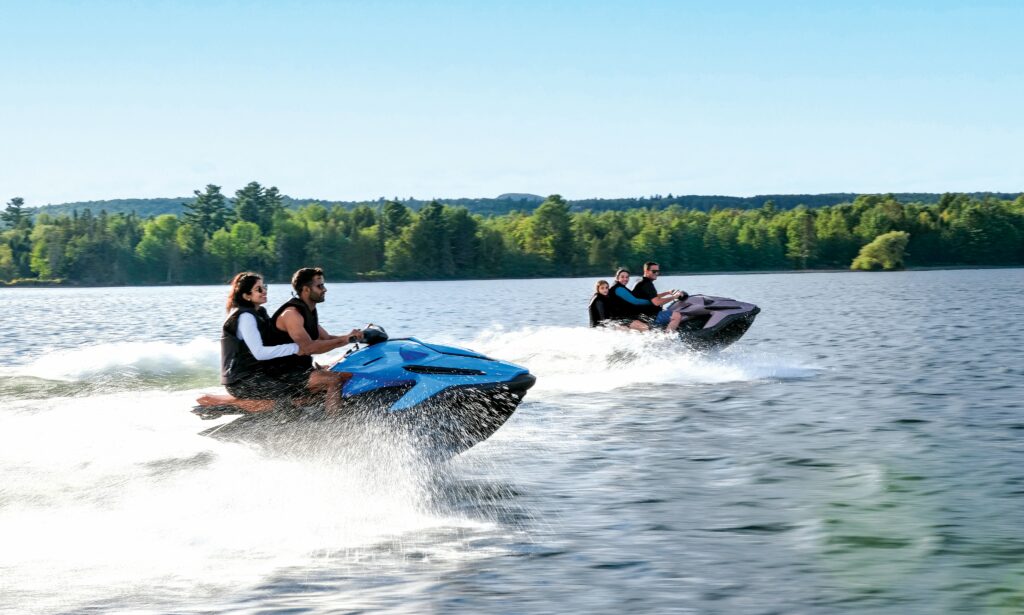
“We have a few different Orca models on the market, all based on roughly the same hull. The Orca Carbon is a limited-series built with a lightweight carbon fibre hull, which is not very scalable but very nice for a higher-end product, while our high-volume products, the P2 and WX3, share similar internals and differentiate themselves on rider capacity.”
The WX3 has an extended hull and a larger seat base to accommodate up to three passengers, while the P2 has a two-passenger architecture, giving it a lower overall weight and slightly faster acceleration. Both have simple handlebar-style controls, with a centralised seven-inch electronic display, together with trim adjust and mode select buttons.
The Orca also incorporates an off-throttle steering system, which operates when a hard over steering movement is detected, providing a minimum amount of thrust to allow the craft to steer for obstacle avoidance. This can be ended by applying the throttle, the reverse lever or returning the steering towards the straight direction.
Taiga’s goal when it initially developed its electrified powertrain was simple: to out-perform the existing ICE-powered competitors in the market on top speed and acceleration. Given the added battery weight, this was not a simple task, but it was offset by the much higher instant torque provided by the electric motor.
“The Orca is targeted at a recreational level rather than top-end, high-performance vehicles and it definitely compares well to the ICE competition,” says Achard. “As far as instantly available torque goes, we’re leading the market and that’s just the inherent advantage of electric because we’re able to get our full 170 Nm of torque at zero rpm.
“The watercraft and the snowmobile are both incredibly quick off the line and when you’re up at speed, you’re still served with a lot of available instant torque, right up to around 75% of the vehicle’s top speed. So, there’s a lot of available acceleration through a really wide band of vehicle speed.”
The Orca was also designed, geometrically, to offer a strong dynamic feel, providing a lot of movement with relatively minor user input. Achard adds: “We wanted to offer something that’s playable, as well as having good acceleration and top speed. We wanted it to be a lot of fun and to offer a high ‘wow’ factor.
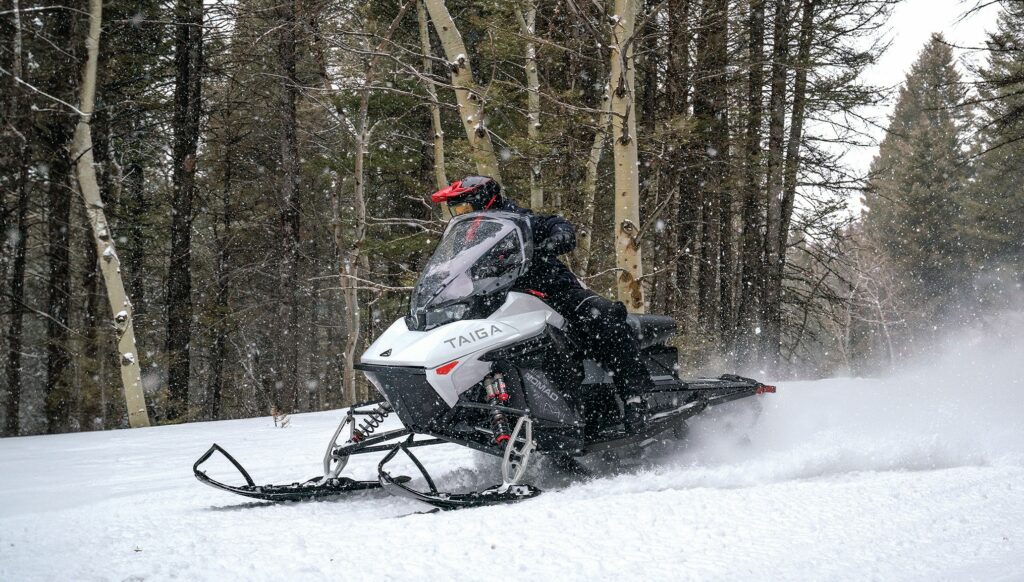
“You don’t have to throw your weight around much to do really interesting manoeuvres and the feedback we get is that the Orca is extremely fun to ride. It’s similar for the Nomad. That’s a relatively big vehicle compared to the competition, but it rides extremely well on the trail and its dimensions also allow it to operate well in deeper snow.”
The fact that creature comforts like battery-sapping air conditioning are not necessary on these types of vehicles is beneficial for range, and although the Nomad does have some element of heating – grip heaters and a plug for a helmet heater – the power draw of those is still relatively small in comparison to a full HVAC system.
In terms of durability, Achard says the electric powertrain will comfortably cope with the abuse that is offered up in both types of operating environment. “Corrosion, vibration and shock are all daily challenges for these vehicles,” says Achard. “Everything from hitting a rock under the snow to the corrosive effects of seawater.
“The powertrain is built to last. The cells are rated for several thousand cycles more than you would expect a vehicle like this to operate for, and there’s no expected degradation on the tractive unit for the lifetime of the vehicle. So, the powertrain is extremely durable in that sense and we build a strong chassis too.
“A lot of off-the-shelf components possibly couldn’t withstand such vibration and shock. So, we have had to design and test all the components and we know the systems will hold up for the lifetime of the vehicle with no issues. We test to more stringent requirements than they even do on some of the more industrial application components.
“Another big advantage is the lack of necessary maintenance. There are no oil changes, no fuel to be worried about and the glycol is good for the duration of the vehicle, so there’s no lifetime maintenance on the powertrain of the vehicle. However, we’re up against similar challenges as the rest of the industry on the chassis.
“The operating conditions are much less predictable than they are for a road vehicle, so we have to anticipate those abuse cases and make sure the vehicles can continue to operate throughout. The Nomad has beefy, long-travel suspension and on the Orca, we have carefully selected our materials to minimise the onset of saltwater corrosion.”
Into the future
Taiga’s clean-sheet approach to vertical integration has resulted in vehicles with competitive price positioning and has truly given electrification a space in the market. The watercraft and snowmobile both come in at a cost of around $20,000, placing them in the same range as their equivalent combustion models while offering a lower lifetime cost of ownership.
Taiga puts this down to its intelligent engineering approach and the development of all technology in-house. Making a high-performing electric vehicle at a high cost, they say, is relatively easy, but manufacturing these vehicles in volume, ready for mass market adoption has been the challenge.
The Orca and Nomad have both evolved significantly from their original form, and it is Taiga’s aim to continually push to gain the most possible out of each platform. The company’s website shows 10 operating system upgrades since launch, while battery technology and other hardware are continually monitored for potential upgrades.
Achard explains: “We see a lot of opportunities to offer new features and capability on these vehicles to continue to improve them, particularly through new software features we’re able to offer over the air. For example, we’re just about to release new GPS mapping features for both of our vehicles.
“We’re also looking to offer vehicle-to-grid capabilities, developing the correct protocols for the vehicle to feed power to a house on the DCFC variant, and we’re looking at unlocking further potential on the peak power, either on new models or in retroactively fine-tuning the way the motor response is tuned on existing vehicles.
“Then, physically, we’re looking at new accessories and new ways to improve the capability of the platform itself. The sky’s the limit on the things we could develop there, so we’re looking at what customers are asking for the most to improve their day-to-day use of the vehicle, things like storage and powered accessories, speakers or lights.”
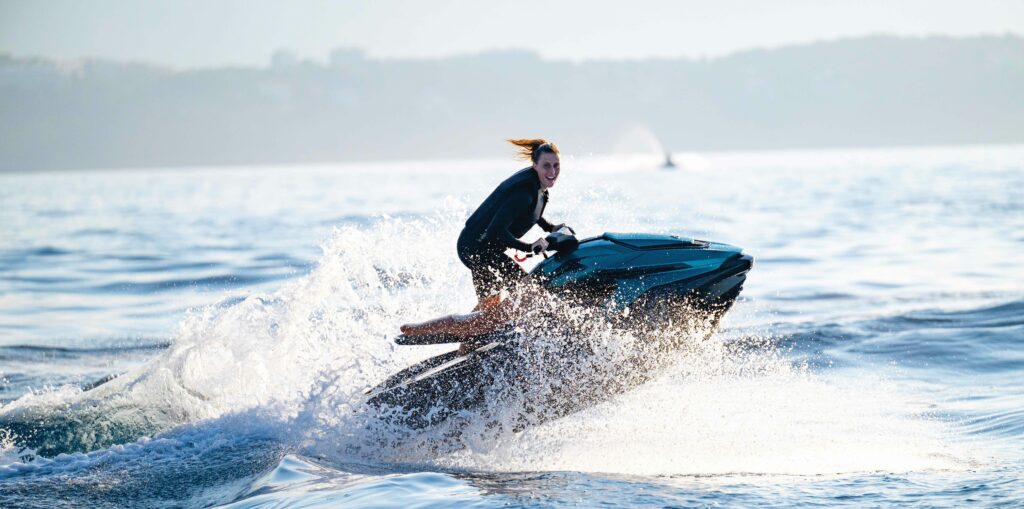
These relatively niche machines – and the charging infrastructure that supports them – are just part of the long-term plan for Taiga, however. Having successfully developed and installed their compact, robust and
IP-protected electrification system into the Orca and Nomad, they are now on the lookout for other use cases.
“We’re positioning ourselves as the leader in terms of powersports electrification, not only watercraft and snowmobiles, but really trying to branch into anything that can be recreational in the off-road and marine space,” says Achard. “After all, they are all applications that share very similar challenges.
“In the last year, we have been working with a sister company called Vita Boats, which produces electric boats for commercial and some recreational applications. Our batteries are going to be used to power their boats, and we’re already trying to push our powertrains into other types of vehicle segments.
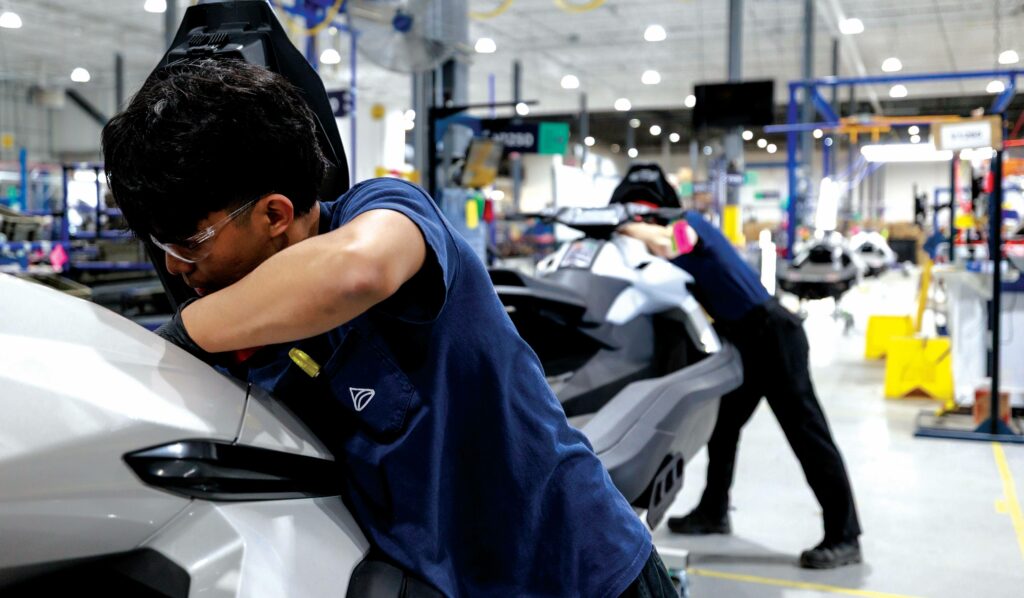
“In terms of off-road, there’s a lot more we could look at. Off-road utility vehicles are a big market and we know that our powertrain is very capable of meeting those requirements, so we’re looking at opportunities there. It’s always a lot of work to put new systems together, but in practice it’s actually extremely doable.
“Our powertrain already has excellent thermal capability and the compact sizing makes it very easy to retrofit into other vehicle platforms. One of the theories right from the start was that if we did something very difficult – like get this into a watercraft or a snowmobile – it would then be very easy to get it into larger platforms that could use electric.
“So, really, it’s a question of opportunity. We’re looking for the right partners to get into new vehicle segments and we’d be really excited to get our battery systems into more and more vehicles. The more we can share the battery technology, the more we can drive up those volumes and that benefits our customers because we can lower our costs.
“So, we are starting to explore collaborative work with other companies that can use elements of our systems, rather than necessarily our own platforms. We’re already working on some opportunities that I can’t talk about, but there’s some exciting things on the way and there’s a heck of a lot that the Taiga powertrain system can do in the right conditions.”
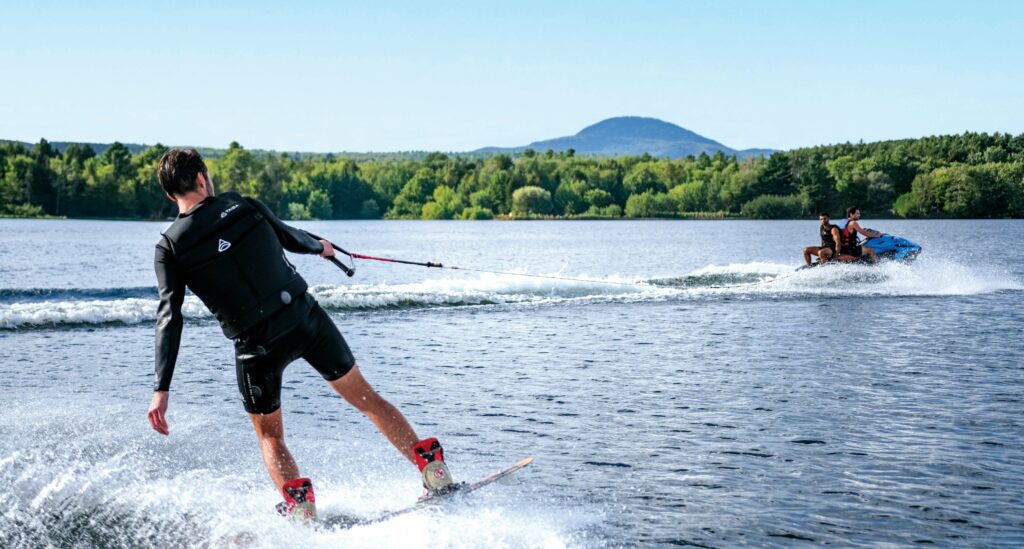
Vehicle specifications
ORCA
Capacity: 3 riders (WX3) / 2 riders (P2)
Power: 120 kW
Weight: 365 kg (WX3) / 355 kg (P2)
Drivetrain: Direct drive jet pump
Stop/Go range: 2 hours
Continuous throttle range: 1 h 20 mins
Charging: <30 mins fast charging
NOMAD
Power: 67 kW (Sport) /
90 kW (Performance)
Range: 100 km
Towing capacity: 511 kg
Charging: <30 mins fast charging
Click here to read the latest issue of E-Mobility Engineering.
ONLINE PARTNERS