




Kent Wanner of John Deere explains electrification for next-gen farm vehicles
(All images: John Deere)
Futuristic farming
Kent Wanner, principal electrification engineer at John Deere, speaks to Will Gray about the challenges of building ruggedised EVs for the agriculture sector
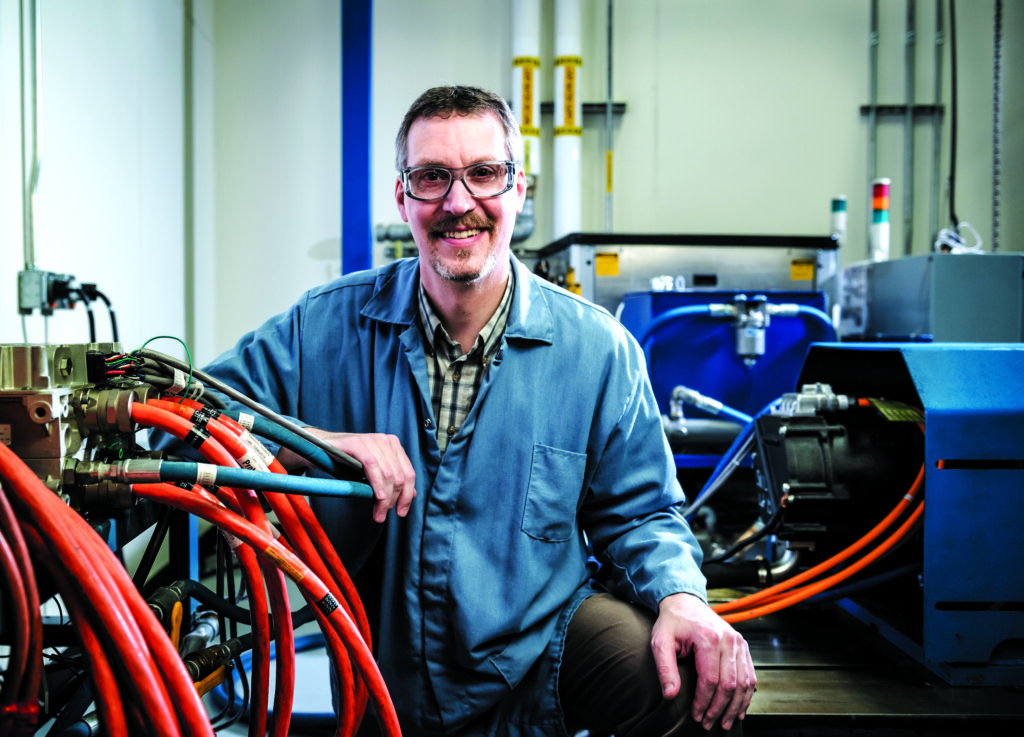
When Kent Wanner was presented with a John Deere Fellowship, noting his globally recognised technical expertise, it was a moment of acknowledgement that connected right back to his roots. Growing up as a self-declared “North Dakota farm kid,” he discovered a love of engineering through tinkering and fixing. He applied it to electronics at college and joined a small company that would be later acquired by the American agriculture giant as soon as he graduated, 29 years ago.
It is hard to imagine a better candidate to lead the company’s innovations in electrification. “The farm was a fabulous place to become an engineer – operating equipment, thinking about how things work and understanding how to fix them when they break down,” he begins. “That really got me curious and it’s still what I love about my job today. We do cool things and we apply them to solve some of the biggest challenges on the planet.”
Agriculture is, arguably, one of the hardest sectors to electrify. Tough work environments and relentless operational demands mean John Deere vehicles must be rugged, reliable and armed with a wide range of tools. Despite the challenge, the company’s Intelligent Solutions Group – a kind of agricultural skunkworks – has managed to introduce almost one electrified solution per year and is about to ramp that up dramatically.
Wanner has been involved in that electrification journey from the very start. Having joined as an electronic design engineer in 1997, he spent his first decade developing electronics for a variety of in-house and customer projects – including an electric-propelled centre pivot irrigation system, which he cites as his first ever electric vehicle. Then, in 2006, he was at the forefront of a project that changed the direction of his career.
“It was an electric forklift,” he recalls. “Most of my work until that point had been in 12 and 24 volts, but this was an 80 volt system – which, at the time, we called high voltage! I designed the electronic controls and we had just released it to production when the company was looking to move into higher-voltage electrification. That experience enabled me to be the guy who got in on the ground floor.
“It was the transition point that took me from conventional electronics into power electronics and it was a fabulous opportunity. There was very little available in that space at that time, so I started to do some courses, went to IEEE conferences to pick things up, talked to suppliers and just did a lot of learning internally. We had to create our own lab, figure out what equipment we needed and grow our team.
“We added people who knew things about motor controls or lab safety, and then I brought in my experience of designing vehicles and getting products into production. We did a lot of rapid learning, collaborating with partners to develop and build applications and features that suited exactly what they wanted – and we then used that new knowledge to design new products that were applicable to John Deere’s own equipment.”
Rugged revolution
Although electrification was gathering pace in the roadcar market, Wanner and his team had a far greater challenge delivering it in the agricultural and construction spaces. Most EV components were unsuitable because their vehicles faced much harsher vibration and shock conditions and had to last an order of magnitude longer, while at the same time, the manufacturing volumes were not big enough to drive development of the custom parts that were required.
The company worked with major industry players to help shape suitable component solutions to meet the needs of the ruggedised vehicle market. Meanwhile, Wanner and his team began an approach that continues to this day – the identification and development of specific vehicles with propulsion and/or work functions that merit electrification in combination, to truly add value.
“That’s one of the things that is really unique about our space,” explains Wanner. “When you talk about cars, trucks or other on-highway vehicles, it’s really mainly about traction, the propulsion system and how good you can make it. In our space, we’ve got to think about a whole bunch of different systems. The many work functions on these vehicles are just as important – and can demand just as much power – as propulsion.
“That’s where we look at how we can provide added value with electrification – so it’s not just the propulsion, it’s the precision, controllability and efficiency that electrification can offer to the different work functions. The fundamental focus is not about following trends or government subsidies, it’s about how to actually provide value for our customers using electrification as an enabling technology.”
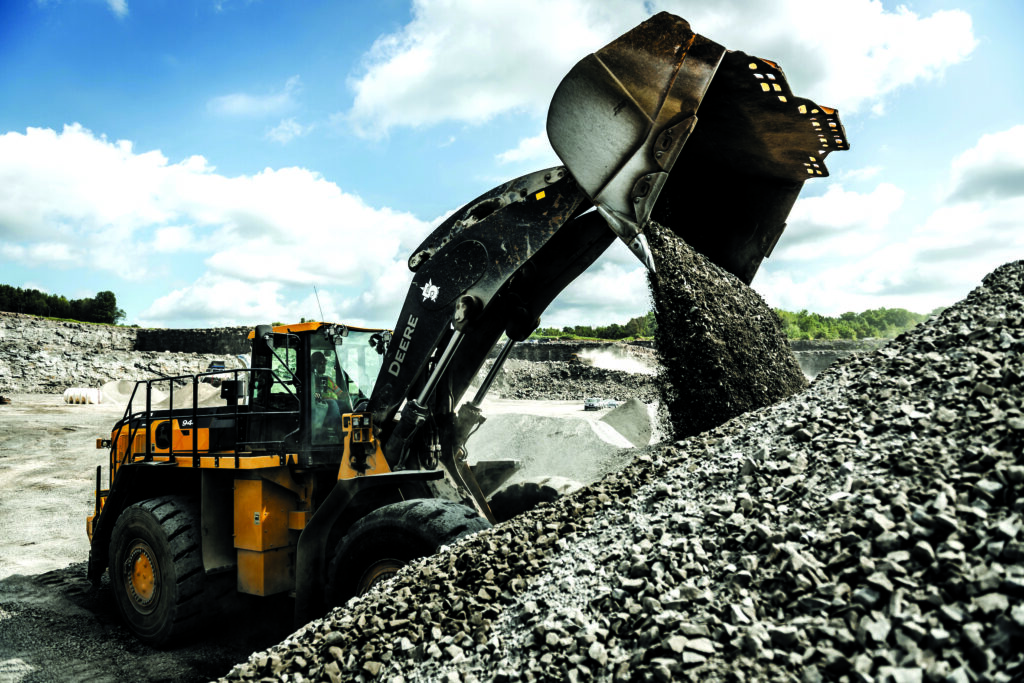
After six years of research and development, John Deere unveiled its first application of high-power electric performance in the 644K Hybrid Wheel Loader, which was released in 2013. Its big brother, the 944K, was introduced in 2015 – which, incidentally, was the subject of a detailed review in the third edition of this very magazine. The secret to the success on the loader was not specifically its electric drive, but rather the way that it fitted electrification into the work cycle as a whole.
“It was absolutely ground-breaking in the industry,” recalls Wanner. “It was real Wild West stuff. We were developing things that simply didn’t exist, rapidly learning and then moving on to the next version – and the reason we picked a loader as opposed to a crawler, a tractor or some other vehicle was because it’s constantly changing direction, stopping, starting and moving in a V pattern for truck loading, so it has a lot of regenerative work opportunities.
“The hydraulics used for steering and operating the boom and bucket use as much power as the traction system, so we developed an architecture that interconnected the electric drive, hydraulics and diesel engine. Using fast, well-integrated controls, we could seamlessly push power to where it was needed – so we were spinning the hydraulic pump for free, lifting the load using the recovered kinetic energy of the vehicle without even the need for a battery.”
At the time, larger 944K-size loaders did not exist in John Deere’s portfolio and the company was not known at all in that market. However, by designing from the ground up around the electric drive, they arrived with a solution that burned significantly less fuel than any competitor, saved on tyre wear thanks to the four-wheel independent traction control, and was easy for a novice operator to get expert operator productivity. “It was easily the best vehicle on the market,” smiles Wanner. “The customers went from ‘Who’s John Deere?’ to ‘Oh my gosh, this lets me do stuff I didn’t think was possible!’”
Innovation through electrification
The loader remains one of Wanner’s most satisfying projects – but it was just the start of an innovation journey that has seen John Deere release an ever-growing range of new vehicles that embrace electrification in many different ways. Having led the team that developed the motor drives and the inverters for the first release, Wanner shifted focus from supervision to pure technical developer, exploring what to electrify next.
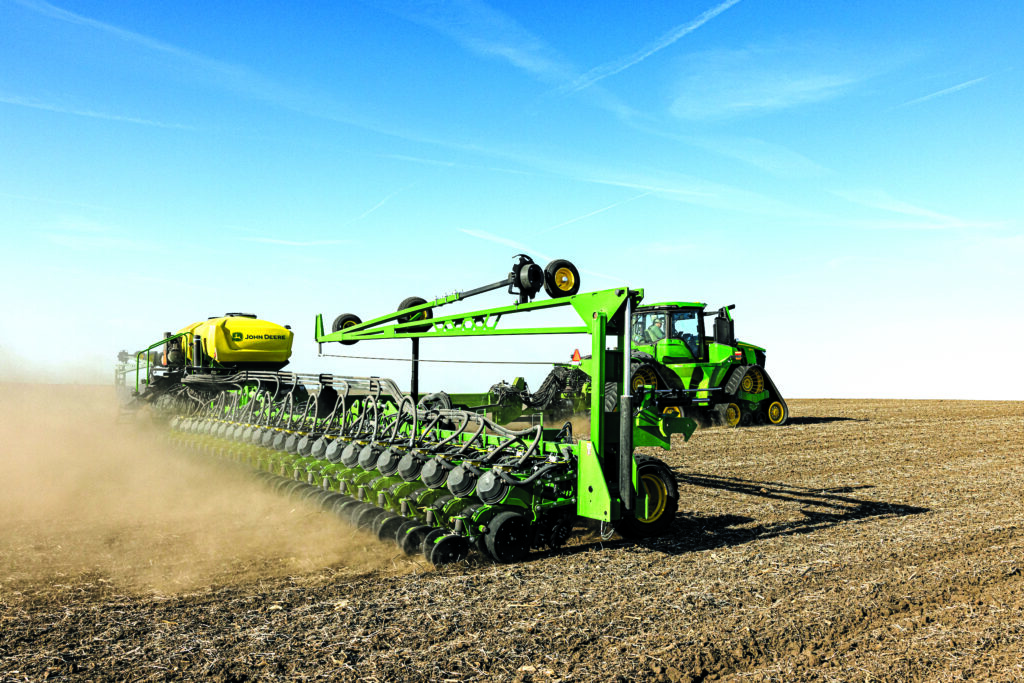
The following year saw the company release an innovative row crop planter, named ExactEmerge. This dramatically improved upon the traditional approach of dropping seeds based on ground speed metering through use of two electric motors and some cleverly developed smart controls to carefully place seeds in the ground with a level of precision previously impossible – enabling customers to plant some seeds twice as fast as they did before.
“The old random drop and roll process limited how fast you could plant because some seeds would end up too close together or too far apart and that hurts the yield,” offers Wanner. “The system we developed uses one motor to meter out seeds per second and another one to turn a brush belt with bristles that spin to perfectly compensate for ground speed, holding the seeds and conveying them to the ground so they drop in perfectly.”
It was another demonstration of how the innovative use of electrification could change the game – with smart technology also enabling it to change planting speeds to compensate for corners and, in a subsequent upgrade, to precisely squirt fertiliser directly on the seed as it is planted, rather than spraying in a continuous stream, reducing the volume used by two thirds and saving even more time and money while also reducing environmental impact.
“Our customers don’t care it’s electric; they don’t care about all the technology; all they care about is that this planter rocks,” he enthuses. “Most don’t realise all the calculations that are going on under the hood, they just know that it enables them to plant at 10 mph rather than 5 mph and still have perfect spacing – so they can buy one rig instead of two, have one operator instead of two and get twice as much work done in a planting weather window.”
The electrification process has now become a two-pronged attack, with one eye on creating new vehicles and another on advancing already-electrified solutions through the use of less expensive or better performing components or the development of new concepts to take to market. Wanner adds: “The idea is once you’ve got this level of precision and control, what’s the next level? What’s the next solution?
“It turns out that electrification really enables a lot of this because it’s smart, it’s fast, it’s controllable, it’s highly efficient, it’s load-sensing and it enables things like more automated systems or even autonomous operation. That’s really been the fun thing in my career – developing all these different competencies and working out how we can solve customer challenges with that technology.”
Leaping forward
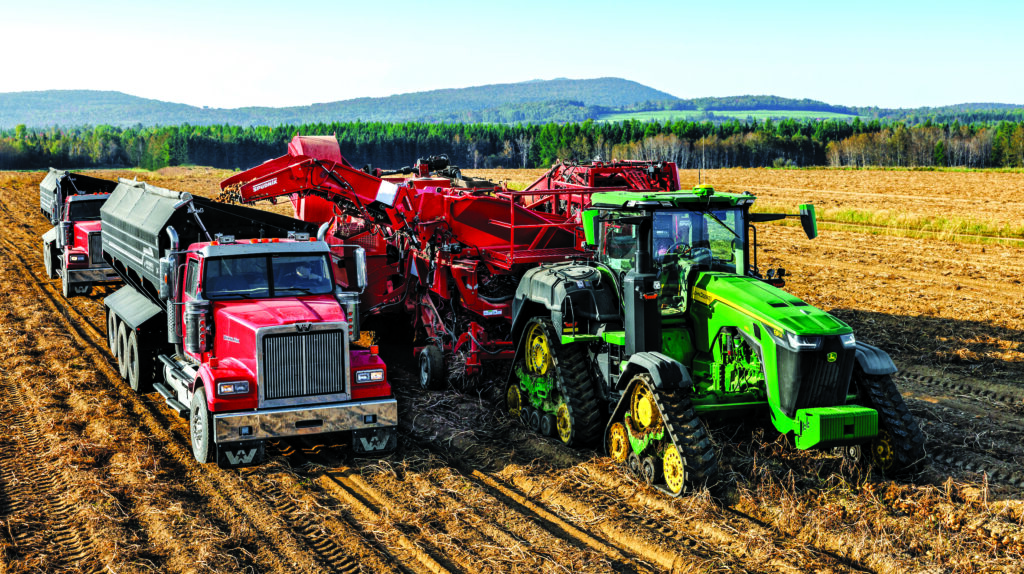
In 2022, John Deere announced plans to rapidly expand its focus on electrification through its ‘Leap Ambitions’ commitment. Its approach was to stick with the gameplan and to do electrification not just for the sake of it, but to develop solutions that make sense, do a job better or do things that had never been done before. That is now coming to fruition, with Wanner leading the development of a broad swathe of new products.
“We’re developing technologies like GPS guidance, precision sensing, machine learning, electrification – the whole technology stack – which can then be applied to all of our different vehicles in construction, forestry and agriculture,” he explains. “Electrification is the combination of control, precision, efficiency and enabling things like autonomy. With electronic controls, we can respond faster and do things better – but it won’t just be every vehicle electrified; you’re going to see a wave of applications coming that really make sense.
“In the past, we were releasing one vehicle per year with electrification, learning, growing competency, and understanding different power levels and different capabilities. We’ve been doing that for 20 years now and we’re really able to leverage that; we’re at a maturity scale where we can take all these things and rapidly apply them to new vehicle forms, so the number of vehicles being launched per year is going up dramatically.
“None of our vehicles are super high-volume compared to automotive. So, from a business standpoint, I can’t develop a custom hardware or software for every single vehicle, that’s just not practical. So, to give you a bit of the secret sauce, we have developed modular products that can scale – like single and dual inverters that reuse the same components and software, and smart ways to package and use multi-inverter systems – then, we also have a really rich software feature set, which does way more than you might think a normal inverter needs.
“Having that all in the software library means I can put it in many different applications. We can enable series electric, split-path variable transmission, battery-electric, all because we have developed this system to work on different types of powertrains or systems and can quickly transition it to a new application. So, we’re electrifying in ways that make sense. Our highest-horsepower tractors are not battery because that is not very practical; instead, we focused attention on lower-horsepower vehicles and have released battery-electric versions of vehicles such as loaders, excavators and zero-turning radius lawnmowers.”
There remains fundamental work to do, however, as these hard-working vehicles not only require ruggedised components, but their heating and cooling systems are on the outer layers of the mainstream – and less work is being done in the supply chain on the extremes of performance. Indeed, having recognised the importance of battery performance, John Deere recently purchased its own majority ownership in a battery company, Kreisel Electric.
This was a strategic move and Wanner explains: “Kreisel has a patented technology to use dielectric immersion cooling inside the battery itself, where all the cells are in direct contact with the coolant. That keeps them at a very uniform temperature, so it’s much more effective cooling, you get more power, they’re safer and they last longer – and those sorts of technologies really do make a difference in our world.
“Although the products we’ve already released to production are very robust, we are always looking for components that have more capabilities or are less expensive for the same capability. New generations of power modules, for example, offer the same performance for lower price, smaller size and weight, while the advent of wide band gap, silicon carbide, gallium nitride and things like that are unlocking different capabilities.”
This, says Wanner, is allowing products to be more power dense, more efficient, have faster switching and still have very high ampacity. The general market trend for higher voltage – to achieve either higher power or reduce the current or the conductor sizes – also requires newer components to handle the higher voltage. So, when it comes to reliability, he sees the next generation of devices delivering marked improvements in that area too.
In this ever-evolving electrification journey, Wanner’s acknowledgement by the company as an Electrification Engineering Fellow puts him out there as a leader in the field and, when asked about this recognition, he quips: “I’ve just made tons of mistakes and learned from them,” before adding: “I think I’m one of the only Fellows in the company that doesn’t have a PhD! I’m just a farm kid and I’m so proud of that.
“To be a Fellow, you have to be known internally and externally as a world expert in your field. So, they had to go out and get testimonies from people in other industries, academia, labs, all sorts of different areas outside of the company recognising my competency. It is about recognising an ability to apply technology in ways that provide business and customer value, which is really important to me; so overall, it was an extremely humbling experience.
“One of the best things about my career has been the constant learning. I’m an electronics guy, but I had to learn a ton about controls, motors, cooling, sealing for the environment, as well as all the system-level interactions. So, there are all of these things that I’ve ended up getting involved with and that has just been really fun – but also over the years, I’ve loved giving people a first-hand experience of American agriculture.
“My oldest brother still runs the family farm. So, I’ve taken interns and engineers from all around the world there to talk to my family, to find out why the vehicles have to be so productive and such high quality. I totally get it. We have to help with labour shortage, help get more things done with fewer people, and use less fertiliser and less herbicides – and our technology enables those things. That’s why it’s exciting to come into work every day.”
Click here to read the latest issue of E-Mobility Engineering.
ONLINE PARTNERS