


Bosch launches Bamberg electrolyser advancing green hydrogen
(Image courtesy of Bosch)
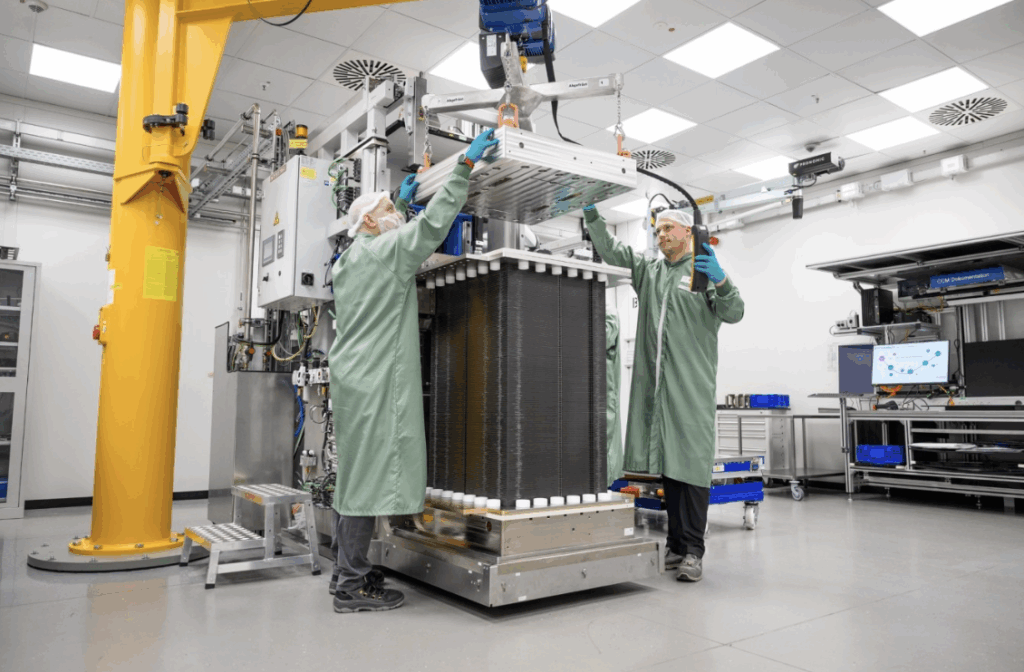
Bosch has put its first in-house electrolyser into full operation at its Bamberg plant, marking a significant step for the company’s hydrogen technology. The installation integrates two Hybrion PEM electrolysis stacks, each rated at 1.25 megawatts and manufactured on-site, delivering a combined output of 2.5 megawatts. Operated with renewable electricity, the system produces over one metric ton of hydrogen per day and complies with EU standards for renewable hydrogen.
Built by FEST in Goslar, the electrolyser forms the centrepiece of Bosch’s new hydrogen landscape, a live testing environment covering production, storage and utilisation. Within the system, the Hybrion stacks convert water into hydrogen and oxygen, while a Bosch fuel cell power module (FCPM) reverses the process to generate electricity for feedback into the grid and for internal testing. This closed-loop configuration enables continuous performance evaluation under fluctuating loads, simulating variable duty cycles typical of transport and stationary power applications.
Inside the lifetime container, the FCPM operates around the clock to study degradation behaviour, electrical efficiency and system response across thousands of cycles. The data generated feeds back into ongoing development at Bosch’s Stuttgart-Feuerbach facility, where series production of the fuel cell modules began in 2023. A single day’s hydrogen output from Bamberg could fuel a 40-ton truck powered by the FCPM for up to 14,000 kilometres, demonstrating the efficiency of the integrated system.
Before any Hybrion stack is shipped to customers, it undergoes verification at a dedicated test station on the Bamberg site. Engineers run each stack through activation routines and dynamic load simulations that reproduce real grid variability, confirming electrical stability, voltage distribution and efficiency across its operating range.
The wider hydrogen landscape includes a 21-metre on-site storage vessel capable of holding hydrogen at up to 50 bar, supporting both test cycles and demonstrations. Bosch has already begun supplying Hybrion stacks to industrial partners such as Kyros Hydrogen Solutions, Neumann & Esser and Pietro Fiorentini’s subsidiary Hyter.
For Bosch, Bamberg represents more than a production site; it is a proving ground linking electrolysis design, fuel cell technology and system integration. The project signals Bosch’s readiness to scale up hydrogen solutions that align industrial manufacturing capability with long-term mobility and energy strategies.
Click here to read the latest issue of E-Mobility Engineering.
ONLINE PARTNERS